Thank you for reading our post, please rate this article at the end.
Reading Time: 9 minutesLast Updated on July 14, 2026 by Paul Clayton
Table of Contents
Pop-Up Camper Versus Travel Trailer
Key Takeaways
This article delves into the distinctions between Pop Up Camper Versus Travel Trailer, helping you make an informed choice for your camping adventures.
-
- Maintenance & Costs: Pop-up campers are easier and cheaper to maintain due to their simple design and fewer mechanical parts. Travel trailers contain complex appliances and piping systems that may require specialized RV mechanics, charging roughly $100 per hour.
- Towability: Pop-ups are lightweight (600–2,300 lbs) and can be towed by most standard cars. Travel trailers are significantly heavier (often 7,500+ lbs), requiring a vehicle with high towing capacity and more driving experience.
- Storage Efficiency: A major advantage of pop-up campers is their compact, foldable design, which allows them to fit in a standard garage. Travel trailers often require rented storage space if you lack a large lot.
- Insurance Premiums: Insuring a pop-up is economical, often costing between $20 and $200 as an add-on to auto insurance. In contrast, travel trailer insurance can average $220 to $550 per month.
- Life Expectancy: A well-maintained pop-up camper typically lasts 10 to 15 years, though travel trailers generally have a longer overall lifespan due to their hard-sided construction.
- Camping Experience: Pop-ups offer a “purist” experience closer to nature with canvas walls, while travel trailers provide a hard-sided, insulated environment with more amenities like those of a traditional home.
- Price Point: Pop-ups are the entry-level choice for RV ownership, with new models starting as low as $7,000, while travel trailers can easily range from $10,000 to $60,000.
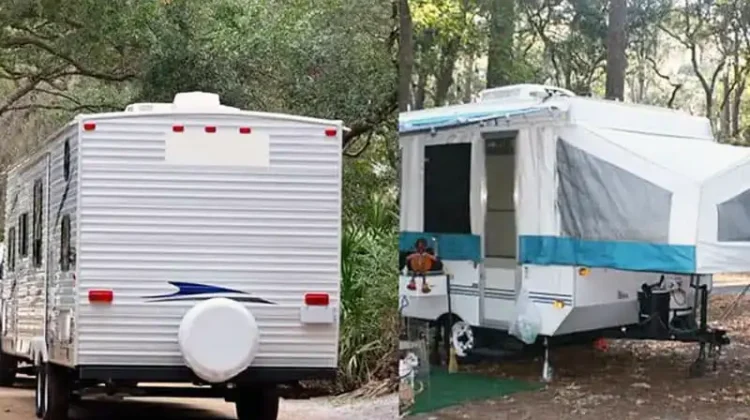
A pop-up camper is a compact, foldable trailer that expands into a comfortable living space, while a travel trailer is a non-motorized, towable trailer used for shelter. Pop-up campers offer the experience of tent camping with added comfort, whereas travel trailers offer more amenities, like those of a home.
The pop-up life expectancy depends on its maintenance and usage; a well-maintained pop-up camper can last up to 15 years or more. Meanwhile, travel trailers have a longer life span.
However, the life of a pop-up is not just about its longevity; it’s about the unique camping experiences it offers to outdoor enthusiasts. A pop-up camper is a smaller recreational vehicle. Pop-up campers are usually purchased by individuals who want the experience of owning an RV but at a low cost and in a modest way.
A travel trailer tends to be big; however, you can also get smaller sizes. It provides RVers with a similar experience, albeit with more amenities and features. One thing that differentiates the bigger travel trailer from a pop-up camper is the ease or lack thereof of towing.
If you are looking for an RV with limited amenities and features packed in at a minimum cost, then a pop-up camper is a perfect choice. If you want the full RV experience with all the amenities you might need for a great camping trip, you should consider a travel trailer.
This article pits these two RV types against each other to help you decide which is the better choice for you. Let us begin.
Maintenance

When it comes to maintenance, pop-up campers are a little easier. Given that pop-up campers are quite small and do not come with hard-sided doors or walls. They are modest RVs, and that means they require less maintenance.
Here is a specialized technical checklist for protecting a pop-up camper’s canvas and structure during the off-season or long-term storage.
1. The “Deep Dry” (Crucial Step)
-
The 48-Hour Rule: Never store a pop-up wet. Even a hint of morning dew can lead to a full-on mold takeover within weeks. Open the camper fully in direct sunlight for at least 48 hours before folding it for storage.
-
Check the “Gullies”: Pay special attention to the areas where the canvas meets the bed slides. Moisture often gets trapped in these folds.
2. Canvas Cleaning & Treatment
-
pH-Neutral Cleaning: Use a specialized cleaner, such as 303 Multi-Surface, or a mild Ivory soap. Harsh detergents can strip the factory’s waterproofing and UV inhibitors.
-
UV Protection: Once dry, apply a fabric guard (like 303 Marine Fabric Guard). This acts as a “sunscreen” against UV degradation and helps water bead off the surface.
-
Vinyl Window Care: Clean clear vinyl windows with a non-ammonia cleaner and a microfiber cloth to prevent yellowing or cracking.
3. Rodent & Pest Barriers
-
The “Scent” Defense: Mice love the tight, dark folds of a stored pop-up. Place scented dryer sheets or peppermint oil-soaked cotton balls inside the cabinets and along the floor.
-
Steel Wool Plug: Check the underside of the trailer for any wire or pipe entry points. Fill these gaps with stainless steel wool to keep pests out of the cabin.
4. Mechanical & Interior Prep
-
Lifter System Lubrication: Grease the lift posts and spray the cables with a dry silicone lubricant. Avoid wet greases that attract grit and salt air, which can grind down the pulleys.
-
Fridge & Plumbing: Leave the refrigerator door propped open to prevent odors. Ensure the water lines are blown out or treated with RV antifreeze if you’re in a climate where temperatures drop.
-
Battery Maintenance: Disconnect the deep-cycle battery and store it on a maintainer/trickle charger in your garage to prevent sulfation.
5. Exterior Shielding
-
Tire Covers: If storing outside, use UV-rated tire covers. Pop-up tires are prone to “dry rot” long before the tread wears out.
-
Breathable Cover: If you aren’t storing it inside a garage, use a breathable RV cover. Avoid blue plastic tarps, as they trap moisture against the roof and the canvas, creating a “sauna” effect that can cause rot.
Conversely, travel trailers come with certain parts that might require additional maintenance. Generally, you might need to take the travel trailer to an RV mechanic more often than not.
It is important to know that visiting a mechanic that specialises in RVs might cost you about $100 an hour. What you should always bear in mind is that maintenance is important when it comes to all types of RVs.
When you neglect routine maintenance, you end up paying much more when your RV breaks down. You will also have to pay for replacement parts.
Components such as piping systems, awnings, and appliances in a trailer will have to be maintained or you will end up paying for repairs that could cost an arm and a leg.
Insurance

Most people believe that the only costs you incur are when you first buy your RV and when you take it in for repairs or maintenance.
However, this is not the case. Insurance is an important aspect of RV maintenance. It is necessary to insure your RV, given how much it costs to buy and the appliances it comes with.
When it comes to insurance, pop-ups are small and economical, so they cost less.
Given that your popup camper is unlikely to have too many amenities and appliances in it, and given that it did not cost as much to purchase in the first place, your insurance premiums could be low, something like $20 extra for the most basic popup camper and $200 for the more extravagant ones, on top of your regular car insurance.
This, however, is not true for a travel trailer, as you are likely to pay an average of $220 to $550 each month.
While you might think you do not need insurance for your pop-up camper simply because of the low costs associated with it, you never know what could happen to your camper. For example, a robbery, fire, or accident can occur, and having insurance can provide you with peace of mind.
Sense of adventure

Most RV purists will say that a pop-up camper offers an authentic camping experience, while a travel trailer simply brings your home on wheels. Now this debate is subjective, and it depends on what you think camping is.
For some, camping is all about being as close to nature as possible, taking in your surroundings. You can do all this with a pop-up camper, as it gives you the actual experience of being out there, even if you are in an RV.
This sense of being outdoors and close to nature cannot be had in a hard-sided travel trailer. When you camp with a travel trailer, it feels like you are back at home, with a thick, insulated wall separating you from nature. Isn’t the point of camping to take in the outside
Towability

Towing a travel trailer is much different from towing a pop-up camper. For one, a travel trailer at its heaviest weighs at least 7,500 pounds, which can be hard on your vehicle.
You have to ensure that whatever vehicle you use to tow your travel camper is capable of towing that weight and above. It is always best not to tow a weight too close to your vehicle’s maximum towing capacity.
Before you make your purchase, you have to decide if your vehicle can handle the weight of a travel trailer. For instance, if you are interested in purchasing a 38-foot travel trailer, you should be aware that it would weigh 8,500 pounds dry.
This means you not only have to account for that weight but also for any additional weight from your things, and make sure your vehicle can handle it.
A pop-up camper, on the other hand, will typically weigh anything from 600 to 2,300 pounds, and this means that you can tow it using almost any car.
One reason a pop-up camper is light is that it doesn’t have wooden walls. It also helps that they have no hard sides and only basic amenities.
Tent trailers, on average, weigh between 600 and 2000 lbs and can be towed very easily by any normal car.
Storage

When it comes to storage, a pop-up camper wins hands down. Trying to store a travel trailer can be quite stressful, especially if you do not have a large enough garage. The only option would be to store it anywhere, but that could severely damage your travel trailer.
Good storage is essential, particularly during the winter. This is a factor that you should never overlook. Doing so could cost you not only time but also money, as you may have to take your trailer to a repair shop.
The advantage of a pop-up camper is that it requires less space. This means that you can simply store them in your garage until you require them.
This is not the case with travel trailers, which require more space. If you do not have enough space, you would most likely have to rent RV storage.
What you choose in this regard depends on whether you are comfortable paying for additional storage or would prefer something you can store safely in your garage.
Price
 Generally, travel trailers cost more than pop-up campers. This is clearly evident in the average price of a travel trailer ($30,000) compared to a pop-up camper ($16,000). You can even purchase a brand-new pop-up camper for as low as $7,000.
Travel trailers are cheaper than other RVs, such as Class A to C motorhomes and fifth wheels; however, even they are still more expensive than a pop-up camper, which can cost 5 times as much.
A brand-new travel trailer can cost anywhere from $10,000 to $60,000, or even more in some cases.
Additional Questions for the pop-up purchaser:
Will a Pop-Up Camper Fit in a Garage?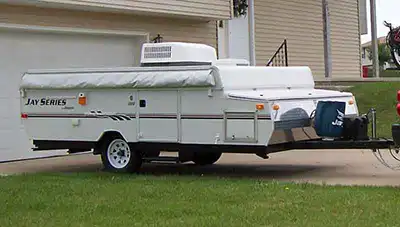
In addition to its lightweight frame, a pop-up camper comes in numerous sizes. This means you do not need much space to tow.
This is particularly important when you consider storage, as a pop-up trailer can be large enough to fulfill your camping needs but still small enough to fit in the garage when not in use.
Can a Pop-Up Camper Canvas Be Painted?
Can their canvas be painted? The answer is yes; however, the process requires careful attention.
Painting the canvas of a Pop-Up Camper can not only enhance its aesthetic appeal but also provide an extra layer of protection against the elements. This can be especially beneficial in keeping your pop-up heat regulated, thereby making your camping experience more comfortable.
How Much Does Pop-Up Camper Insurance Cost?
Compared to fifth wheels and travel trailers, pop-up campers do not require you to be a seasoned driver. Given that pop-up campers cost less, most people wonder whether getting insurance is worth the risk.
Getting your pop-up camper insured might not be legally required in every state; however, it is still a good idea.
Do Pop-Up Campers Have Titles?
The answer is yes, a pop-up camper title is typically required for legal purposes.
Depending on the state, having a title for your pop-up camper is necessary for registration, insurance, and resale. It serves as an official document proving your ownership.
How Long Will A Pop-Up Camper Last?
The lifespan of a pop-up camper, also known as a folding camper, is heavily influenced by several factors, including its construction quality, maintenance, and usage. On average, the life expectancy of a well-maintained pop-up camper is 10 to 15 years.
However, with meticulous care and minimal exposure to harsh weather conditions, a pop-up camper can last even longer. This longevity is attributed to the simplistic design and fewer mechanical parts, which reduce the potential of breakdowns.
Final Thoughts
In conclusion, when comparing a pop-up camper and a travel trailer, several factors should be considered, including the pop-up’s lifespan, how long it lasts, and its overall lifespan. In terms of lifespan, pop-up campers tend to be shorter-lived than travel trailers due to their lightweight, compact design. They are typically made from soft materials, which are susceptible to weathering and wear and tear over time.
However, with proper care and maintenance, the lifespan of a pop-up can be significantly extended.
On the other hand, travel trailers are generally built to last longer. They are more robust and constructed with hard materials that can withstand harsh weather conditions and rough terrains. However, they also require regular maintenance to keep them in good condition.
When comparing how long a pop-up camper lasts to a travel trailer, it’s crucial to consider the type of camping you plan to do. If you frequently camp in harsh environments or for extended periods, a travel trailer may be a better option due to its longevity and durability.
On the other hand, if you are an occasional camper who enjoys short trips and easy setups, a pop-up camper may be sufficient. The decision ultimately depends on your specific camping needs and preferences.