Thank you for reading our post, please rate this article at the end.
Reading Time: 6 minutesLast Updated on April 30, 2026 by Paul Clayton
Table of Contents
Is It Legal To Drive An ATV On The Road?
Key Takeaways
-
- Default Prohibition: ATVs and UTVs are legally classified as “off-highway vehicles” (OHVs). In both the U.S. and Canada, they are illegal on public roads by default due to safety and equipment standards; road use is always the exception, not the rule.
- Hyper-Local Control: Legality is a “patchwork.” Even if a state or province allows road use, individual counties and municipalities often have the final say on which specific streets are open to riders.
- Limited Road Access: Permission is almost never universal. It is usually restricted to secondary rural roads, unpaved surfaces, or specific “trail connectors,” while Interstates and major highways remain strictly prohibited.
- The “Street-Legal” Myth: Obtaining a license plate (e.g., via a Montana conversion) does not guarantee legality in other jurisdictions. Reciprocity is rare for OHVs, and a “street-legal” rig in one state may be impounded in another.
- Mandatory Compliance: On-road riding typically requires specific hardware (mirrors, turn signals, DOT tires), a valid driver’s license (usually age 16+), insurance, and registration.
- Operational Constraints: Even on legal roads, riders are often subject to strict speed limits (25–35 mph), daylight-only hours, and mandatory safety gear, such as DOT-approved helmets.
This guide explores the legal landscape of operating All-Terrain Vehicles (ATVs) and Utility Terrain Vehicles (UTVs) on public roads in the United States and Canada.

The Baseline Rule: “Off-Highway” by Design
By definition, ATVs are Off-Highway Vehicles (OHVs). Manufacturers design them with low-pressure tires and a high center of gravity for off-road traction, not for pavement.
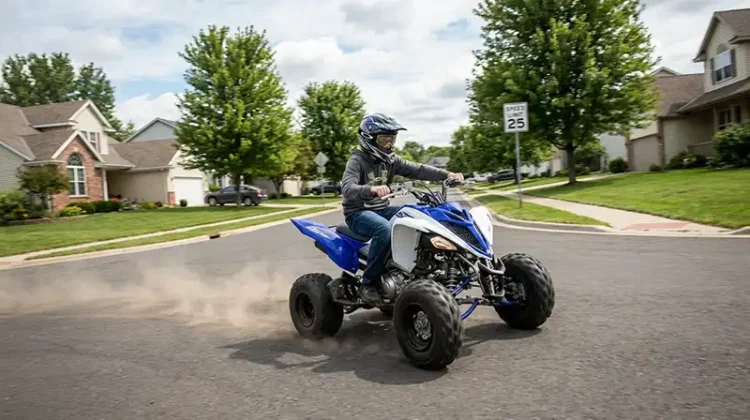
The “Not Street Legal” Principle: In almost all jurisdictions, ATVs are illegal on public roads by default. Their tires lack the grip required for asphalt, and they often lack the safety features (turn signals, mirrors, differentials) required for motor vehicle standards. Any permission to ride on a road is an exception to this rule, not the standard.
United States: A Patchwork of State Laws
In the U.S., there is no federal law for ATV road use; it is governed by state statutes and often further restricted by local (county or city) ordinances.
Common Permission Pathways
-
Designated Routes: Some states “open” specific segments of secondary roads to connect trailheads.
-
Agricultural/Utility Use: Farmers and utility workers are often exempt when moving between fields or work sites.
-
Local Option: States like Ohio and Texas allow counties or townships to decide which roads are open.
-
Direct Crossings: Most states allow you to cross a road at a 90-degree angle after coming to a full stop.
Key Restrictions
-
Road Class: Use is almost never allowed on Interstates or limited-access highways.
-
Speed: Even on legal roads, ATVs are often capped at 25–35 mph.
-
Equipment: Requirements often include a USDOT-approved helmet, eye protection, and functional headlights/taillights.
-
Age: Operators typically must be at least 16 with a valid driver’s license to ride on any public road.
Source: ATV Safety Institute (2026); Florida Dept. of Highway Safety.
Canada: Provincial & Municipal Control
In Canada, the Highway Traffic Act of each province sets the stage, but municipalities can “opt in” to road use.
-
Provincial Variation: Ontario and Newfoundland are relatively permissive on secondary roads, while British Columbia and Alberta focus heavily on “road allowances” (unmaintained paths beside roads) rather than the pavement itself.
-
Road Types: Use is generally restricted to highways with numbers in the 500–899 range (secondary/rural) and prohibited on 400-series or Trans-Canada routes.
-
Mandatory Compliance: Unlike some US “farm use” leniency, Canada strictly enforces insurance, registration, and licensing (Class G2/M2 or higher) for any road-adjacent travel.
Source: Ontario Federation of Agriculture; B.C. Ministry of Forests.

Street-Legal Conversions
In some states (e.g., Montana, South Dakota, Arizona), you can “convert” an ATV to be fully street-legal and receive a standard license plate.
Common Requirements for Conversion:
Lighting: Turn signals, brake lights, and a license plate light.
Mirrors: At least one rearview mirror (often two side mirrors).
Horn: Must be audible from 200 feet.
Tires: Some states require DOT-approved tires (standard ATV tires can “skate” on pavement).
Windshield: A glass or polycarbonate windshield (sometimes with a wiper).
Note: A “street-legal” plate from Montana may not be recognized for road use in a “prohibited” state like New Jersey or New York. Always verify reciprocity.
Quick-Reference Comparison Tables
Table A: United States (Select Highlights)
| State | Allowed on Roads? | Key Conditions | Age/License |
| Arizona | Yes | With “primarily on-road” registration/insurance | 16+ / Valid License |
| California | No | Crossing only; agricultural/emergency exceptions | 16+ (for crossings) |
| Florida | Limited | Unpaved roads <35mph; local county approval | 16+ (on public land) |
| Montana | Yes | Full “Quadricycle” registration & equipment | 16+ / Valid License |
| New York | No | Crossing is prohibited on almost all public roads | 16+ |
| Utah | Yes | Designated roads only; must have street-legal kit | 16+ / Valid License |
| West Virginia | Limited | Local/Secondary roads only; no “center line” roads | 16+ / Valid License |
Table B: Canada (Select Highlights)
| Province | Allowed on Roads? | Key Conditions | Age/License |
| Alberta | Limited | Road allowances; municipal bylaws only | 14+ (Class 7) |
| B.C. | Limited | Mostly for crossing or FSR (Forest Service Roads) | 16+ / Valid License |
| Ontario | Yes | Secondary highways (500-899); municipal opt-in | 16+ / G2 or M2 |
| Quebec | Limited | Designated trail-link segments only | 16+ / Valid License |

Frequently Asked Questions
Q: If my ATV is registered and insured, can I drive it on any public road?
No. Registration and insurance are mandatory requirements for road use, but they do not grant universal access. In most jurisdictions, you are still restricted to specific road types (such as unpaved or secondary roads) or routes explicitly designated by local municipal ordinances. Interstates and major state highways remain strictly off-limits almost everywhere in North America.
Q: Can I get a ticket for driving on the shoulder instead of the actual pavement?
Yes. In many states and provinces, the “shoulder” is legally considered part of the highway right-of-way. Unless local law specifically directs OHVs to use the shoulder (as is common in parts of Ontario), riding there is treated the same as riding on the pavement. Always check if the law requires you to stay on the extreme right of the traveled portion or strictly within the shoulder.
Q: Does a “Street-Legal” license plate from another state work everywhere?
Not necessarily. This is a common legal pitfall. While many states have “reciprocity” for standard car registrations, they often do not recognize out-of-state OHV “street-legal” conversions. For example, a Montana “permanent” plate might be legal in Arizona, but if you trailered that vehicle to New York or California, local law enforcement could still cite you for operating a non-compliant vehicle on their roads.
Q: Are the rules different for UTVs (Side-by-Sides) than for ATVs?
Frequently. Because UTVs often include safety features such as Roll-Over Protective Structures (ROPS), seatbelts, and automotive-style steering, some jurisdictions are more lenient toward them than toward straddle-seated ATVs. Conversely, some trails and small-town bridges have width restrictions that may allow a 48-inch ATV but prohibit a 64-inch wide UTV.
Q: What is the “Agricultural Exemption,” and do I qualify for it?
The agricultural exemption generally allows farmers to move equipment between fields or to a repair shop via public roads. However, this is typically restricted to daylight hours and requires a Slow-Moving Vehicle (SMV) triangle. Using an ATV for a “quick grocery run” or recreational joyriding does not fall under this exemption, even if you own a farm; the trip must be directly related to a commercial farming operation.
Scenario-Based Guidance
-
Crossing a Road: Stop fully, yield to all traffic, and cross at a 90-degree angle. (Legal in ~95% of jurisdictions).
-
Riding on a Shoulder: Often illegal unless the road is specifically marked as an OHV route. In Ontario, you must ride on the shoulder if it is safe to do so.
-
Small-Town Local Road: Check the Municipal Code. Many rural towns pass “golf cart/ATV” ordinances that override state prohibitions.
-
Farm Use: Most regions allow you to use the road to move from “Field A to Field B.” You usually need a “Slow Moving Vehicle” (SMV) triangle.
-
Trail Connection: Some trails end at a town limit and pick up on the other side. You must verify if the town has a “connector” ordinance.
Compliance Checklist & Glossary
Pre-Ride Checklist
-
Registration: Is my plate/sticker current and visible?
-
Insurance: Do I have a liability policy that covers road use?
-
Local Maps: Have I confirmed this specific road is “open”?
-
Equipment Check: Are my lights and horn functioning?
-
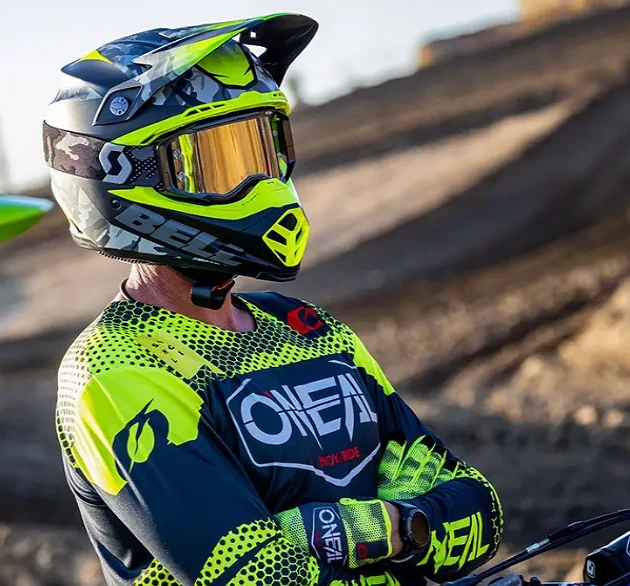
Safety Gear: Am I wearing a DOT helmet and eye protection?
Glossary
-
ATV (All-Terrain Vehicle): Straddle-seated, handlebar-steered vehicle.
-
UTV (Utility Terrain Vehicle): Side-by-side seating, steering wheel, roll cage.
-
OHV: The broad category including ATVs, UTVs, and dirt bikes.
-
Road Allowance: The land between the edge of the road and the adjacent property line.
-
Designated Route: A road segment specifically signed for OHV use.
Final Thoughts
Navigating the legalities of on-road ATV use requires moving past the “off-road” mindset and treating the vehicle as a specialized motor vehicle subject to heavy regulation. While many regions have become more permissive to support rural economies and trail tourism, the burden of proof rests entirely on the operator.
Success on the road boils down to two steps: confirming the specific road’s classification through local municipal bylaws and ensuring your vehicle meets the equipment standards of that specific jurisdiction. When in doubt, assume the road is closed to OHVs until you see the official “Designated Route” signage or confirm the local ordinance.