Thank you for reading our post, please rate this article at the end.
Reading Time: 7 minutesLast Updated on May 3, 2026 by Paul Clayton
Table of Contents
Do Polarized Glasses Work For Fishing?
Key Takeaways
-
- Beyond Eye Protection: While UV protection is a bonus, polarization is primarily about sight. It acts as a “picket fence” for light, blocking the horizontal glare that creates a silver shimmer on the water and allowing only the vertical light, which contains the visual data of what’s beneath, to pass through.
- The Power of Contrast: Lens color is a tool, not a fashion choice. Copper and amber bases act like a “contrast knob” for shallow water and flats, while gray bases are essential for the relentless sun and deep blues of offshore fishing.
- Specialized Low-Light Tech: You shouldn’t take your glasses off when the clouds roll in. Yellow or high-contrast “sunrise” lenses are specifically designed to gather available light and sharpen weed lines and structure during overcast periods.
- Frame Fit Matters: A premium lens is ineffective if light “leaks” in from the top or sides. Effective fishing frames utilize a wrap design to create a “darkroom” effect, preventing internal reflections of your own eye on the back of the lens.
- The Glass vs. Polycarbonate Trade-off: Glass provides the pinnacle of scratch resistance and 4K-like clarity, but is heavier. Polycarbonate is feather-light and impact-resistant, essential for safety against flying lures, but requires more careful cleaning to avoid scratches.
- The Value of “The Recipe”: Premium brands like Costa, Smith, and Bajío don’t just darken the world; they use advanced filtering (like Costa’s 580 or Smith’s ChromaPop) to trap “bad” light and boost specific color frequencies, reducing the end-of-day eye fatigue known as a “phantom headache.
You know, there’s a specific kind of frustration that only a fisherman truly understands. It’s that moment when you’re standing on the bank or the deck of a boat, the sun is high, and the water looks like a sheet of hammered silver. You know the fish are down there, you can feel it in your gut, but all you’re seeing is a blinding white bounce-back that makes you squint until your head aches. That’s the glare, and it’s the Great Wall of China between you and a successful day.
Polarized lenses offer the best protection while fishing because they cut glare, helping reduce eye strain and unnecessary squinting. The best polarized fishing sunglasses will help you see beyond the surface of the water, making it much easier to spot your next big catch.
I get asked all the time if polarized glasses actually make a difference, or if it’s just marketing fluff to get you to drop a couple of hundred bucks on a pair of frames. Let me tell you, sitting here right now, I’d sooner leave my favorite rod at home than head out without my polarized glass. It isn’t just about “eye protection,” though keeping hooks and UV rays out of your retinas is a nice bonus. It’s about sight.
When light hits the water, it scatters horizontally. That’s what creates that “shimmer” that hides everything beneath the surface. A polarized lens acts like a picket fence. It only lets vertical light through, which carries the actual information, like the shadow of a big largemouth tucked under a log or a bonefish moving across a flat. Without them, you’re fishing casting at ripples and hoping for the best. With them, you’re hunting.
People often get hung up on the brand, but the real magic is in the lens color, and that’s where the “expert” wisdom comes in. You can’t just buy one pair and expect them to work from the deep blue sea to a muddy creek.
If we’re sitting on the flats or I’m working a shallow river, I’m reaching for a copper or amber base, usually with a green mirror. That amber tint is like turning up the “contrast” knob on a TV. It makes the greens and browns of the underwater world pop, helping you distinguish a fish’s tail from a piece of sunken timber.
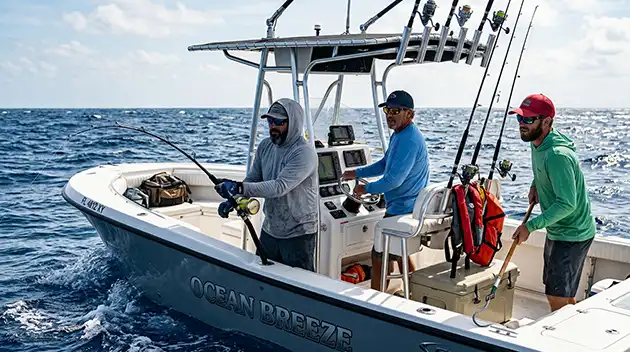
But, if we take the boat ten miles offshore into that deep, “electric” blue water, that amber lens is going to feel too bright. Out there, you want a gray base with a blue mirror. It’s designed to handle that brutal, open-ocean sun and cut through the deep blue glare without distorting the colors.
And don’t even get me started on those hazy, overcast mornings. A lot of guys take their glasses off when the clouds roll in, but that’s when a yellow or high-contrast sunrise lens shines. It gathers the available light and sharpens everything up so you aren’t guessing where the weed line starts.
Now, a word of advice from someone who has dropped more pairs of glasses in the drink than I’d care to admit: go to the store and put them on your face. Don’t just click “buy” online because they look cool.
You need a frame that wraps around your face a bit. If light is leaking in from the sides or the top, it hits the back of the lens and creates a reflection of your own eye, which is just as distracting as the glare on the water.
Whether you’re looking at glass or polycarbonate is another trade-off. Glass is heavier, but the clarity is unbeatable, and it’s hard to scratch. Polycarbonate is light as a feather, great for a long day, and won’t shatter if a lead weight comes flying back at your face, though you have to be a bit more careful when cleaning them.
At the end of the day, fishing is a game of observation. The guy who sees the most catches the most. If you’re still wearing those gas-station “tinted” glasses, you’re basically playing the game with one hand tied behind your back. Invest in a good pair of polarized lenses, take care of them, and I promise you’ll start seeing a world beneath the surface you never knew was there.
If you spend enough time around the docks, you’ll start to see the same few names pop up on the side of guys’ frames. It isn’t just about who has the biggest marketing budget; it’s about whose lenses are actually helping you put meat in the cooler when the sun is doing its best to blind you.
When you’re looking at the big players, the Costas, the Smiths, the Bajíos, you aren’t just paying for a logo. You’re paying for the “recipe” of the lens.
The Heavy Hitters: Costa Del Mar and Smith
Costa Del Mar is basically the gold standard out here, and for good reason. They’ve got this 580 technology that’s famous among anglers. Most sunglasses just darken everything, but Costa’s 580s actually “trap” the harsh yellow light that’s hard on your eyes and boost the reds, blues, and greens.
-
The Price of Admission: You’re usually looking at $200-$300.
-
Why they’re on every boat: It’s their variety. If you’re a guy who fishes the sunrise on a glassy lake, their Sunrise Silver Mirror is like magic; it lets in enough light to see while still killing the glare. If you’re offshore, their Blue Mirror is unbeatable. Plus, their frames, like the Fantail or Blackfin, are built with “Hydrolite” rubber; the sweatier you get, the grippier they get.
Then you have Smith Optics. If Costa is the king of the salt, Smith is the darling of the fly-fishing world. They use something called ChromaPop. While Costa filters light out, Smith focuses on overlapping colors so your brain perceives them more clearly.
-
Why they win: Their Guide’s Choice frames are legendary for their built-in side shields. When you’re sight-fishing, light leaking in from the sides is your enemy. Smith keeps you in a “darkroom,” so your pupils stay dilated, and you can see deeper into the holes where trout like to hide.
The Tech Disrupters: Bajío and Oakley
There’s a newer kid on the block called Bajío, started by some folks who left the big brands to do things their own way. They’ve caught fire lately because of their Lapis technology.
-
The Difference: They claim to block more “bad blue light” than anyone else, which reduces that end-of-day eye fatigue that makes you feel like you’ve been staring at a welder’s torch.
The Feel: They use bio-based resins for their frames (think castor beans), making them incredibly light. If you’ve ever had a pair of heavy glass lenses start to hurt the bridge of your nose by 2:00 PM, you’ll appreciate why Bajío is winning over the “marathon” anglers.
And don’t overlook Oakley. Their Prizm lenses were originally for baseball and golf, but they realized they could tune that tech for the water. They have specific Shallow Water and Deep Water polarized versions.
The “Wow” Factor: Prizm Deep Water is rose-based. Most offshore lenses are grey, but Oakley’s rose tint makes the white “flash” of a billfish or the green of a mahi-mahi stand out like a neon sign against the deep blue.
Is the “Investment” Really Worth It?
Look, you can buy a $25 pair of polarized glasses at a bait shop, and they will work. They have a polarized film that cuts glare. But the difference between a $25 pair and a $250 pair of Maui Jims or Smiths comes down to optical clarity and durability.
Cheap lenses are usually just “triacetate” (TAC) thin layers of plastic pressed together. They often have slight distortions that give you a “phantom” headache after four hours. The top-tier brands use Mineral Glass or high-grade Polycarbonate. Glass is virtually scratch-proof, useful when you’re constantly wiping salt spray off with a shirt tail, and the clarity is like switching from an old tube TV to 4K.
Quick Guide to Choosing Your Brand
| Brand | Best For… | Notable Tech | Price Range |
| Costa Del Mar | The all-around pro; best color variety. | 580G (Glass) / 580P | $200–$300 |
| Smith | Fly fishing & freshwater; best contrast. | ChromaPop | $180–$280 |
| Bajío | High-tech clarity; eco-conscious & light. | Lapis Blue Light Blocking | $200–$260 |
| Oakley | High-speed boating; impact resistance. | Prizm Polarized | $170–$250 |
| Maui Jim | Comfort & everyday “lifestyle” to fishing. | PolarizedPlus2 | $250–$350 |
Where to Do Your Homework
If you want to dig deeper into the “lab” side of things, check out:
-
SportRx: They do incredible deep-dive videos on “VLT” (Visible Light Transmission) and frame measurements.
-
OutdoorGearLab: They put these things through actual torture tests to see which coatings peel first.
-
Manufacturer Sites: Costa and Bajío both have “lens simulators” on their sites that let you see a digital version of how their different tints change the water.
At the end of the day, these brands are popular because they’ve been tested in the world’s harshest environments. When you find a pair that fits your face and your specific type of fishing, it’s like someone finally turned the lights on.
Take a deep breath and work on this problem step by step.
Final Thoughts
Choosing the right polarized sunglasses is arguably as important as choosing the right rod or reel. In the world of fishing, you are only as successful as what you can observe; if you can’t see the fish or the structure, you’re merely casting at ripples.
By investing in high-quality optics tuned to your specific environment, whether that’s the “Lapis” tech of Bajío for blue-light blocking or the specialized “Prizm” water tints from Oakley, you transition from fishing blind to hunting with precision.
Ultimately, a “street-legal” pair of shades might look the part, but true high-performance eyewear is what finally “turns the lights on” beneath the surface.