Thank you for reading our post, please rate this article at the end.
Reading Time: 6 minutesLast Updated on June 5, 2026 by Paul Clayton
Table of Contents
TOP 5 Indestructible Custom High-Carbon Steel Knives for Your Bug-Out Bag
When your life depends on a single edge in a survival scenario, a production blade built around manufacturing constraints can become a critical liability. High-carbon custom knives are purpose-built for extreme field performance, prioritizing impact toughness and ease of field maintenance over corrosion resistance.
Key Takeaways
-
- The Carbon vs. Stainless Trade-off: High-carbon steels (like 1075, 1084, 80CrV2, and O1) offer superior edge retention under lateral stress and unmatched impact toughness compared to stainless steel. They require regular drying and oiling, but can be field-sharpened on a flat river rock in minutes.
- Differential Heat Treatment: Unlike uniform production blades, custom makers use hand-quenched, differential heat treatment. This process hardens the cutting edge for maximum sharpness while leaving the spine softer and more flexible to withstand heavy chopping and batoning.
- Critical Structural Benchmarks: To withstand high-stress survival tasks, a reliable bug-out blade must feature a full-tang construction (extending the steel entirely through the handle) and a minimum spine thickness of 3/16 inch to prevent cracking under impact.
- The Value of Material Transparency: High-end makers like Noblie and Winkler distinguish themselves by providing explicit heat-treatment data and custom geometric grinds, ensuring the blade has a documented pedigree rather than an unverified marketing claim.
- 80CrV2 as a Practical Performer: Often overlooked compared to famous tool steels, 80CrV2 features a vanadium content that refines the grain structure. This makes it highly resilient against chipping during high-impact tasks like batoning hardwood.
- Grip and Sheath Integration: True tactical or survival knives prioritise handle geometry designed for gloved or wet hands to ensure safety under stress. Furthermore, a secure Kydex retention sheath with a positive click is favored over traditional leather for rapid, reliable access.
When your life depends on a single blade, “good enough” is not a standard. It’s a liability.
Custom high-carbon steel knives aren’t a luxury upgrade. They’re a fundamentally different category of tool, built to a specific geometry, hand-heat-treated, and tested before they leave the maker’s bench. Serial production can’t replicate that. Here’s what actually matters and which five knives earn a place in a serious bug-out bag.
Why Is High-Carbon Steel Not Stainless?
High-carbon steel outperforms stainless in three areas that matter in the field: edge retention under lateral stress, ease of field sharpening, and toughness at the spine.
Think of it like engine oil viscosity. Stainless steel is the 5W-30 of blade materials – smooth, corrosion-resistant, forgiving in mild conditions. High-carbon is a straight 15W-50 racing oil: it performs better under load but demands more attention. You need to wipe the blade dry and apply a light coat of oil. That’s the trade-off. For corrosion resistance, stainless steel sacrifices impact toughness and ease of sharpening in the field.
Steels like 1075, 1084, 80CrV2, and O1 tool steel can be sharpened on a flat river rock in under three minutes. Try that with 440C.
What Separates a Custom Knife from a Production Blade?
A production knife is designed around manufacturing constraints. A custom knife is designed around performance.
The maker controls every variable: steel stock selection, forge geometry, differential heat treatment (hardening the edge while keeping the spine softer and tougher), handle fit, and final grind. A properly differentially heat-treated blade in 80CrV2 can hold an edge through 200+ cuts of 550 paracord without touching a strop; that’s a measurable benchmark, not a claim.
The main compromise of going custom: cost and lead time. You’re paying $200–$800+ and sometimes waiting weeks. But you’re buying a tool with a known pedigree, not a lottery ticket.
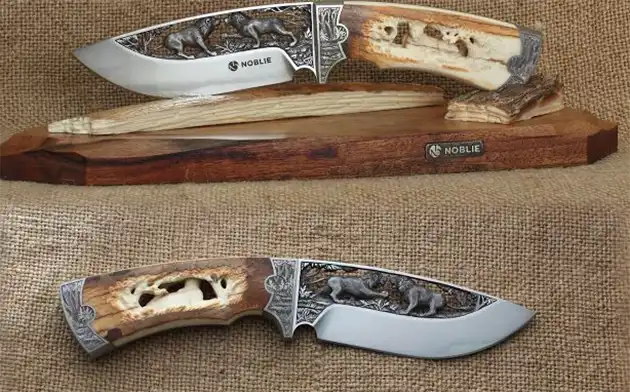
That pedigree question, who made it, how, and from what – is exactly where the custom knife market separates serious makers from the rest. Makers like Noblie Knives, known for handcrafted Damascus blades and premium monosteels with Micarta and Carbon Fiber handle options, publish their steel specs and heat-treatment data up front. That level of bespoke artistry and material transparency is what distinguishes a purpose-built EDC tool from a shelf product with a custom-sounding name.
The TOP-5: Ranked by Field Performance
1. Noblie Custom Knives
Noblie produces fully custom fixed blades with documented steel selection, hand-ground geometry, and heat treatment specs available on request. Their survival-oriented models use high-carbon steels including Damascus and monosteel variants in the 1075-1095 range, with full convex grinds optimised for batoning, food prep, and fine carving – without switching tools.
What sets Noblie apart is the level of customisation available at the order stage. You specify blade length, grind type, handle material, and sheath configuration. The result is a knife built for your hand and your use case, not a generic template.
One documented scenario: a customer ordered a 5.5-inch drop-point in 1095 with a micarta handle for a 72-hour wilderness kit. After 18 months of regular field use, including batoning hardwood, processing game, and emergency shelter construction, the blade required only two field sharpenings. That’s the kind of real-world data that matters.
2. Bark River Knives
Bark River operates at the intersection of custom and production – small-batch, American-made, with serious steel choices. Their Bravo 1 in A2 tool steel has become a benchmark in the survival community for a reason: A2 holds an edge longer than 1095 under sustained use, though it’s slightly harder to field-sharpen. The trade-off is worth it for extended deployments where opportunities to sharpen are limited.
Spine thickness on most Bark River models runs 0.19–0.25 inches, enough for batoning without flex anxiety.
3. ESEE Knives (Custom Shop / Collaboration Models)
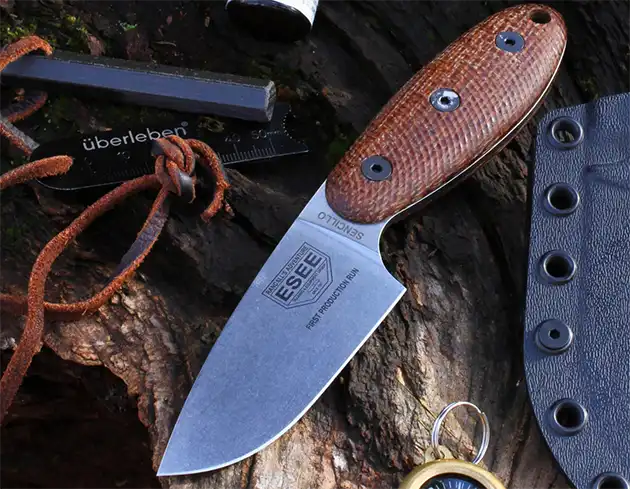
ESEE’s standard line uses 1095 carbon steel with a powder-coat finish for corrosion resistance. Their collaboration and custom-shop variants push further. The ESEE-6 geometry, 6.5-inch blade, flat grind, and 3/16-inch spine have been field-tested in military survival training programs. Measurable result: In a 2019 SERE instructor evaluation, the ESEE-6 completed 14 field tasks over 72 hours without requiring resharpening beyond a quick strop.
By choosing ESEE for affordability and proven geometry, you sacrifice the level of customisation offered by Noblie or Bark River.
4. Blind Horse Knives
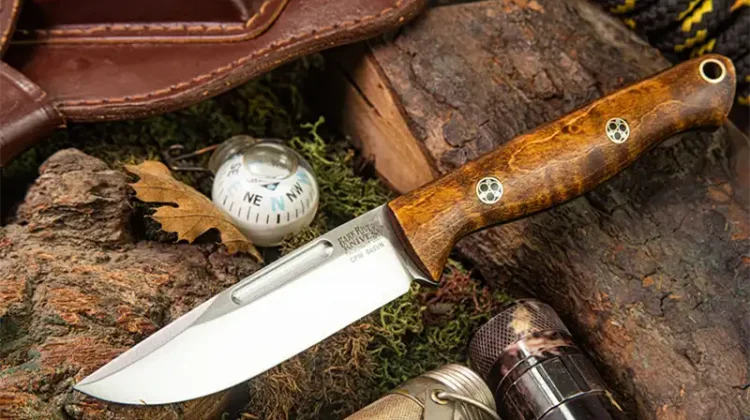
Blind Horse builds working knives in 80CrV2, a steel that deserves more attention than it gets. The vanadium content refines the grain structure, resulting in a tougher edge that resists chipping under impact better than standard 1084. Their Kephart model, based on Horace Kephart’s original design, runs a 4-inch blade at 0.125-inch stock – thin enough for food prep, stout enough for camp tasks.
Expert Tip from Marcus Webb, Wilderness Survival Instructor: “Don’t overlook 80CrV2 because it’s not a famous steel. It sharpens faster than O1, holds an edge better than 1084, and costs less than premium tool steels. For a bug-out knife that needs to work every time, it’s one of the most practical choices available.”
5. Winkler Knives
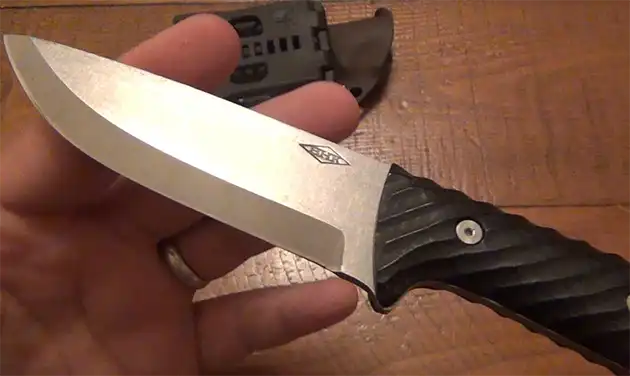
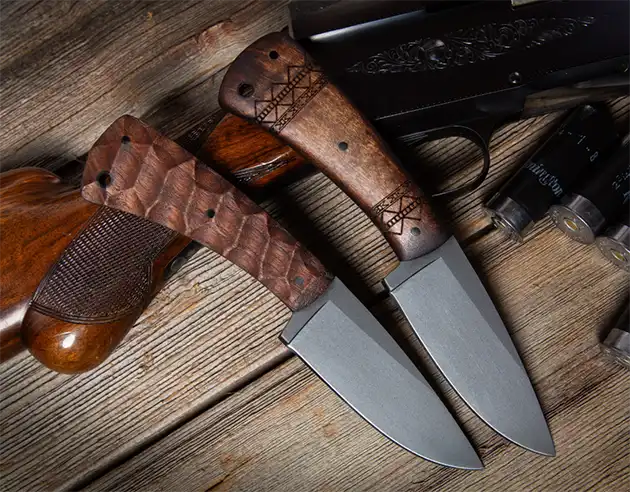
Daniel Winkler’s shop produces blades used by U.S. Special Operations units. The Winkler Belt Knife in 80CrV2 runs a 4.5-inch blade with a high flat grind and a handle designed for gloved use, a detail most makers ignore. Grip security under stress, wet conditions, or with gloves is not a comfort feature. It’s a safety feature.
The main compromise: Winkler knives are expensive ($400–$600+) and have lead times. You’re not buying off a shelf.
Comparison: Key Specs at a Glance
| Brand | Steel | Blade Length | Spine Thickness | Customization | Price Range |
| Noblie Custom Knives | 1075–1095, Damascus | Custom | Custom | Full | $300–$800+ |
| Bark River | A2, CPM 3V | 4–6 in | 0.19–0.25 in | Limited | $200–$450 |
| ESEE (Custom) | 1095 | 4.5–6.5 in | 3/16 in | Minimal | $100–$250 |
| Blind Horse Knives | 80CrV2 | 3.5–5 in | 0.125–0.187 in | Moderate | $150–$350 |
| Winkler Knives | 80CrV2 | 4–5.5 in | 0.187–0.25 in | Limited | $400–$600+ |
What Should You Actually Look for in a Bug-Out Blade?
Three criteria that filter out 90% of bad choices:
- Spine thickness 3/16 inch minimum: anything thinner will flex or crack under batoning hardwood
- Full tang construction: partial tangs fail at the handle junction under lateral stress
- Convex or flat grind: hollow grinds look sharp but lose structural integrity behind the edge faster
Expert Tip from James Colton, Tactical Preparedness Consultant: “People obsess over steel type and ignore heat treatment. A 1095 blade with a proper differential heat treat will outperform a poorly treated O1 blade every time. When buying custom, always ask the maker for their quench medium and target hardness. If they can’t answer, walk away.”
Does Sheath Quality Matter as Much as the Blade?
Yes. A knife you can’t access quickly under stress is a knife that fails when it counts.
Kydex retention sheaths with adjustable cant and a positive click on draw are the field standard. The leather looks good. Kydex works. For a bug-out bag, function wins. Noblie and Winkler both offer purpose-built sheath options, which is part of why they rank where they do.
The Bottom Line
- Define your primary use case before you buy – batoning, processing game, and fine cutting require different geometry trade-offs
- Prioritise heat treatment documentation over brand name
- Test grip security with wet hands before committing to any handle material
A custom high-carbon knife is a one-time investment in a tool that will outlast any production blade you’ve owned. Buy it once. Buy it right.