
Thank you for reading our post, please rate this article at the end.
Reading Time: 7 minutesLast Updated on April 13, 2026 by Paul Clayton
Table of Contents
What Happens If You Get Caught Without A Fishing License?
Key Takeaways
-
- Legal Obligation: Under the “Fish and Wildlife Conservation Act,” it is illegal to fish in most jurisdictions without a valid license, regardless of whether you are fishing for business or sport.
- Florida-Specific Penalties: In Florida, fishing without a license is a noncriminal, level-one violation. First-time offenders typically face a fine equal to the cost of the license plus $50.
- Escalating Fines: Repeated violations within a 36-month window result in higher fines. If you fail to pay a ticket or appear in court, the offense can be elevated to a second-degree misdemeanor, carrying a $500 fine and up to 60 days in jail.
- “Forgot My License” Rule: If you own a valid license but do not have it on your person when inspected, you can often present it in court later to have the fine reduced to a small administrative fee (approximately $10).
- Exemptions: * Age: Generally, those under 16 or over 65 are exempt from license requirements.
- Property: Fishing on your own homestead (or that of a spouse/child) usually does not require a license.
- Military: Specific exemptions apply to military personnel fishing in their home county with natural bait and non-mechanical gear.
- Catch and Release: Most states, including Florida, require a license even if you intend to release every fish you catch.
- License Types: Anglers can choose between Sport licenses (higher limits) or Conservation licenses (lower limits/lower cost). Lifetime licenses are also available, ranging from $200 to $500 depending on age.
Fishing can build full-body strength, strengthen your immune system, strengthen family bonds, promote relaxation and patience, teach self-reliance, encourage travel, and, last but not least, improve mental health.
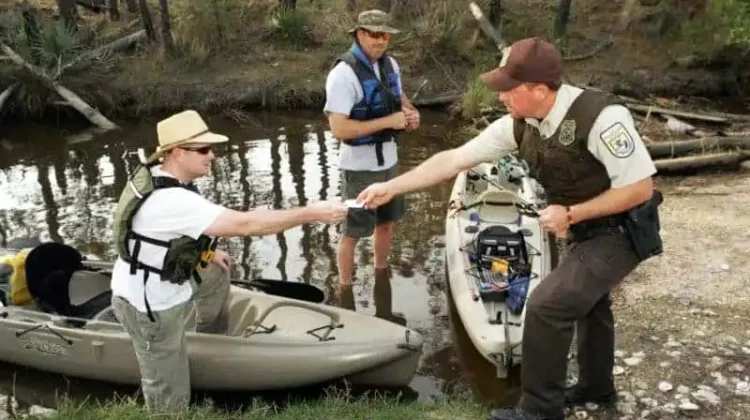
Assume the role of an environmental conservation officer. You are patrolling as part of your regular routine and come across four people packing their fishing gear. As they are about to leave the fishing spot, you ask them for their fishing licenses.
As a person, you might be thinking, “What sort of license?” Under the “Fish and Wildlife Conservation Act 1997,” it is illegal to go fishing without a license. Many of us don’t realize that you need a license to go fishing.
- 22 Fishing License Questions and Requirements
- The 10 Best Spinning Rods For Bass
- Beginners Guide to Bass Fishing
There are a few exceptions where you do not need a fishing license, and we will talk about these exceptions further.
Many of the fishermen or the correct word anglers (a person fishing using a rod and line) do not know that they may be penalized for not having a license. The penalty is way more than the cost of the actual license. So, it is better to have a license than to pay the penalty and face the consequences of being caught fishing without one.
So, what happens if you get caught without a fishing license? You might get away with a warning and the confiscation of any fish. You might also be ticketed and heavily fined up to $500, and if you’re really unlucky or a repeat offender, you may face jail time.
What Happens If You Get Caught Without A Fishing License?
The consequences of fishing without a license differ from region to region. However, the overall policies and range of fines are almost the same.
It is a violation of government rules and fish and wildlife conservation if you fish in saltwater or freshwater. You might be fined for this or jailed if you are found guilty more than once. Since 2006, these laws have been implemented strictly and are followed by everyone.
In Florida, fishing without a license is considered a level-one violation. The section that covers this offense is 379.354. It is a noncriminal offense.
In this offense, the culprit is to be penalized with a fine of the license cost plus an additional $50. If you are found breaking the same rule more than once in a period of 36 months, the penalty fine is increased to $100.
Generally, if you are caught fishing without a license, you will be given a ticket; that is, a citation is issued to you. You are required to accept this ticket and append your signature. You have to pay the fine within 30 days of the ticket’s issuance date.
By doing this, you accept your mistake and your right to a hearing.
However, your acceptance is not liable for other proceedings. It will just help to devise appropriate fines for further violations. The final verdict is in the hands of the county court. It determines your guilt and decides the fine applicable to you.
Fines are always more than $50 for your first violation. For any subsequent violation, the fine is greater than $50 and less than $500.
If you have a license, but it was not available when you were convicted, you can produce the same in the county court. In this case, you will only have to pay $10 in court fees.
If you fail to attend the hearing, do not pay the fine, or do not accept the ticket, then your offense is considered a second-degree misdemeanor. This offense is punished by 60 days in jail and a $500 fine.
If there is a repeated violation of the fishing license rule, the conservation officer can seize any property they find reasonable. There is a chance you will lose your property, and you will face a fine of $25,000 or jail for 1 year. This is decided under section 92.1 of the conservation activities.
Exemptions to the fishing license
Certain exceptions exist to a fishing license. The age criteria for having a fishing license are 16 to 65 years. Any age group below or above this specified range need not have a fishing license.
If you want to go fishing in a homestead (a house or a farmhouse) of your own or your child’s or spouse’s, then there is no need for a license. You do not need a license when you are a minor as well.
There are also some exemptions for military personnel. Like, there is no need for a license if you are fishing in your home county. This is only if you do not use fish management areas or rod-and-reel mechanisms and have natural or live bait for fishing.
Besides, there are also some exemptions for fresh- and saltwater fishing licenses.
Types of fishing licenses
To avoid the significant penalties and consequences of breaking the Conservation Act, it is advisable to purchase a fishing license and follow the fishing rules.
The rules for fishing vary depending on the type of license. It is mandatory for you to follow the rules that apply to your license type.
A sports fishing license is a type of license that limits the number of species of fish you can catch. The benefit of this license is that you can have the majority of the fish caught by yourself.
Another type of license is a conservation license. It is suitable for those who want to release almost all their catches, keeping a smaller number for themselves. This license type also has rules regarding the types of species that may be caught.
The conservation license is less expensive than the sports license and is suitable for people who fish infrequently.
Buying a fishing license
To avoid the heavy penalty, make sure you have a valid fishing license. The fishing license expires on June 30 each year. So you can update your license in June. It is not a good idea to let a license lapse.
Many fish stores and convenience stores sell these licenses. You can also search on Google for fishing license sales. You can also search for license information to find the type of license that suits you.
You can make the payment using methods like MasterCard or a credit card.
There are also contact numbers available for purchasing your fishing license. Fishing licenses can also be purchased at wildlife and fisheries offices.
The fee for a basic freshwater fishing license is $17.50. For a saltwater fishing license, onshore recreational fishing is free. With it, you can fish with live bait and a cane pole.
Lifetime licenses are also available for serious fishing enthusiasts. Their prices range between $200 and $500. Your age and the type of license you want would decide the actual cost of your license.
What do the laws say?
The following points are covered under the Environmental Conservation Law and must be followed by every individual who wishes to go fishing. Failing to abide by these rules may result in fines and potential jail penalties.
A person without a license must not:
- Hunt or trap any animal, bird, or fish, or parts of them, in any way and for any purpose.
- Hunt or trap any animal, bird, or fish or parts of them in any way and for any purpose, except in a few places and for a certain time duration formulated by the law or any prescribed department.
- Hunt or trap any animal, bird, or fish, or parts of them, in any way and for any purpose, and should not purchase, sell, import, or export them without a license or permit from the concerned department.
- Hunt or trap any animal, bird, or fish, or parts of them, in any way and for any purpose, if the person is not a resident.
- Hunt or trap migratory birds or fish without a license from the concerned department.
- Hunt or trap any animal, bird, or fish, or parts of them, in any way and for any purpose, if the said animal or fish is wounded.
Do You Need A Fishing License For Catch and Release?
The exact rules vary from state to state; however, in the vast majority of cases you will need a fishing license regardless of whether you intend to catch and release. 
National Parks may even require additional permits, while others won’t require any sort of license, so you must do your research before you start catching and releasing.
Texas doesn’t require a license for fishing in state parks if you’re practicing catch and release. While Florida will require a license no matter where you’re fishing or the type of fishing you’re doing. To confuse matters further, California can, in certain circumstances, allow fishing from a pier without a license.
Final Thoughts
It is mandatory to have a fishing license if you are fishing in areas that are not exempt from a fishing license. It is also necessary to abide by the rules formulated by the type of license you have.
Under the Environmental Conservation Law, anyone over 16 years of age who wishes to fish must purchase a license.
Beyond avoiding heavy fines, gear confiscation, or potential jail time, the license serves as a commitment to conservation laws that protect the environment. Since most licenses expire annually on June 30, staying proactive with renewals is the best way to ensure your time on the water remains stress-free and legal.