Thank you for reading our post, please rate this article at the end.
Reading Time: 9 minutesLast Updated on June 30, 2026 by Paul Clayton
Table of Contents
When Should You Use a Braided Fishing Line?
Key Takeaways
-
- Unmatched Strength and Durability: Braided fishing line (superline) is woven from polyethylene micro-strands, delivering an incredibly small diameter, high tensile strength, and abrasion resistance up to 15 times greater than steel wire.
- The Power of Zero Stretch: Unlike monofilament, braid has virtually no stretch. While this requires some practice to properly configure your reel’s drag, it allows anglers to instantly feel subtle fish bites and achieve fast, secure hook sets.
- When to Pack Braided Line: Braid is the ultimate choice for heavy cover (dense vegetation or rocky areas where other lines strip and break), deep-sea fishing (cuts through water and holds up against strong currents), surf fishing (allows long-distance casting with low memory), and vertical jigging.
- Built for Monsters: Thanks to its high pound test and extreme cut resistance, braid is heavily favored when targeting giant fish or species with sharp teeth, including catfish, sharks, tuna, and kingfish. It is also highly effective when fishing with live bait rigs, spoons, or topwater setups.
- Managing the Visibility Disadvantage: The main drawback of a braided line is that it is highly visible underwater, which can easily spook fish if fished directly. Anglers solve this by tying a short, less-visible leader section of monofilament or fluorocarbon to the end of the braid.
- When to Avoid Braid: While braided line dominates high-abrasion and high-strength environments, fishing experts recommend avoiding it entirely for specific techniques like crankbaiting and trolling.
Frequently Asked Questions
Q: What are the primary advantages of using braided fishing line (superline)?
A: Braided lines offer maximum strength (high pound test), small diameter, long-distance casting ability, and extreme durability/abrasion resistance (up to 15 times greater than steel wire). They also have virtually no stretch, allowing for an instant feel of a fish bite.
Q: When should an angler choose to use braided fishing line?
A: Braided line is best used in situations requiring maximum strength and cut resistance, such as deep-sea fishing, fishing in or around heavy cover (like dense vegetation or rocky areas), surf fishing, and when targeting giant fish (like catfish, sharks, or tuna). It is also excellent for jigging.
Q: What is the main drawback of braided line, and how can it be fixed?
A: The main drawback is its high visibility in the water, which can spook fish. This can be fixed by tying a small section of a less-visible line, such as monofilament or fluorocarbon, to the end of the braided line as a leader.
Q: How does a braided fishing line compare to monofilament and fluorocarbon lines?
A: Braided lines are the strongest and most durable, with no stretch. Monofilament is the most affordable and stretchable, which helps prevent line breakage. Fluorocarbon is almost invisible underwater but is stiffer and more expensive than mono, with low stretch.
Q: In what fishing scenarios should braided line be avoided?
A: Experts recommend avoiding braided fishing lines when performing specific techniques like crankbaiting and trolling.
When Should You Use a Braided Fishing Line?
Ah, the braided fishing line, the unsung hero of the fishing world. When should you use it? If you’re planning to battle with a sea monster (read: big fish) or fish in dense vegetation, a braided fishing line is your best bet.
It’s strong, durable, and can handle more lbs of line than you can shake a fishing rod. So, for those types of fishing where you’re going up against the titans of the deep or navigating the underwater jungles, don’t forget to bring your trusty braided line.
It’s like bringing a tank to a swordfight. Overkill? Maybe. Effective? Absolutely.
It would be best to have something that offers maximum strength, small diameter, and long-distance casting. This is why you should invest in a high-quality braided fishing line, also known as superline.
What makes these fishing lines extra strong and suitable for fishing? The micro-strands of polyethylene fibers contribute to their minimal stretch, small diameter, and excellent strength.
However, a braided fishing line will only be beneficial if you know when to use it. Don’t worry, though. In this article, we have covered everything in detail.
To help you understand better, I will start with the different types of fishing lines.
Related content you may be interested in reviewing.
-
- What Are The Different Types of Fishing Lines?
- What Is The Strongest Fishing Line?
- Will Old 8 Pound Fishing Line Go Bad
- Does Fishing Line Stretch?
- Beginners Guide Top 3 Types of Fishing Line
- What Is The Best Monofilament Fishing Line For Saltwater?
- Does Color Of Braided Fishing Line Matter?
- Does Walmart Put Fishing Line On Reels?
- Can You Use Braided Fishing Line On A Spinning Reel?
- Can Fish See Braided Fishing Line?
- What Color Line Is Best For Saltwater Fishing?
- What Pound Test Should I Use For Saltwater Fishing?
- What Size Test Line For Bass Fishing?
- 10 Best Line for Surf Fishing
- What Is The Strongest Fishing Line?
Different Types of Fishing Line
When buying a fishing line, consider the three important parameters: length, material, and diameter.
Apart from that, several other factors also matter and can determine when and how to use it.
Monofilament Fishing Line
Monofilament, as the name suggests, comprises a single strand of nylon. It is the most stretchable fishing line out of all.
Benefits
Here are some of the advantages of using a monofilament fishing line:
Low Visibility
These fishing lines are now available in various colors, thanks to the manufacturers. This multi-colored innovation has dramatically decreased the visibility of monofilament fishing lines.
Stretchability
As mentioned above, monofilament lines can stretch quite a bit. Anglers like to call them the stretchy line because of this.
Their ability to stretch excessively prevents the fish from breaking the line. This often happens when the fish tries to bite the bait and escape.
Castability
They can cast well on different reel types. There is a lower chance of your reel dragging, allowing you to fish smoothly.
Drawbacks
Although monofilament fishing lines can give a smoother fishing experience, there are some drawbacks you may face if you are inexperienced.
Extremely Stretchy
Remember, I said their stretching ability is remarkable? Yes, it is, but it’s not good news for noob beginners. You have to practice to get the hang of it.
While you are fishing, your prey can turn the tables on you, and before you feel a nibble, the fish may grab the bait and swim away. However, you can get better at handling this fishing line with practice.
Abrasion Resistance
Lower abrasion resistance means there is a greater chance that your line will erode. This is especially true if you are fishing in rocky areas. Why? The sharp objects can strip the nylon line, causing it to break.
UV Radiation
A monofilament line is less likely to withstand high UV light exposure, which accounts for its shorter lifespan.
Nonetheless, anglers love to use nylon line because it’s easy on the pocket and its weak points are avoidable.
Fluorocarbon Fishing Line
This low-stretch fishing line is made up of a highly non-reactive polymer  of polyvinylidene fluoride, hence the name.
Benefits
The PVDF polymer provides several benefits. Let’s take a look at them.
Invisibility
With this fishing line, you can almost go invisible in water. This is a great asset for the fishermen to lure any fish into the booby trap.
High Tolerance Level
A PVDF polymer protects fluorocarbon lines from strong acids, UV radiation, and nuclear radiation, extending their lifespan.
Strength
These fishing lines are way stronger than the nylon lines. But make sure to check the test strength before buying. A good-quality fishing line should have a maximum test strength.
Drawbacks
I have identified a few shortcomings you should know about as well.
Stiffness
As I mentioned earlier, this fishing line cannot stretch. This means your fishing line most likely won’t stand a chance against the fish bite. And that happens frequently, so yeah. A huge bummer!
Sky-High Rates
A fluorocarbon fishing line might impress you with its strength and resistance to chemical reactions. However, it can be a bit pricier than nylon monolines.
Now that you have a general idea about the other two fishing lines, let’s discuss our primary topic—braided lines.
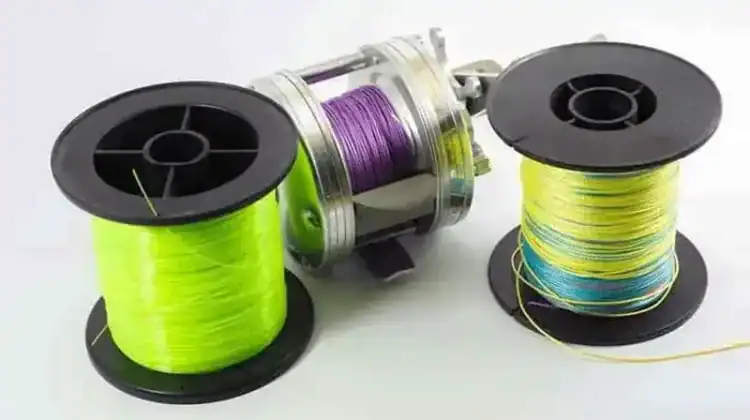
Braided Fishing Line
In the first few years of the 1990s, manufacturers began developing different types of fibers that could be braided together, offering improved quality. Braided fishing lines are trendy because they can be used in different conditions.
Benefits
Let’s dig a little deeper and first get familiar with the braided fishing line’s pluses (good) and minuses (bad).
Diameter
Many people prefer braided fishing line because of its small diameter. It surpasses the other two lines by cutting through the water more easily.
Durability
Due to its very high resistance to abrasion and UV radiation, it lasts longer than the rest.
Moreover, manufacturers vouch for its 15 times greater abrasion resistance than steel wire. Yes, you heard it right!
No Stretch
Braided fishing lines exhibit little to no stretch. I know this sounds like a problem, but if you know how to set the drag on reels, it shouldn’t be a problem. Once again, it would help if you had practiced.
You can feel the fish bite instantly due to the stiffness. However, since these lines are very strong, the fish bite won’t break them.
Strength
It is difficult to break these lines as several fibers are woven together. This is one reason why braided fishing lines have a small diameter and increased strength.
Drawbacks
Let’s not forget about the other side of the coin. Luckily, these fishing lines do not have any severe drawbacks you can’t tackle.
Visibility
Yes, visibility could be an issue with a braided fishing line. However, you can tie a mono or fluoro line to extend your braided line because it is less visible in water. This way, the braided line won’t spook the fish away.
If you use a braided line with no leads, the fish will easily see the string and not get trapped.
Costly
Braid lines are pricey, but considering their long-term durability, I think they are worth the money.
When Should You Use a Braided Fishing Line?
It’s pretty clear from the above discussion that braided fishing lines offer more benefits than the other two. However, knowing when to use braided fishing line is essential before you fish.
Yes, there are a few situations when a braiding line isn’t a good idea. But first, we will discuss when to use a braided fishing line.
In and Around Heavy Cover
Since braided fishing lines have remarkable abrasion resistance, you won’t have trouble fishing on rough surfaces and rocky terrains.
Bass fishermen use these lines on heavy water vegetation because they can yank it out without stripping it.
Deep-Sea Fishing
If you want to go further and try deep-sea fishing, a braided line can help. Due to its lack of stretch and small diameter, you can plug this line deeper.
You know what’s more interesting? It can withstand the high current of waves several feet below the surface, making it the best choice for deep-sea fishing.
When Targeting Giant Fish
So you had your way with small fish, and now, you aim to catch the bigger one. No matter how tough the fish bite is, it’s not enough to damage the line. The sharper teeth won’t make any difference either.
People mostly use this line when targeting catfish. However, you can also catch sharks, tunas, kingfish, and many more.
Fishing With Live Bait
If you want to spice up your fishing trip, you can use live bait to set a trap. It’s fun and effective. There are many baits you can hook with your braided line. I am listing a few of them to give you a sense of the whole.
- Carolina rigs
- Topwater rigs
- Spoons
- Drop shotting
Going for Jigging
You can also use a braided fishing line when fishing with a jig. Jigs create a jerky, vertical motion in the water, so you need something to cross several feet down. Due to this reason, a braided fishing line outweighs the other types.
Moreover, these lines offer minimal stretch, which makes them ideal for jigging. Less stretch means fewer chances for your prey to escape. You will feel the pull at the first bite.
Surf Fishing
If you are going surf fishing, you will need a braided line. You can easily cast long distances in seawater if your fishing line has excellent tensile strength, good abrasion resistance, and low memory.
When Should You Not Use a Braid?
Does it sound like a braided fishing line wins the trophy? Well, not every scenario is the same. For instance, fishermen prefer mono or fluorocarbon lines for crank baiting and trolling. Experts recommend avoiding braided fishing lines in these two scenarios.
Final Thoughts
-
Sizing Up Your Fishing Environment: Deciding when to spool up with a braided line comes down to the terrain you are fishing and the size of your target prey. If you are casting into thick underwater jungles, fishing rough rocky bottoms, or battling massive deep-sea monsters, braid acts like a tank in a swordfight, offering heavy-duty performance that traditional lines cannot match.
-
Balancing Line Types for Success: No single line wins every trophy, and understanding the trade-offs is key. Monofilament offers beginner-friendly stretch and affordability, while fluorocarbon gives you complete underwater invisibility; however, braid provides the long-term investment value, structural toughness, and UV resistance that outlast them both.
-
The Ultimate Hybrid Strategy: To get the absolute most out of your time on the water, look at braid not as a rigid single option, but as the strong backbone of a hybrid setup. By running a durable braided main line for casting distance and power, and capping it with a clear mono or fluoro leader, you overcome the line’s visibility flaws and create an unstoppable presentation for any off-road angling adventure.