
Thank you for reading our post, please rate this article at the end.
Reading Time: 7 minutesLast Updated on February 23, 2026 by Paul Clayton
Table of Contents
Easy Guide to Using a Flasher for Ice Fishing
Key Takeaways
-
- Sonar Fundamentals: Flashers use sonar to identify the bottom, your jig, and fish. Denser objects create wider signals, with colors typically progressing from green (least dense/fringe) to yellow to red (most dense/center).
- Transducer Placement: For the clearest image, the transducer should be lowered below the bottom edge of the ice hole to prevent the signal from bouncing off the ice hole walls.
- Depth Calibration: To get the best resolution, set your flasher’s depth range to one increment above the actual water depth (e.g., set to 40 feet for 36 feet of water).
- The Power of Gain: The “Gain” setting controls the sensitivity. The best practice is to turn it up until interference appears, then dial it back until the screen clears, ensuring your lure shows as a thin, crisp line.
- Strategic Zoom: Use the zoom function to focus on the specific “strike zone” (e.g., the bottom 10 feet for walleye) to see fine movements of fish reacting to your bait.
- Real-Time Feedback: The primary benefit is the ability to see a fish’s reaction to your jigging. If a fish moves away, you can immediately change your cadence to entice it back.
- Buying Essentials: Prioritize portability, a high-quality transducer, and a unit that offers a balance between sonar power and battery longevity.
At first glance, flashers can seem mysterious and complicated. A display may show a myriad of colors that can be challenging to decipher unless you know what you’re looking for. Furthermore, some people seem to believe that flashers are meant to attract fish to a location.
However, they don’t need to be complicated and can be easy to understand once you know a little bit about them. Within this article, we’re aiming to remove some of the mystery surrounding flashers, and we’re confident you’ll be expertly using a flasher on your next ice fishing trip.
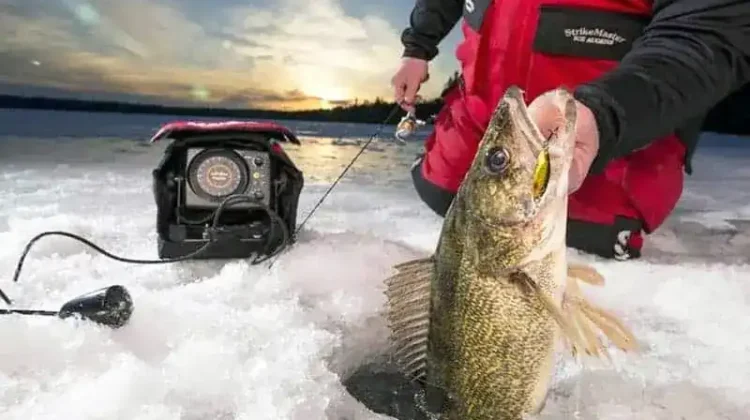
Firstly, flashers are merely portable sonar units. Once configured, they will allow the operator to see what’s happening beneath the water’s surface. You can see the bottom of the body of water, your jig, and any fish that pass under the beam of the sonar. The denser an object is, the wider the signal it will show on the flasher display.
The color will also change with the object’s density, progressing from green to yellow to orange. For example, the soft, silt-laden bottom of a lake may start as a narrow green line, which then thickens into a red line to indicate the rocky, harder bottom beneath the silt. Similarly, baitfish can appear as thin green lines, while larger predatory fish may show thicker red or yellow lines.
Related content you may be interested in reviewing.
-
- The Best Fish Finders: Reviewed and Rated
- Garmin STRIKER 4 GPS Fish Finder Review
- Venterior VT-FF001 Portable Fish Finder Review
- Lowrance HDS-7 Fish Finder with Transducer Review
- Humminbird Helix 5 Chirp GPS G3 Fish Finder Review
- Can I Use a Fish Finder for Ice Fishing?
- Garmin STRIKER Plus 7sv Transducer Review
- 7 How To Use Tips for Portable Fish Finders
How to Use a Flasher for Ice Fishing
Even experienced ice-fishing veterans might not be using their flashers to their full  potential. A few small adjustments can make a big difference to what you’re seeing beneath the waves, which in turn can mean bigger catches and more exciting fishing trips.
Step 1. Lower the Transducer
Once you’ve wired everything together and turned the flasher on, lower the transducer into your ice hole. It’s a good idea to make sure the transducer sits below the bottom of the ice edge, especially with older models. Not doing this can cause the sonar to bounce off the sides of the ice hole, resulting in a muddled, unclear image.
Newer models are less susceptible to this interference, but we still recommend it as part of best practices.
Step 2. Set the Depth
Most flashers are capable of reading anywhere from one foot all the way up to 250 feet of water. To maximize the utility of your flasher, it’s a good idea to know how deep the water is where you’re fishing. This information can normally be found online by consulting a hydrographic map or by consulting other anglers or tools.
To maximize the usefulness of the readings you’re getting, set the bottom depth of the flasher to one step above the actual depth of the water. For example, if you’re fishing in 36 feet of water, set the flasher bottom to 40 feet.
Step 3. Fine-tune the Gain
The gain is basically the power that the transducer will use to create a picture of what’s going on underneath the ice. As the sonar signal leaves the transducer, it travels downward in a cone-shaped beam, bouncing off objects until it eventually hits the bottom and is reflected back to the surface. If you’re fishing in deep water, the transducer will need more power to bounce the sonar off the bottom.
To start the tuning process, turn the gain up until you see significant interference, then slowly turn it down until the screen begins to clear. This method allows you to maximize gain with minimal interference, which, in turn, means you’ll have the best chance of detecting anything entering your water column.
Step 4. Use the Zoom
Using the zoom function on your flasher is a great way to maximize the resolution and sensitivity of what’s displayed on it. Focus on the area where you’re fishing or where you’re expecting the fish to be. For example, if you’re looking to catch some bottom dwellers, such as walleye, and you’re fishing in 40 feet of water, then zoom in so that only the bottom 10 feet are displayed.
Unfortunately, every flash zoom works differently, so you’ll need to consult the user manual to see how to do this with your model.
Step 5. Start Fishing
Once you drop your jig or lure into the ice hold, you ought to see it clearly represented on the flasher’s screen as a solid bar. At this point, you may need to further tune the flasher’s gain to make the lure show as a very thin line. This has the benefit of making other fish movements easily distinguishable.
If your lure is flickering or doesn’t show as a solid line, turn up the gain until it does. If you see any new lines appearing, then these are either going to be baitfish or, fingers crossed, the catch of the day.
Why Use a Flasher
The biggest advantage of using a flasher when ice fishing is that it allows you to see what’s happening beneath the ice. Once you’re experienced using a flasher, you can use it to watch your jig, to see how high you are lifting it, how it’s moving, and where it is relative to the fish. When a fish takes an interest in the jig, you’ll see a yellow or red solid line approach your lure, which will normally show as a green line.
As the fish moves even closer, the lines may well converge, indicating a strike is imminent. If the fish loses interest and begins to move away, you can adjust the movement of the lure to entice the fish back.
This obviously offers many benefits, as you can see in real time if your jig movement is interesting, if the fish are in the area, and if a change of lure or movement has had a positive or negative effect on enticing fish. Without access to a flasher, an angler is blind to all of this information and relies solely on intuition and what may have worked on previous fishing trips.
Frequently Asked Questions
Q: Does a flasher actually attract fish to my hole?
No. A flasher is a portable sonar unit, not a lure. Its purpose is to show you what is happening underwater—such as the depth, the location of your jig, and the presence of fish, rather than pulling fish into the area.
Q: What do the different colors on the display mean?
Colors represent the density and position of an object within the sonar beam. Generally, signals progress from green (least dense or on the outer edge of the cone) to yellow, and finally to red (densest or directly under the transducer). For example, a large predatory fish will show as a thick red or yellow line.
Q: Why is it important to lower the transducer below the ice?
You should position the transducer so it sits below the bottom edge of the ice hole. If it is too high, the sonar signal can bounce off the frozen sides of the hole, resulting in a muddled, unclear image on your screen.
Q: How do I properly set the “Gain” on my unit?
The best method is to turn the gain up until you see significant screen interference, then slowly turn it down until the display clears. You want the gain high enough to see your lure as a thin, solid line, but low as possible to minimize “noise” or “flicker.”
Q: How can a flasher tell me if a fish is about to bite?
On the display, your lure usually appears as a thin green line. When a fish approaches, you will see a solid yellow or red line move toward your lure. If the lines converge and stay together, a strike is likely imminent; if the fish line moves away, you know you need to change your jigging motion to get its attention back.
What to Look For When Buying an Ice Flasher
There are a few things to take into consideration when you’re looking to buy an ice flasher. To make your life easier, we’ve put together the most important factors for functionality and value for money.
Transducer: This is responsible for producing and receiving the sonar signal the unit uses to build a picture of what’s going on beneath the ice. Look for a model with good build quality from a reputable manufacturer.
Portability: You’ll want to select an ice flasher that is compact and easy to transport. Both the battery and the unit itself should easily fit in a backpack or even a custom carry case. Avoid anything bulky for ice fishing.
Data Representation: Most flashers are available with either a graphical view or textual details; both types offer various pros and cons. If possible, look for a flasher that has both options available on a single screen.
Cone Size: Look for an ice flasher with an adjustable cone to provide both a wide area and more focused viewing.
Power: The more power available, the better the performance and the greater the sonar’s penetration. Look for a balance between power and battery life.
Final Thoughts
Using a flasher transforms ice fishing from a game of guesswork into a data-driven sport. By mastering the settings for depth and gain, an angler can “see” through the ice to witness the high-stakes dance between predator and prey. While the spinning colors may seem daunting at first, they are simply a language that tells you exactly when to change your lure or prepare for a strike.
Flashers are an inexpensive way of understanding what is happening under the ice and are suitable for both experienced and beginner anglers alike.
One of the biggest selling points is the lack of maintenance required and ease of use. As long as the battery is charged and the flasher is wiped dry and cleaned after use, there’s very little that can go wrong with them. You can teach yourself to use a flasher in only a few minutes, after which you’ll know exactly why they are such great tools, and you’ll wonder how you ever went ice fishing without one before.