
Thank you for reading our post, please rate this article at the end.
Reading Time: 10 minutesLast Updated on December 17, 2025 by Paul Clayton
Table of Contents
Can You Park Your RV At Truck Stops In The US?
Key Takeaways
Feasibility & Logistics
- Yes, it is legal: You can generally park an RV at most truck stops (now often called “Travel Centers”), but you must follow specific facility rules.
- Trucker Priority: Truckers are legally mandated to rest after a certain number of driving hours. Since their parking options are limited by regulation, RVers must be considerate and never occupy spots designated strictly for commercial trucks.
- Safety & Security: Truck stops are considered safer than roadside parking or Walmart lots, though they are often noisy due to constant traffic and idling engines.
- Use Technology: Use apps like RVParky and Allstays to check availability, reviews, and the number of available parking spots before arriving.
Etiquette (The “Unspoken Rules”)
- No “Camping”: Truck stops are for resting, not vacationing. Do not extend slide-outs, set up patios, or use grills.
- Parking Behavior: Always back into spots. If designated RV spots are full, park in a back corner without blocking traffic.
- Support the Business: It is courteous to purchase fuel, food, or supplies from the truck stop in exchange for the parking space.
- Keep it Quiet: Minimize noise, as many drivers around you are trying to sleep.
Amenities & Major Chains
- Available Services: Most stops offer refueling, clean showers, laundry, WiFi, and sometimes medical offices or barber shops.
- Love’s: Offers dedicated RV hookups (power/water) at many locations. Prices range from $40–$50, and booking in advance via their app is advised.
- Pilot Flying J: Features over 750 locations. Some offer free first-come, first-served parking, while others have paid reservations.
- TravelCenters of America (TA): The largest full-service chain. They often have designated RV parks that serve as full-service alternatives to the standard truck lots.
Frequently Asked Questions
Q: Is it legal to park my RV at a truck stop overnight?
A: Yes. The article confirms that you can park an RV at virtually any truck stop, now often called “Travel Centers.” However, you must comply with state ordinances and the facility’s specific rules. It is highly recommended to call ahead or use an app to confirm availability.
Q: What is the most important etiquette I should follow when parking?
A: The most critical rule is to never park in a designated trucker’s spot, as truckers are legally mandated to rest and have limited options. Additionally, you should treat the stop as a place to rest, not a vacation. This means:
- Do not put out slide-outs or awnings.
- Do not set up patios or grills.
- Back into your spot.
- Support the business by purchasing fuel, food, or supplies.
Q: What amenities are available to RVers at these locations?
A: Modern truck stops have evolved into full-service travel centers. Beyond fuel, you can expect to find:
- Clean shower facilities and restrooms.
- Laundry services.
- WiFi (often better than RV parks).
- Convenience stores, restaurants, and occasionally medical offices or barbershops.
- Love’s specifically offers RV dumps and hookups at many locations.
Q: Is parking free, or do I need to pay?
A: It depends on the location and the chain.
- Free: Many spots are available on a first-come, first-served basis (like at some Pilot Flying J locations), though usage charges generally apply to amenities.
- Paid: Chains like Love’s offer dedicated RV hookups for $40 to $50, which can be booked in advance via their app.
Q: Is it safe to sleep at a truck stop?
A: Yes. The article states that truck stops are quite secure and certainly safer than parking on the side of the highway or in a Walmart parking lot. However, while secure, they can be very noisy due to the constant arrival and departure of trucks and idling engines.
- Today’s Best Pop-Up Campers
- New vs. Used RV: Navigating the Price Trends
- Can You Rent an RV for a Year?
Can You Park Your RV At Truck Stops In The US?
Have you ever found yourself desperately scouting for a safe and legal parking spot as you navigate your RV through the highway in the late hours? Maybe you’re behind schedule. Maybe the closest RV Park is still a sunrise away.
Or perhaps you want to recharge for a bit before being on your way.
Love’s has dedicated RV pads at several locations throughout the U.S., 360 in 28 states. Recently, Love’s has catered to RV owners.
So what are your options? Lucky for you, you can park your RV practically anywhere, according to most state parking ordinances.
But that doesn’t mean you should just pull up at the side of the highway.
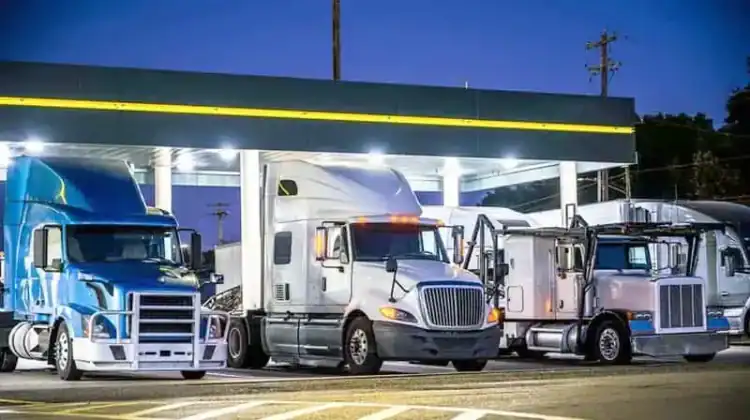
Then, there are your typical truck stops. These commercial facilities cater to motorists, truckers, and you guess it, RVers. But before you pull up into a truck stop for an overnight stay, you must remember that you’re not the only community of motorists looking for a rest station.
In this article, I will walk you through the do’s and don’ts, pros and cons, and logistics of parking your RV at a truck stop.
Can You Park Your RV at a Truck Stop?

Let’s get this out of the way. The short answer is: yes. You are allowed to park your RV at virtually any truck stop. Most truck stops have designated RV parking spots.
Truck stops are also dubbed “Travel Centers.” These Centers provide refueling, parking, and a range of amenities to different travelers. You’d be surprised at just how many facilities you can find at a truck stop. But more on that later.
First, let’s back up a little. At the very least, truck stops are supposed to provide refueling stations for trucks, rigs, and various types of large motorhomes. Be careful not to confuse these with motorway service or rest areas meant for smaller vehicles.
Truck stops are specially designed to accommodate large vehicles such as your beloved RV.
So what exactly is the problem then? Well, to understand the logistics of most modern truck stops, you must understand the context of state-specific parking ordinances and regulations of large motorized vehicles.
What Exactly is the Point of Contention?

So here’s the bitter truth. Over the past few decades, the trucking industry has undergone exponential corporatization. This increase is explicit in the shift from “Truck Stops” to “Travel Centers.” Franchises capitalize on the increasing needs of long-haulers.
Additionally, truckers are mandated by law to rest for a set number of hours before resuming their drive. This becomes problematic when strict regulations severely limit the parking options available to Truck Drivers.
In contrast, RVers can essentially park wherever, and that’s no exaggeration. Nor must they abide by unyielding driving laws.
So where does that leave you, a well-intentioned RVer who just wants to avail himself of the parking facilities to which he is already entitled? Basically, all of this was to say that you must always be considerate in your conduct at a truck stop.
A good rule of thumb is to call ahead and confirm if a truck stop has any available RV parking. Most of all, never, I repeat, never, park in a Trucker’s spot.
The Dos and Don’ts of Parking Your RV at a Truck Stop

So now you know that there are myriads of truck stop franchises dotting the highways and byways. You also understand that you can utilize the full extent of these facilities. Nevertheless, there are some implicit etiquettes of staying at truck stops.
Do This
I said it once, and I’ll say it again: always be mindful of the parking allocations. Calling ahead of time and double-checking with management is the most foolproof way to do this.
To do this, you need to know your options. Having at least one travel app will drastically reduce the hassle. Apps such as RVParky and Allstays are the best sources for reviews. Allstays are especially handy for tracking the number of RV parking spots available at any given stop.
Another unspoken rule is to always back into the parking spots. This is more so for your convenience than anyone else’s. If you find there are no parking spaces available, you can always park in the empty lot at the back corner. As long as you’re not blocking anyone’s way, you should be fine. Remember, if you are blocking “anything,” you should leave before the business opens.
Try to keep the noise to a minimum. Remember that most of the Truckers and RVers around you are probably looking to get a quick shut-eye.
But it doesn’t just end there. Once you’ve settled in, always make a point of doing your business at the truck stop. Yes, even when you’re stopping for just a few hours. Play fair and buy something. It’s just all in good spirits.
Don’t Do This
At the risk of sounding redundant, let me reassert this one more time. Do not park in a spot that is designated for other vehicles, no matter what.
On top of that, keep in mind that it is equally inappropriate to put out your slide, set up your patio, or bust out your grill. Remember, this is a truck stop, not an RV Park.
In the spirit of neighborliness, be careful not to hog the facilities. Again, just try to be as heedful and considerate as possible.
The Pros and Cons of Parking Your RV at a Truck Stop

When it comes to truck stops, you must remember that it is all about convenience. Truck stops are ideal if your only concern is quick and frugal replenishment. Technically, there are charges for utilizing the parking. However, they are almost negligible.
These truck stops are quite secure, notwithstanding the outdated stereotype of a dangerous environment. At least, they’re certainly more secure than the side of the highway or the parking lot of a Walmart.
While the convenience aspect is indisputable, there are a few major drawbacks to these facilities. Firstly, the constant noise of vehicles coming and going is very distressing. This is also because truck stops are always busy.
There is no set time for comings and goings. This means that you must be ready to deal with the persistent clamor
What Amenities Are Available for RVers at Truck Stops?

If anything good has resulted from truck stops’ corporatization, it’s that amenities have substantially increased. Essentially, happy customers mean a booming business. Accordingly, a booming business means repeated patronage.
Truck stops are great places to stock up on toiletries and other essentials. Most truck stops will have shower facilities of their own. These facilities are, by and large, well-stocked and clean. Similarly, some stops may have laundry facilities available.
Surprisingly, the WiFi services at some of these truck stops are better than those of most RV Parks.
But that’s not it. Some of the fancier truck spots will also have chain restaurants, medical offices, and barbershops. Very few franchises might even have casinos.
Most Popular Truck Stop Chains in the US
Love’s

Love’s is a privately owned family chain of truck stops and convenience stores throughout the US. They have 500 different stores across 41 states. This makes them one of the largest private companies.
Love’s offers an encompassing range of services and amenities. This includes refueling stations, RV repair and maintenance, restaurants, convenience stores, storage, showers, and RV dumps.
Love’s RV Hookups and RV Stops are conveniently located at Love’s Travel Stops across the country and offer RV travelers a safe, clean, and well-maintained place to stop on their journey. To assist you on your travel, Love’s has compiled a list of frequently asked questions and answers about our expanding RV network.
Individual site pricing is available on the Loves app at LovesRVStops.com and varies by season and occupancy. The prices range from $40 to $50. For the best rates and to take advantage of Senior, Military, and Good Sam discounts, it is often advisable to book in advance.
Most sites offer limited discounts for weekly and 28-day stays. Pricing is reduced in sites without full utility hookups.
Love’s offers around 30 locations and approximately 360 RV hookups. There are 28 RV hookups in the parking lot of a Love’s Travel Stop, and four bigger RV Stops adjacent to a Love’s Travel Stop with additional facilities. And Love’s is constantly expanding its RV spots.
A current list of locations can be found on the Love’s app or at LovesRVStops.com.
Pilot Flying J

Pilot Flying J operates a chain of truck stops in over 750 locations throughout North America and Canada.
Due to their vastness, Pilot Flying J travel centers offer an extensive range of amenities. These include parking, vehicle washes, accessories, laundry, game rooms, WiFi, ATMs, payphones, a Western Union, and large lounges.
You’ll also find that select Flying J truck stops offer free parking. Unfortunately, spots are limited and available on a first-come, first-served basis.
Overnight RV parking is usually available at Pilot Flying J locations. Many have RV-specific parking places or zones, while others allow RVs to pay to reserve slots. There’s even a website dedicated to the facilities available to RVers en route, along with ways to save money on services.
Travel Centers of America

TravelCenters of America is the oldest and largest full-service truck stop in the US. Service centers, convenience stores, and restaurants are among the many operations of this franchise.
TA. TA Express and Petro Stopping Centers contain everything you might need, whether you just need gas and a snack or to stretch your legs and let the dog out before tossing in a load of laundry and enjoying a hot shower.
Have you forgotten something? Our stores stock thousands of items, so please let us know if you need assistance finding anything.
It has over 270 centers across 43 states.
TravelCenters actually has designated RV parks that are equivalent to truck stops. These provide overnight parking to RVers along with RV-specific services. These parks are great full-service alternatives to designated truck stops.
Final Thoughts
Parking an RV at a truck stop is a viable, secure, and amenity-rich option for travelers needing a rest, provided they respect the ecosystem of the “Travel Center.” While the corporatization of chains like Love’s and Pilot Flying J has led to better facilities and dedicated RV hookups, the primary rule remains courtesy.
RVers must remember that while they choose to stop, truckers are mandated to stop. Therefore, success relies on proper etiquette, avoiding trucker-specific lanes, keeping a low profile (no “setting up camp”), and supporting the business financially.
Home page
Back to the top of the page