

Thank you for reading our post, please rate this article at the end.
Reading Time: 4 minutesLast Updated on November 6, 2026 by Paul Clayton
Do RV solar panels work on cloudy days? Yes, they still produce power, just much less of it. Under heavy overcast, panels often make only around 10% to 25% of their rated output, while thin or broken clouds cost less. To keep your batteries charged through gray weather, you need more panel wattage than you’d use in full sun, enough battery storage to carry you through a few dull days, an MPPT charge controller, and a backup charging source like a generator or your vehicle’s alternator.
Part of our guides: RV Air Conditioning Troubleshooting Guide and RV Power Guide
Table of Contents
Key Takeaways
| Topic | Key takeaway |
|---|---|
| Cloudy-day output | Panels still produce, often a fraction of their rated output |
| Add capacity | Extra panels help make up for weaker light |
| Batteries | Lithium batteries store more usable power for cloudy stretches |
| Tilt and clean | Angle panels toward the sun and keep them clean |
| Backup | A generator or shore power covers long gray spells |
What can your solar run?
Check off what you use in your RV, set your panels and battery, and see how much of your day the sun covers. Change the weather or the panel count and watch the answer move. Battery and solar only, no generator, no shore power.
Today's energy budget
Daily energy
Limit checks
Weight you're adding
Add this to your loaded trailer weight in the Towing Calculator. On a motorhome or truck camper it comes out of your payload.
How Clouds Affect RV Solar Output
| Conditions | Rough output vs. full sun |
|---|---|
| Full sun, panel facing the sun | Close to rated output (less in heat) |
| Light haze or thin clouds | Often well over half |
| Broken clouds | Swings up and down as clouds pass |
| Heavy overcast or rain | Often around 10% to 25% |
| Shade from trees or buildings | Can drop output sharply, even in sun |
These are general ranges. Panel type, angle, temperature and how dark the clouds are all change the result. Shade is often a bigger problem than clouds, because shading part of a panel can cut its output far more than you’d expect.
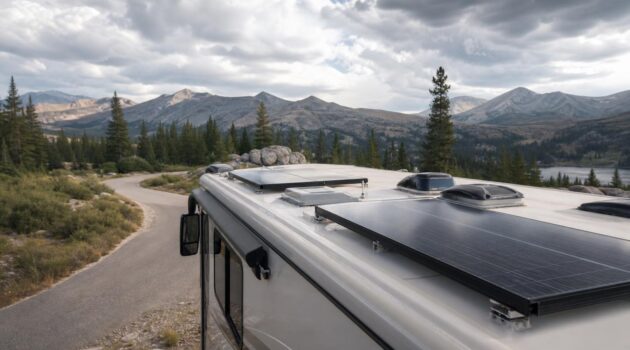
8 Ways to Get More Solar Power on Cloudy Days
1. Add more panel wattage
The simplest fix. If you need a certain amount of energy per day, size your array so that even a cloudy day’s output covers your essentials. Use our guide to how much solar power you need for your RV to work out your daily use.
2. Increase battery storage
Batteries let you bank energy on sunny days and use it when it’s cloudy. Lithium (LiFePO4) batteries can be drawn down much further than lead-acid ones, so you get more usable energy from the same rated capacity.
3. Use an MPPT charge controller
An MPPT controller pulls more power from panels than a basic PWM controller, especially in low light, cold weather, and when panel voltage is higher than battery voltage.
4. Add a portable panel
A portable or foldable panel can be placed in the brightest spot and aimed at the sun, even when your RV is parked in shade. See our FlexSolar C100W foldable panel review and our list of the best RV solar panels.
5. Tilt and clean your panels
Tilting roof panels toward the sun and keeping them clean of dust, pollen and bird droppings squeezes out more power in any weather.
6. Park for the sun
When you pick a site, avoid tall trees on the south side (in the Northern Hemisphere) and park where your panels get the longest clear exposure.
7. Cut your power use
On cloudy days, switch to LED lights, turn off inverters when not needed, avoid electric heating and cooking, and charge devices during the brightest part of the day.
8. Keep a backup charging source
A generator, DC-DC charger from your tow vehicle or motorhome alternator, or shore power when available fills the gap after several dark days.
What Solar Can and Can’t Run on a Cloudy Day
- Usually fine: lights, water pump, fans, phones, laptops, a 12V fridge with enough battery.
- Harder: microwaves, coffee makers and hair dryers, which draw a lot of power through an inverter.
- Very hard: air conditioners. Read whether solar panels can power an RV air conditioner.
Other Solar Options
Solar awnings and flexible panels add charging surface without taking up more roof space. See our picks for the best solar awnings for off-grid RVing.
Frequently Asked Questions
Do RV solar panels work on cloudy days?
Yes, but output drops. Heavy overcast often cuts it to around 10% to 25% of rated power.
Do solar panels charge in the rain?
A little. Rain usually means thick clouds, so output is low, but rain does help clean the panels.
How many days can I go without sun?
It depends on battery capacity and how much power you use. Many off-grid RVers plan for at least two to three days of storage plus a backup charger.
Are some solar panels better in cloudy weather?
Monocrystalline panels generally perform somewhat better in low light than older or cheaper panels, and an MPPT controller helps any panel make the most of dim conditions.
Final Thoughts
Solar doesn’t stop on cloudy days, it just slows down. Oversize your array a bit, store energy in a good battery bank, cut your loads and keep a backup charging option for long stretches of bad weather.
Resources
- Solar panel manufacturers’ performance specifications
- U.S. Department of Energy solar energy basics




