

Thank you for reading our post, please rate this article at the end.
Reading Time: 7 minutesLast Updated on November 15, 2026 by Paul Clayton
How much does it cost to ship an RV overseas? For ocean freight alone, expect roughly $100 to $300 per foot of RV, so a 30-foot motorhome typically costs about $3,000 to $9,000 to ship from a US port to Western Europe by roll-on/roll-off (RoRo) vessel. Longer routes such as Australia or New Zealand, oversized rigs that need a flat rack, and door-to-door service push the total higher, and once you add port fees, marine insurance, customs brokerage, and import duties and taxes at the destination, the real cost is often $5,000 to $20,000 or more.
Below is a breakdown of every cost, the export and import paperwork, the shipping methods available, and whether shipping your own RV is worth it compared with renting or buying abroad.
Table of Contents
Key Takeaways
| Question | Short answer |
|---|---|
| Typical ocean freight | About $100 to $300 per foot by RoRo; a 30 ft RV is often $3,000 to $9,000 to Europe |
| All-in cost | Often $5,000 to $20,000+ including fees, insurance and taxes |
| Main shipping method | RoRo for most motorhomes and trailers; containers only for small vans and campers; flat rack for over-height rigs |
| US export paperwork | Clear title and documents presented to CBP at least 72 hours before export, plus an EEI filing in AES |
| Biggest hidden costs | Import duty and VAT, port storage, destination handling, compliance modifications |
| Transit time | Roughly 2 to 4 weeks to Europe and 4 to 8 weeks to Australia, port to port |
| Size watch-out | Most US RVs are 102 inches (2.59 m) wide, wider than the 2.55 m limit used across the EU and UK |
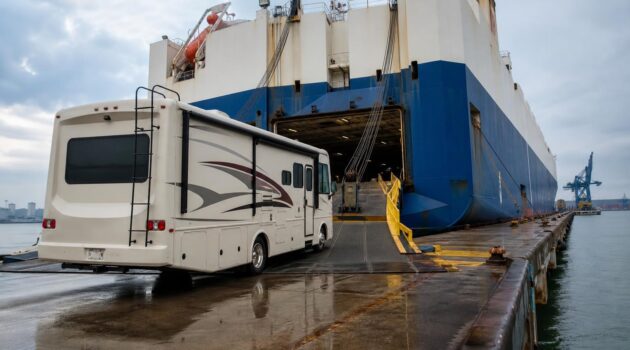
How Much Does It Cost to Ship an RV Overseas by Route?
Ocean freight for RVs is usually priced by volume (length x width x height) or by length. These rounded ranges are for port-to-port RoRo service on a typical motorhome or travel trailer and are planning figures only; carriers change rates often, so get several written quotes.
| Route (from US ports) | Small RV / camper van (under 22 ft) | Mid-size RV (25 to 32 ft) | Large Class A (35 to 45 ft) |
|---|---|---|---|
| To Western Europe (UK, Germany, Belgium, Netherlands) | $2,000 to $4,500 | $3,000 to $9,000 | $6,000 to $14,000 |
| To Mediterranean or Scandinavia | $2,500 to $5,500 | $4,000 to $10,000 | $7,000 to $15,000 |
| To Australia or New Zealand | $3,500 to $7,000 | $6,000 to $13,000 | $10,000 to $20,000+ |
| To Central or South America | $2,000 to $5,000 | $3,500 to $9,000 | $6,000 to $14,000 |
Other costs to budget for
| Cost | Typical range |
|---|---|
| Trucking or driving to the US port | $0 if you drive it; roughly $1 to $3 per mile for transport |
| US port and terminal handling | $200 to $800 |
| Export documentation and EEI filing by your shipper | $100 to $400 |
| Marine cargo insurance | About 1.5% to 3% of the RV’s value |
| Destination port handling and unloading | $500 to $1,500 |
| Customs broker at destination | $300 to $1,000 |
| Import duty and VAT or GST (permanent import) | Often 15% to 35%+ of the RV’s value combined, depending on country |
| Compliance work, inspection and registration | A few hundred to several thousand dollars |
| Port storage if delayed | Commonly $25 to $100+ per day after free time |
For comparison, shipping a boat follows a similar pricing model; see our guide on how much it costs to ship a houseboat.
How RVs Are Shipped Overseas
| Method | Best for | Pros | Cons |
|---|---|---|---|
| Roll-on/roll-off (RoRo) | Most motorhomes, fifth wheels and travel trailers | Usually the cheapest; RV is driven or towed on and secured on a covered vehicle deck | Limited sailings to some ports; personal belongings usually not allowed inside |
| Container (20 ft or 40 ft high cube) | Small camper vans, truck campers, pop-ups, teardrops | Fully enclosed; you can often ship belongings with the vehicle | Height and width limits of about 8.5 ft rule out most RVs |
| Flat rack | Over-height or oversized rigs and bus conversions | Handles almost any size | Most expensive; RV is exposed to weather and spray |
Small rigs such as those in our list of lightweight teardrop trailers often fit inside a container, which can be cheaper than RoRo for a single small unit and lets you pack gear. A full-size Class A almost always goes RoRo. Shipping companies such as Schumacher Cargo Logistics let you get a quote for your RV shipping online, and it is worth comparing at least three providers.
Paperwork for Shipping an RV Overseas
Exporting from the United States
- Original title or certified copy. US Customs and Border Protection (CBP) rules for used self-propelled vehicles require the ownership documents and vehicle information to be presented to CBP at the port at least 72 hours before export. Your shipping agent usually handles the submission.
- Electronic Export Information (EEI). Used vehicles need an EEI filing in the Automated Export System (AES), which produces an Internal Transaction Number (ITN) that goes with your title documents.
- Lien release or lender letter. If the RV is financed, you need a letter from the lienholder authorizing export.
- Bill of sale if you recently bought the RV, and a valid passport or ID.
Importing at the destination
- Temporary vs permanent import. Many countries allow visitors to bring a foreign-registered vehicle in temporarily without paying full duty, typically with time limits and conditions. For example, the EU allows temporary admission for non-residents, commonly up to six months in a twelve-month period; check the rules for your entry country. Some countries use a carnet de passages instead. Permanent import triggers duty, VAT or GST and vehicle compliance rules.
- Size and weight rules. Most US RVs are 102 inches (2.59 m) wide, while the EU and UK use a general 2.55 m width limit, so many US RVs face registration or road-legal problems in Europe. Heavy motorhomes over 3,500 kg can also require a higher license category for European drivers.
- Australia and New Zealand. These countries require import approval before shipping, enforce strict biosecurity cleaning (any soil, seeds or insects can mean expensive cleaning or refusal), and have rules on left-hand-drive vehicles.
- Insurance and registration. You need local third-party liability insurance to drive. US RV insurance generally does not cover you abroad; our guide on RV insurance costs explains what US policies typically include.
Rules change and differ widely by country, so confirm current requirements with the destination country’s customs agency and a licensed customs broker before you book.
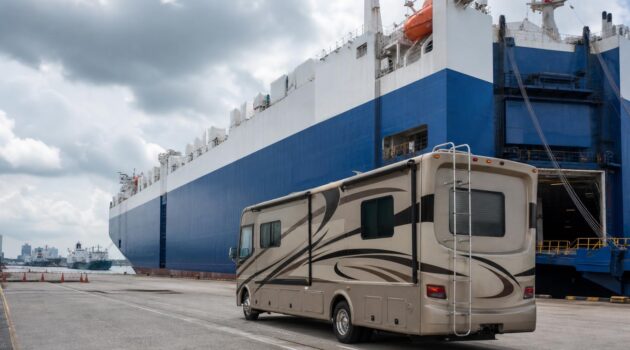
How to Prepare an RV for International Shipping
- Clean it inside and out, including the underside, wheel wells and awnings. Destination countries can hold or reject dirty vehicles, and Australia and New Zealand are especially strict.
- Empty personal belongings unless your shipper explicitly allows them. Most RoRo carriers prohibit loose cargo inside vehicles.
- Turn off and secure propane. Close tank valves; many carriers require propane tanks to be empty or removed, and some require a purge certificate. Ask your carrier for its exact rule.
- Leave about a quarter tank of fuel or less, per the carrier’s limit.
- Drain fresh, gray and black water tanks and winterize the plumbing if it will pass through cold climates.
- Secure the interior. Latch cabinets, drawers, the fridge and doors, retract slides, lower antennas and secure roof vents.
- Check mechanicals. Fix fluid leaks, charge or disconnect the batteries, check tires and brakes, and make sure air brakes build pressure, because the RV must be driven on and off the ship.
- Photograph everything, inside and out, with date stamps, and record the mileage for any damage claim.
- Hand over a full set of keys and written instructions for starting, leveling jacks and slides.
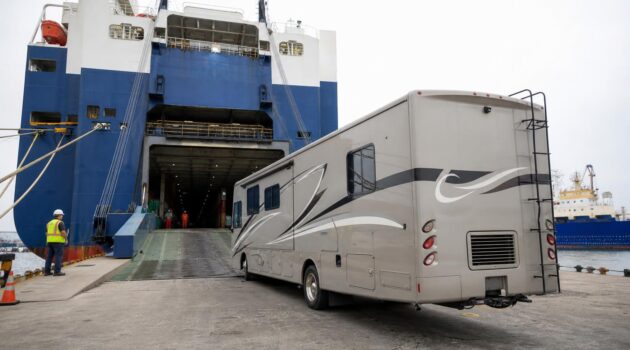
Is It Worth Shipping an RV Overseas?
| Option | Makes sense when | Rough cost picture |
|---|---|---|
| Ship your own RV | Trips of several months or longer, a small rig that fits local roads, or a permanent move | $5,000 to $20,000+ one way, plus local insurance and fuel |
| Rent abroad | Trips of a few weeks | Often $100 to $300+ per night in peak season |
| Buy abroad and sell at the end | Long trips of six months or more | Purchase price minus resale value, plus registration and insurance |
For most trips under two or three months, renting is cheaper and avoids the size and compliance headaches. See our guides to budgeting for RV rentals and ownership and RVshare vs Outdoorsy to compare rental costs. Shipping makes the most sense for smaller, self-built or highly customized rigs and long overland journeys.
How Much Does It Cost to Ship an RV Overseas FAQ
How long does it take to ship an RV overseas?
Ocean transit is roughly 2 to 4 weeks to Europe and 4 to 8 weeks to Australia or New Zealand, but allow extra time for port scheduling, customs clearance and inspections. Plan on 4 to 10 weeks door to door.
Can I pack my belongings in my RV when shipping?
Usually not on RoRo ships, which generally require the vehicle to be empty apart from standard equipment. Container shipping is the main way to send belongings with the vehicle, and they must be declared.
Can I ship a travel trailer or fifth wheel overseas?
Yes. Towables go RoRo on a roll trailer or are towed aboard, and pricing is still based on size. Small trailers may fit in a container.
Do I have to pay import duty on my RV?
For a temporary visit, many countries let you avoid duty if you meet their temporary admission rules and take the RV out again on time. For a permanent import, expect duty plus VAT or GST, which together can add a large percentage of the RV’s value.
Is it cheaper to ship an RV from the East or West Coast?
Ship from the coast closest to your destination: East Coast or Gulf ports for Europe, and West Coast ports for Australia, New Zealand and Asia. Getting the RV to the right port is often cheaper than a longer sea route.
Final Thoughts
Shipping an RV overseas typically costs $100 to $300 per foot in ocean freight, or about $3,000 to $9,000 for a 30-foot RV to Europe, but port fees, insurance, brokerage, compliance work and import taxes can double that or more. Check the destination’s size, weight and import rules before you book, get at least three written quotes, prepare the RV carefully, and compare the total against renting or buying locally. For long trips in a rig that fits local roads, shipping can be worth it; for short trips, renting usually wins.
Resources
- US Customs and Border Protection – Exporting a motor vehicle
- Code of Federal Regulations – 19 CFR Part 192, Export Control
- US Census Bureau – Automated Export System (AES) and EEI filing
- European Commission – Temporary admission of vehicles and vehicle dimension rules
- Australian Department of Infrastructure – Road Vehicle Standards import approvals
- Australian Department of Agriculture – Biosecurity requirements for imported vehicles




