Thank you for reading our post, please rate this article at the end.
Reading Time: 3 minutesLast Updated on November 20, 2026 by Paul Clayton
Choosing a UTV or ATV for a farm comes down to the work: a UTV is better for hauling heavy loads, carrying passengers and towing, while an ATV is better for quick, nimble jobs like checking fences, herding and spraying in tight spaces. Many farms with big chores and crews choose a UTV, and many small farms and ranches get by with a utility ATV that costs less and fits more places.

Table of Contents
Key Takeaways
| Feature | UTV (side-by-side) | ATV (quad) |
|---|---|---|
| Seating | 2 to 6 people | Usually 1 rider |
| Cargo | Dump bed, often 500 to 1,500+ lb | Front and rear racks |
| Towing | Often 1,000 to 2,500+ lb | Often 500 to 1,500 lb |
| Maneuverability | Wider and less nimble | Narrow and agile |
| Safety | Roll cage, seat belts | No cage; rider skill matters more |
| Typical price | Roughly $10,000 to $25,000+ | Roughly $6,000 to $15,000 |
UTVs on the Farm
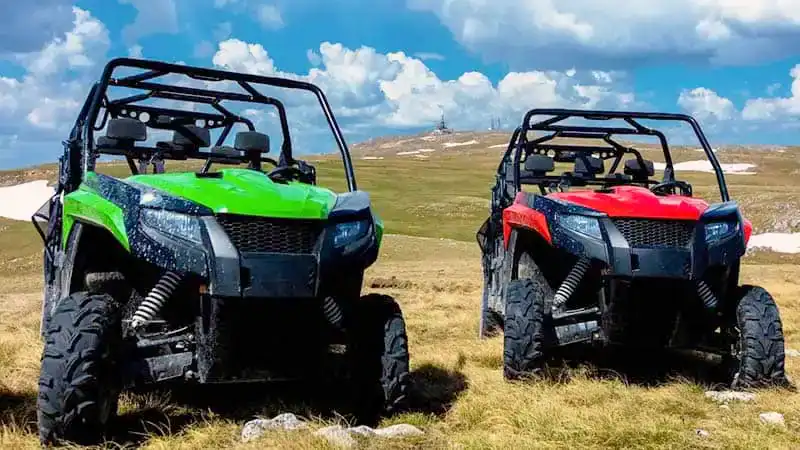
A UTV, or side-by-side, has a steering wheel, bench or bucket seats, a roll cage and a cargo bed. That makes it the workhorse for hauling feed, tools, fencing supplies and hay bales, and for carrying workers or family. Many offer cabs, heaters and windshields for year-round use. Electric UTVs are quiet around livestock; see the best electric utility vehicles and the quietest UTVs.

ATVs on the Farm
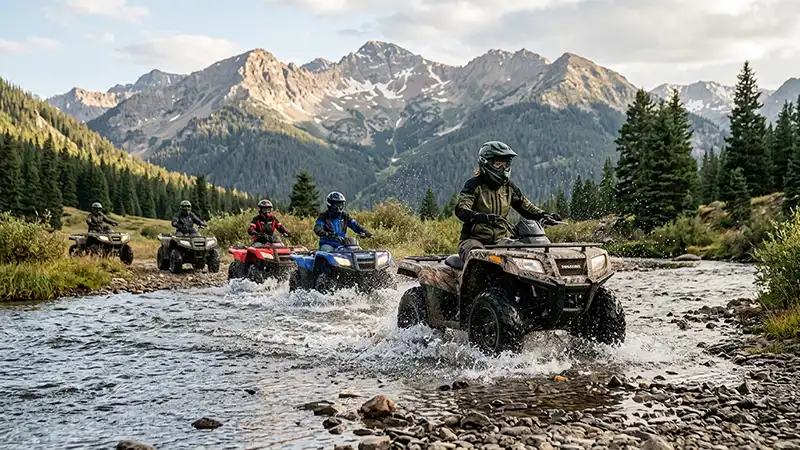
A utility ATV is narrower, lighter and quicker to hop on and off. It’s ideal for checking fences and water, moving cattle, spraying weeds with a tank sprayer and getting through gates and narrow trails. ATVs also cost less to buy and maintain. Learn more in what is an ATV quad bike and what kind of ATV you should get.

UTV or ATV for a Farm: Which Should You Choose?
- Choose a UTV if: you haul heavy loads, carry passengers, tow trailers or want weather protection.
- Choose an ATV if: you need agility, work alone, have tight spaces or a smaller budget.
- Consider both: Large operations often use a UTV for hauling and an ATV for quick checks.
Good all-terrain tires, such as SuperATV Intimidator tires, help either machine in mud. For wet ground, some farms even look at amphibious machines like the Gibbs Terraquad. For extreme wet or remote land, some owners look at amphibious machines; see how much a Sherp ATV costs.

Safety Tips for Farm Machines
- Wear a helmet on ATVs and use seat belts in UTVs.
- Don’t exceed load and towing limits.
- Take slopes straight up or down, not across.
- Keep kids off adult machines and never carry passengers on single-rider ATVs.
Planning road trips between fields? Check ATV road laws and whether side-by-sides are street legal. Texas farmers should also check whether ATVs are street legal in Texas.
Before you choose, check how wide an ATV is compared with a UTV so it fits your gates, trailer and trails.
FAQ: UTV or ATV for a Farm
Is a UTV or ATV better for a small farm?
An ATV often suits a small farm with light chores; a UTV is better if you haul a lot or carry passengers.
Can an ATV pull a trailer?
Yes, most utility ATVs can tow small trailers within their rated capacity.
Are UTVs safer than ATVs?
UTVs have roll cages and seat belts, which add protection when used properly.
Do UTVs scare livestock?
Loud engines can; electric or quieter models help.
Final Thoughts
The right UTV or ATV for a farm depends on your chores, crew and budget. UTVs win for hauling and passengers, while ATVs win for agility and cost. Match the machine to your daily work.
Resources
- Manufacturer specifications for towing and cargo capacity
- ATV Safety Institute and ROHVA, rider safety guidance