
Thank you for reading our post, please rate this article at the end.
Reading Time: 6 minutesLast Updated on November 15, 2026 by Paul Clayton
Yes, most deep sea fishing boats have bathrooms. Almost every licensed charter boat and party (head) boat that runs offshore has at least one marine toilet, called a head, and large party boats of 60 feet or more often have two or more. The exceptions are small center-console boats, usually under about 25 feet, which may have only a portable toilet inside the console or nothing at all, so always ask the captain before you book.
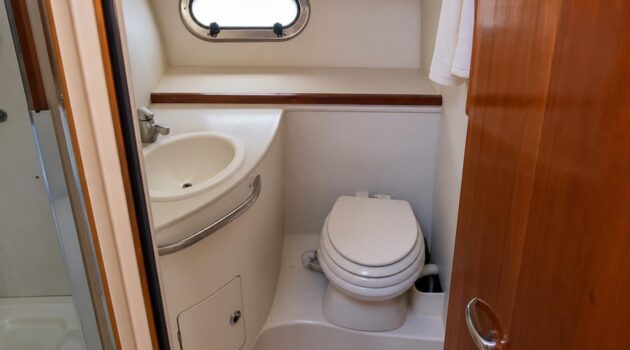
Table of Contents
Key Takeaways
| Boat type | Typical size | Bathroom? |
|---|---|---|
| Party or head boat (pay per person) | About 60 to 100+ ft, 30 to 100+ anglers | Yes, usually one or more enclosed restrooms |
| Private sportfishing charter | About 30 to 60 ft, up to 6 anglers | Yes, almost always an enclosed head in the cabin |
| Walk-around or express cabin boat | About 22 to 30 ft | Usually a small head in the cuddy cabin |
| Center console | About 20 to 30+ ft | Sometimes a portable toilet inside the console; small boats may have none |
| Small skiff or bay boat | Under about 22 ft | Usually no bathroom |
Why Deep Sea Fishing Boats Have Bathrooms
Offshore trips are long. A half-day trip usually runs four to six hours, a full day eight to twelve hours, and overnight or multi-day trips can last 24 hours or more. Fishing grounds may be 10 to 60-plus miles from port, so returning to the dock for a restroom break is not realistic. Charter and party boat operators know that customers will not book again if there is no bathroom, so a head is standard equipment on almost every boat that sells offshore trips.
Bathrooms are also a safety feature. Relieving yourself over the side of a moving boat is one of the classic ways people end up in the water, especially at night or in a swell. See our guide to what most often causes someone to fall overboard.
What a Deep Sea Fishing Boat Bathroom Is Like
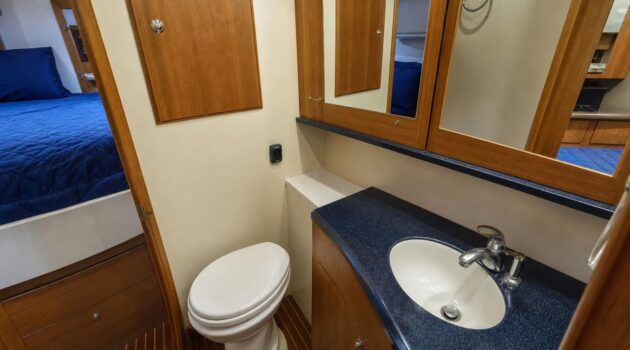
Do not expect a home bathroom. A marine head is compact, often in a small cabin below or behind the bridge, and the boat will be moving the whole time. Common setups include:
- Manual pump head: You pump a handle to flush seawater through the bowl. Simple and reliable, but follow the posted instructions exactly.
- Electric or macerating head: Push-button flush that grinds waste before it goes to the holding tank or treatment system. Common on newer charter boats and party boats.
- Portable toilet: A self-contained unit with a removable tank, often found inside the console of center-console boats.
Bathroom Etiquette on a Charter Boat
- Ask for a quick explanation from the mate before you need it. Every boat’s head works a little differently.
- Flush only human waste and the toilet paper provided. Wipes, paper towels and feminine products clog marine toilets and can end a trip early. Use the bin if there is one.
- Use small amounts of toilet paper; many boats supply marine-safe, quick-dissolving paper.
- Hold on. Brace yourself with a hand on a rail or the wall, and sit down even if you normally would not. Waves can throw you off balance.
- Do not lock yourself in if you feel seasick; the enclosed, moving space can make it worse. Tell the crew.
- Tell the mate if something is not working rather than trying to fix it yourself.
Where Does the Waste Go?
Boats with installed toilets must have a Coast Guard-certified marine sanitation device (MSD). There are three types:
| MSD type | How it works | Allowed on |
|---|---|---|
| Type I | Treats waste (maceration and disinfection) before discharge | Boats 65 ft and under |
| Type II | Higher level of treatment before discharge | Any size boat |
| Type III | Holding tank; no treatment, stores waste until pumped out ashore or discharged legally offshore | Any size boat |
Under federal law, untreated sewage cannot be discharged within 3 nautical miles of the U.S. coast or in inland waters. Treated discharge from a Type I or II device is allowed in most coastal waters, but in designated No Discharge Zones no sewage, treated or not, may be discharged, and holding tanks must be emptied at a pump-out station. Charter captains handle all of this; your part is to use the head properly.
How to Check Before You Book
- Ask directly: “Does the boat have an enclosed head, and is it working?”
- On a small private charter, ask whether the head is in an enclosed cabin or a console. A console toilet offers privacy but limited room.
- On party boats, ask how many restrooms there are for the number of passengers on a full trip.
- If you have a medical condition, are pregnant or are traveling with young children, mention it so the captain can recommend a suitable boat; see our tips on boating while pregnant.
- Read recent customer reviews for comments on cleanliness.
Private charters typically cost from about $500 to $1,000 for a half day and $1,000 to $3,000 or more for a full day, depending on boat size and port, while party boats usually run about $50 to $150 per person for a half day. Larger, higher-priced boats tend to have better facilities.
Tips for Using the Bathroom on a Fishing Trip
- Go before you board. Use the restroom at the marina even if you do not feel you need to.
- Stay hydrated anyway. Avoiding water to skip bathroom trips leads to dehydration, headaches and worse seasickness in the sun.
- Limit alcohol and heavy coffee; both make you need the head more and can worsen seasickness.
- Time your visits for calmer moments, such as when the boat is drifting or idling rather than running at speed.
- Bring a small personal kit with wipes (to throw in the trash, not the toilet), hand sanitizer and any sanitary products.
- On boats with no head, agree on a plan with the captain before leaving the dock. A bucket with a lid or a portable toilet is far safer than leaning over the rail.
Seasickness and the Head
Being below deck in a small enclosed space is one of the fastest ways to feel seasick. If you start to feel queasy, go back out on deck, look at the horizon and get fresh air. Take seasickness medication the night before and morning of the trip if you are prone to it, following the label. Vomit over the downwind side of the boat while holding onto something solid, not in the head. For more on offshore risks, read is deep sea fishing dangerous.
Deep Sea Fishing Boats Have Bathrooms FAQ
Do party boats have bathrooms?
Yes. Party or head boats that carry dozens of anglers almost always have at least one enclosed restroom, and larger boats often have two or more.
Do small charter boats have toilets?
Most sportfishing charters over about 30 feet have an enclosed head. Smaller center consoles may have a portable toilet in the console or none, so ask when you book.
Can you poop in a boat toilet?
Yes. Marine heads are designed for both urine and solid waste. Just flush only human waste and the toilet paper the crew provides.
What if the boat has no bathroom?
Go before leaving the dock, choose a shorter trip, and agree on a plan with the captain, such as a lidded bucket. Never urinate over the side of a moving boat without someone watching and a firm handhold.
Do boats dump sewage in the ocean?
Untreated sewage may not be discharged within 3 nautical miles of the U.S. coast, and no discharge at all is allowed in No Discharge Zones. Many boats store waste in a holding tank and pump it out at the marina.
Final Thoughts
Deep sea fishing boats have bathrooms on nearly every charter and party boat, so most anglers can book a full-day trip with confidence. The exceptions are small center consoles and skiffs, so ask the captain before booking, learn how the head works when you board, flush only what the crew allows, and keep a hand on a rail. A little preparation keeps the focus on the fishing.
If you are planning to fish from a smaller boat of your own, see how size and weight compare in our fishing boat weight guide, and for calm-water outings with facilities, browse pontoon boats with bathrooms.
Resources
- U.S. Coast Guard, Marine Sanitation Device regulations (33 CFR Part 159)
- U.S. Environmental Protection Agency, Vessel Sewage Discharges and No Discharge Zones
- NOAA Fisheries, recreational fishing information
- U.S. Coast Guard Boating Safety Division