
Thank you for reading our post, please rate this article at the end.
Reading Time: 3 minutesLast Updated on November 2, 2026 by Paul Clayton
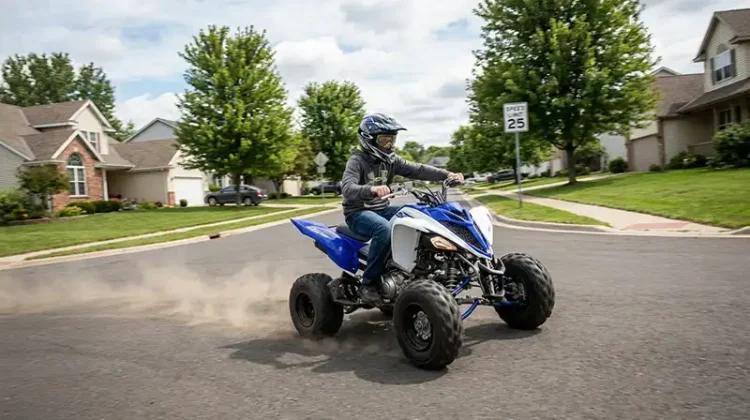
Is it legal to drive an ATV on the road? Usually not on busy public roads, but it depends on your state, county and town. ATVs are built as off-highway vehicles, so most states ban them from paved highways. Many allow short road crossings, farm or work use, designated ATV routes, or full street-legal registration once the machine has lights, mirrors, a horn and insurance. Always check state and local rules before riding on any road.

Table of Contents
Key Takeaways
| Situation | Usually allowed? |
|---|---|
| Highways and interstates | No |
| Crossing a road at a right angle | Often yes, with care and a valid license |
| Farm, ranch or utility work | Often yes, within set distances or speeds |
| Designated ATV routes or towns that allow them | Yes, under local rules |
| Street-legal registration | In some states, with equipment and insurance |
Why ATVs Aren’t Road Vehicles
Manufacturers design ATVs for off-highway use. Low-pressure tires, a solid rear axle on many models, a high center of gravity and no crash protection make them unstable on pavement. That’s why most warning labels say not to ride on public roads, and why many states classify ATVs as off-highway vehicles.

When It’s Legal to Drive an ATV on the Road
Road Crossings
Many states let riders cross a road at a 90-degree angle, after a full stop, to connect trails. Some require a driver’s license for crossings.
Work and Agricultural Use
Farmers, ranchers and utility workers often get exceptions for short trips on roads, usually with speed limits and daylight-only rules.
Designated Routes and Local Ordinances
Some counties and towns open roads to ATVs to connect trail systems. These routes are posted, and rules can change at city or county lines.
Street-Legal Registration
States such as Utah and Arizona let owners register an ATV for limited road use after adding required equipment. Other states don’t allow it at all.

What It Takes to Make an ATV Street Legal
- Headlight, taillight and brake light
- Turn signals, where required
- Mirrors and a horn
- DOT-approved tires, in some states
- License plate and registration
- Liability insurance; get a quote from Progressive ATV insurance
- A valid driver’s license and, often, a helmet
Learn more about whether a Polaris RZR is street legal and ATV road rules in Texas.
Canada and Other Countries
In Canada, provinces and municipalities control ATV road use. Some allow ATVs on certain roads or shoulders, while others restrict them. Other countries have their own rules, and some register quads as road vehicles.

Road Riding Safety Checklist
- Confirm state, county and town rules.
- Carry your license, registration and insurance.
- Wear a helmet and eye protection.
- Keep speeds low and stay to the right.
- Avoid riding at night unless allowed and equipped.
- Never carry a passenger on a single-rider ATV.
See also do you need a license to drive a dirt bike and our Tracker ATV ownership guide.
FAQ: Is It Legal to Drive an ATV on the Road?
Can I drive my ATV on the road to get to a trail?
Only where state or local rules allow it, often on posted connector routes.
Can I get a ticket for riding an ATV on the road?
Yes, riding where it isn’t allowed can bring fines and other penalties.
Do I need a driver’s license to ride an ATV on the road?
Usually yes, wherever road riding is permitted.
Can a side-by-side be street legal?
In some states, yes, with the right equipment and registration.
Final Thoughts
Whether it’s legal to drive an ATV on the road comes down to where you live. Most highways are off limits, but crossings, work use, local routes and street-legal registration open doors in many areas. Check your state and local rules first.
Resources
- State departments of motor vehicles and natural resources, ATV rules
- ATV Safety Institute, safety guidance
- Manufacturer owner’s manuals and warning labels