Thank you for reading our post, please rate this article at the end.
Reading Time: 5 minutesLast Updated on November 15, 2026 by Paul Clayton
How do tiny houses get electricity? In one of two ways: they connect to the grid, or they make their own power off-grid. Tiny houses on wheels usually plug into a 30- or 50-amp outlet just like an RV, while tiny houses on foundations get a permanent utility hookup with a meter. Off-grid tiny homes rely mostly on solar panels with a battery bank, often backed up by a generator and sometimes a small wind turbine. Many owners also use propane for cooking, heat and hot water to cut how much electricity they need.

Table of Contents
Key Takeaways
| Topic | Key takeaway |
|---|---|
| Grid hookup | Many tiny houses plug into shore power or a home connection |
| Solar | Popular for off-grid builds, paired with batteries |
| Generators | Common as backup power |
| Wind | Helpful in windy locations |
| Efficiency | LED lights and efficient appliances reduce needs |
Tiny House Power Options at a Glance
| Power source | Best for | Upfront cost | Main drawback |
|---|---|---|---|
| Grid hookup | Tiny homes in RV parks, communities or backyards | Low to high, depending on distance to the nearest line | Monthly bills; tied to one place |
| Solar + batteries | Off-grid and mobile tiny homes | About $8,000 to $30,000 | Weaker in winter and long cloudy stretches |
| Wind turbine | Open, consistently windy land | About $1,000 to $10,000+ for small systems | Needs steady wind and a tall mount |
| Generator | Backup power, short stays | About $500 to $5,000 | Fuel cost, noise, exhaust |
| Micro-hydro | Property with a year-round stream and drop | Varies widely | Rare site conditions; water rights |
1. Connecting to the Grid

Grid power is the simplest and most reliable option.
- Tiny houses on wheels are usually wired like RVs, with a shore power inlet. A 30-amp connection covers a modest home; a 50-amp connection gives room for an electric water heater, heat pump and cooking appliances at the same time. You can plug in at RV parks, tiny house communities or a pedestal installed on private land. Before choosing land, check what states allow tiny houses and the local zoning rules.
- Tiny houses on foundations are treated like small houses. A licensed electrician installs a service panel and the utility sets a meter. If the nearest power line is far away, trenching and new poles can make this the most expensive part of the build.
Before you buy land or park a tiny home, check whether your area allows it at all. Our guide to putting a tiny house on your property covers state rules.
Safety note: plugging a tiny house into a regular household outlet with an extension cord is a fire risk for anything more than very light loads. Use a dedicated, properly rated circuit.
2. Solar Power

Solar is the go-to choice for off-grid tiny homes. A complete system has four parts:
- Panels on the roof or on a ground mount (ground mounts are easier to angle and clean)
- A charge controller that regulates power into the batteries
- A battery bank, usually lithium iron phosphate (LiFePO4), to store power for night and cloudy days
- An inverter that turns battery power into standard household AC
Many off-grid tiny homes use somewhere around 2 to 6 kilowatts of panels and 10 to 30 kilowatt-hours of battery storage. Your size depends on climate, appliances and whether you heat or cool with electricity. All-in-one portable units can run a very small cabin or serve as backup; see our pick for the best portable solar generator. The same sizing math used for RVs applies, so our guides on how much solar power you need and the best RV solar panels are a good starting point.
3. Wind Power

A small wind turbine can charge the same battery bank as your solar panels, and it often produces the most power in winter and at night, when solar is weakest. The U.S. Department of Energy notes that small wind generally needs an average wind speed of at least about 9 mph to make sense. Turbines also need to sit well above nearby trees and buildings, and some areas restrict tower height. On wooded or sheltered sites, wind rarely pays off.
4. Generators

Gas, propane or dual-fuel generators are mostly used as backup to recharge batteries during long cloudy spells. Inverter generators are quieter and safer for electronics. Always run a generator outdoors, well away from windows and vents, and keep a working carbon monoxide detector inside.
5. Micro-Hydro
If your land has a stream that flows year-round with some vertical drop, a micro-hydro turbine can produce steady power day and night. It’s the most consistent off-grid source when conditions allow, but few sites qualify, and you may need water rights or permits.
How Much Electricity Does a Tiny House Use?
A typical U.S. home uses around 30 kilowatt-hours a day. Many tiny homes use well under half of that, and careful off-grid homes can get by on a few kilowatt-hours a day. The biggest loads are:
| Appliance | Impact | Lower-power option |
|---|---|---|
| Electric heat | Very high | Ductless mini-split heat pump or propane heater |
| Electric water heater | High | Propane tankless water heater |
| Electric range or oven | High | Propane cooktop |
| Air conditioning | Medium to high | Mini-split, shade, insulation |
| Refrigerator | Medium, always on | Efficient 12V DC fridge |
| Lights and electronics | Low | LED lighting |
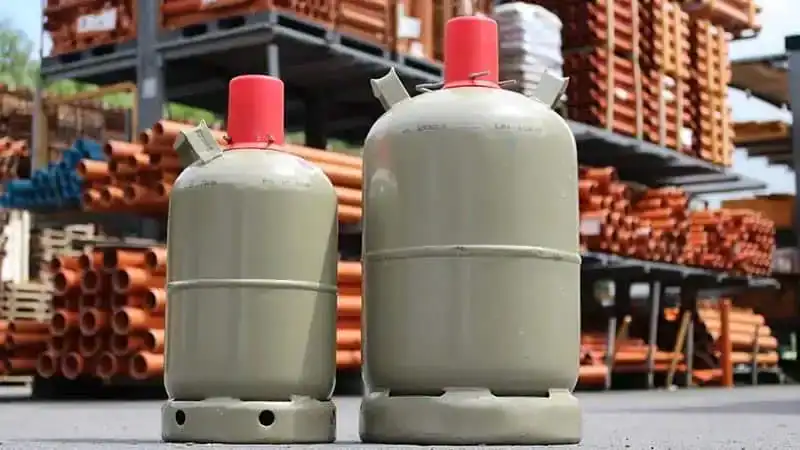
Moving heat, hot water and cooking to propane can shrink a solar system dramatically. Our guide to propane tank sizes helps you plan fuel storage.
FAQ: How Do Tiny Houses Get Electricity?
Can a tiny house run entirely on solar?
Yes, with a large enough battery bank and efficient appliances. Most full-time off-grid owners keep a generator for long stretches of cloudy weather.
Can I plug my tiny house into my main house?
Yes, if an electrician installs a dedicated 30- or 50-amp outlet sized for the load and local rules allow a tiny home on the property.
How much does it cost to connect a tiny house to the grid?
It ranges from a few hundred dollars for a pedestal near existing service to many thousands when new lines, trenching or poles are needed. Ask your utility for a quote.
Do tiny houses use 110 or 220 volts?
A 30-amp setup provides 120 volts. A 50-amp setup provides 120/240 volts, which allows 240-volt appliances. Foundation homes on a standard panel get 120/240 volts.
How do other small homes get power?
Houseboats use many of the same options. See how houseboats get electricity.
Final Thoughts
Tiny houses can get power from the grid, solar, generators or a mix. Size your system to your actual use, and invest in efficiency first to keep costs down. The same options apply if you are weighing the cost of converting a shed into a house.
Resources
- U.S. Department of Energy, small wind electric systems guidance
- U.S. Energy Information Administration, residential electricity use data
- U.S. Department of Energy off-grid and solar guidance
- Local electrical code and permitting offices