Thank you for reading our post, please rate this article at the end.
Reading Time: 5 minutesLast Updated on November 5, 2026 by Paul Clayton
The most important survival skills are finding and treating water, building shelter, starting fire, navigating and signaling for help, followed by first aid, food gathering and making tools like cordage. Most people survive emergencies by staying calm, protecting themselves from the weather and being found quickly. This guide covers 21 practical skills, from orienteering and shelter building to urban preparedness, so you can practice them before you ever need them.

Table of Contents
Key Takeaways
| Priority | Why |
|---|---|
| Shelter | Exposure can kill in hours |
| Water | You can last only about three days without it |
| Fire | Warmth, water purification, signaling and morale |
| Signaling | Getting found is the fastest way out |
| Navigation | Prevents getting more lost |
| Food | Important but lower priority in short emergencies |
21 Essential Survival Skills
1. Orienteering

Orient your map to north with a compass, identify landmarks and recheck your position often. Learn to navigate without GPS before you need to.
2. Build a Shelter

Get out of wind, rain and cold first. Debris shelters of sticks and leaves, snow shelters like quinzhees and raised beds in wet areas all trap heat and keep you dry.
3. Balance Risk vs. Reward

Stay positive, avoid unnecessary risks like night travel or crossing dangerous terrain, and choose the safest option that solves your biggest problem.
4. Cross Water Safely

Look for wide, shallow, slow sections; unbuckle pack straps, face upstream and use a pole for balance. Avoid crossing fast or deep water.
5. Improvise Camouflage

Natural blinds and muted clothing help when hunting or observing wildlife.
6. Make Rope

Twist or braid plant fibers such as inner bark, grasses or yucca into cordage for shelters and traps.
7. Signal for Help

Use whistles in sets of three, mirrors, bright clothing and three fires or rock piles in a triangle. An acorn cap whistle works in a pinch.
8. Move Smart When Lost

Stop, think, observe and plan. Often staying put is best. If you move, follow a landmark or downhill water toward civilization and mark your path.
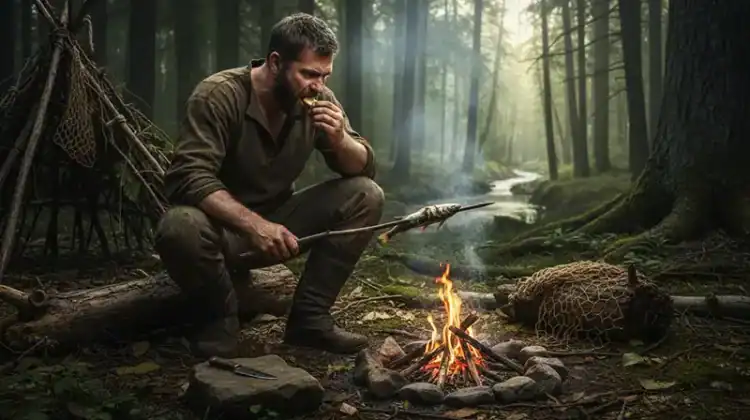
9. Catch Fish

Improvised nets, lines and hooks can catch fish in streams and ponds.
10. Beat the Heat

Travel at dawn and dusk, rest in shade, cover your skin and ration sweat, not water.
11. Lashing

Square, diagonal and shear lashings join poles for shelters and tools.
12. Find Protein

Fish, insects and small game provide calories; cook all meat thoroughly.
13. Avoid Unknown Plants

Eat only plants you can identify with certainty. The universal edibility test is slow and can’t protect you from deadly plants and mushrooms. One plant worth learning to identify is wild lettuce, and our guide on how to use wild lettuce for survival covers identification and safe preparation.
14. Dry Food

Sun, wind and smoke can dry meat and fish for later.
15. Avoid Rabbit Starvation

Very lean meat alone lacks fat; add fats and carbohydrates when possible.
16. Prevent Wound Infections

Clean wounds with safe water, cover them and watch for redness, swelling or fever.
17. Prepare Acorns
Leach acorns in water to remove bitter tannins before eating.
18. Find and Treat Water
Look for springs, streams and morning dew, then boil, filter or chemically treat it.
19. Build a Solar Oven
A box lined with foil and covered with clear plastic can cook food with sunlight.
20. Urban Survival
Keep a go-bag, know evacuation routes, store water and food, and have a communication plan.
21. Survive a Dog Attack
Stay calm, avoid eye contact, put an object between you and the dog, and protect your face and neck.
Build Your Survival Kit
- A reliable fixed-blade knife; see our Fallkniven A1 review and our ESEE 6P-B review.
- Fire starter, water filter and purification tablets
- Compass, map and whistle
- Emergency blanket, cordage and first aid kit
- Long-lasting food storage; see long-term food containers
Plan ahead with the best crops for a survival garden and stay safe outdoors with wildlife safety tips.
FAQ: Survival Skills
What is the rule of threes in survival?
Roughly three minutes without air, three hours without shelter in harsh weather, three days without water and three weeks without food.
What is the most important survival skill?
Staying calm and making good decisions, followed by shelter and water.
Should I stay put if I’m lost?
Usually yes, especially if someone knows your plans.
How can I practice survival skills safely?
Take a course and practice in your backyard or on short trips.
Final Thoughts
Survival skills are about preparation and calm thinking. Practice shelter, water, fire, navigation and signaling before you need them, and always tell someone your plans.
Resources
- U.S. Army Survival Manual (FM 21-76)
- American Red Cross, first aid
- National Park Service, hiking safety