
Thank you for reading our post, please rate this article at the end.
Reading Time: 11 minutesLast Updated on January 23, 2026 by Paul Clayton
Table of Contents
Is Fishing A Sport?
Key Takeaways
-
- Defining “Sport”: While definitions vary, a sport is generally a competitive activity requiring skill and effort. Fishing meets many criteria established by organizations such as the Council of Europe, including improving well-being and achieving competitive results.
- Physical and Mental Demand: Fishing is more than just sitting still; it requires specific physical skills, such as casting and “fighting” fish, as well as complex mental strategies involving animal behavior, equipment selection, and environmental analysis.
- Formal Recognition: Fishing is officially recognized as a sport by the Global Association of International Sports Federations (GAISF) through the International Sports Fishing Confederation (CIPS). It even adheres to World Anti-Doping Agency rules.
- Olympic Status: Despite its international governing bodies and annual world championships, fishing is currently not recognized by the International Olympic Committee (IOC) and is not an Olympic event.
- The “Harm” Contradiction: Under some older definitions (like those previously held by SportAccord), fishing might not be considered a sport because it involves “harming living creatures,” though catch-and-release practices aim to mitigate this.
- Professional vs. Amateur: While professional fishing exists, it is largely an amateur sport. Unlike major sports (football, golf), anglers typically rely on sponsorships and endorsements rather than prize money or salaries to make a living.
Fishing is a highly popular activity, but is it a sport?
This is a pretty difficult and common question, but you’ll find different opinions on it, which doesn’t really help you.
Frequently Asked Questions
Q: Does fishing require enough physical effort to be considered a sport?
Yes. While often seen as a relaxing activity, fishing involves significant physical effort, including casting bait, maintaining balance and position for long periods, and the physical “fight” required to reel in a fish. These actions require specific muscle strength and coordination that are distinct from those of other sports.
Q: Is there a formal governing body that recognizes fishing as a sport?
Yes. Fishing is formally recognized by the Global Association of International Sports Federations (GAISF). It is governed by the International Sports Fishing Confederation (CIPS), which oversees international federations for freshwater, fly, and sea fishing. These organizations even enforce anti-doping rules through the World Anti-Doping Agency.
Q: Can you compete in fishing at the Olympic level?
No. Although fishing has international federations and holds annual world championships, it is not currently recognized by the International Olympic Committee (IOC). While this could change in the future, you cannot currently win an Olympic medal for angling.
Fishing has rarely been part of the Olympics, appearing only as an unofficial, undocumented event at the 1900 Paris Games. While the Confederation Internationale de la Peche Sportive (CIPS) has sought official recognition, and efforts are ongoing to include bass fishing for the 2028 Los Angeles Olympics, it is not currently an
official Olympic sport.
- 22 Fishing License Questions and Requirements
- The 10 Best Spinning Rods For Bass
- The Ultimate Guide to Understanding Fishing Hooks
- What Are The Different Types of Fishing Lines?
- Beginner’s Guide to Bass Fishing
In the vast realm of activities that mankind indulges in, fishing stands proudly as a highly popular pursuit. However, a question mark hangs heavily over its categorization – Is fishing a sport?
There are those who cast their lines in serene silence, absorbed in the tranquility of the moment, while others thrum with competitive energy, turning the calm waters into battlegrounds for sport fishing.
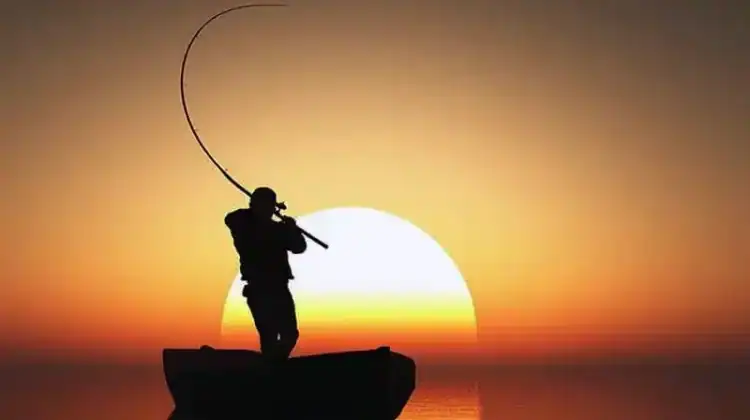
They reel in their sports fish with the determination of an athlete and the spirit of a warrior.  This juxtaposition of tranquility and competition sets the stage for a profound debate: Is fishing merely a leisure activity or does it rightfully belong to the thrilling world of sports?
We also have our view on whether fishing is a sport. Below, we would like to share our position and thoughts with you. Hopefully, our position is clear enough so that you get a clear answer to your question.
What Is Sport?
First, we should understand what sport even means.
Usually, the term “sport” refers to a competitive activity involving physical effort and skill. Some definitions focus not only on the competitive component of sport, but also on the Cambridge Dictionary’s definition of the word “sport” as an activity done for enjoyment or as a job, among other things.
The Council of Europe reasons why fishing is a sport as a casual or organized physical activity which aims at:
- Improving physical and mental well-being.
- Forming social relationships.
- Obtaining results in competition.
Under these definitions, fishing is indeed a sport since it:
- Involves physical activity and skill.
- May improve physical and mental well-being.
- May form social relationships.
- May bring enjoyment.
- May be done as a job.
- May be done competitively.
That said, sports do not necessarily involve physical activity. For example, the Global Association of International Sports Federations (GAISF, formerly SportAccord) recognizes such non-physical sports as checkers (draughts), chess, bridge, and Go. The International Olympic Committee also recognizes bridge and chess as sports.
What this means is that the definitions of sport are kind of blurry.
Similarities of Fishing With Sports
To demonstrate better that fishing can indeed be considered a sport, we would like to have a look at some key similarities between fishing and sports. This doesn’t really mean anything from a formal point of view, but it’s nonetheless pretty interesting to think about how fishing can be treated as a sport.
Fishing involves physical activity and skill
As mentioned above, the key feature of sports is that it involves physical activity and skill, though not necessarily. Examples of sports that don’t involve physical activity and skill include Go or chess, though you could argue that they do involve physical activity, since strategizing is supported by physical processes in the brain.
We digress, though.
So what kind of physical activity does fishing involve? Well, among the things that you would do during your fishing trips are:
- Casting the bait into the water.
- Maintaining a position for prolonged periods of time, which is difficult without exercise.
- Fighting with fish.
Do these activities require physical ability? Of course, they do. You need to  train specifically for fishing activities, since they are very distinct and aren’t encountered outside of fishing. You may be a world champion weightlifter, but your strength and speed won’t necessarily contribute to your fishing performance.
What about skill? Well, there is plenty of skill involved in fishing. Arguably, skill has a more significant role in fishing than physical conditioning.
You need to know how to use fishing equipment, cast the bait, and retrieve the fish without losing it or damaging your tackle. People unfamiliar with angling lack the skills necessary for efficient fishing.
Fishing involves strategizing
A big part of sports is strategizing. No matter how dumb or mindless a sport may seem, it will include some form of strategy.
Mind sports such as chess or Go are the greatest examples of strategy in sports. There’s not much physical activity involved – instead, you need to plan your actions several moves ahead, not to mention that you need to be able to predict the strategy of the opponent and enforce your own strategy on them.
There is a strategy even in sports such as weightlifting or boxing. In weightlifting, one could, in particular, strategize their attempts and force others into higher weights, while in boxing, one could play defensively, exhaust their opponent, and then take advantage of them.
Fishing is no different since there are plenty of things to strategize there. Among the things that you could build a fishing strategy upon are:
- The species of the fish you want to catch. It’s crucial to know the behavior of the fish, when they’re active, and what kind of bait and equipment to use with them.
- Fishing location. There may be plenty of bass in Texas, for example, but not all water bodies where bass live are equal. You need to recognize solid fishing spots and focus on them to maximize your efficiency.
- Luring fish towards the hook. You may take advantage of fish’s territorial instincts, or you may take advantage of food shortages in the waters.
These are just a few things that you could plan and build a strategy upon in fishing. This clearly shows that fishing – just like any other sport – is not only about physical ability.
Fishing improves physical and mental well-being
Now, to be fair, sports aren’t about physical and mental well-being. Regular exercise and sports shouldn’t be confused.
The purpose of the former is to maintain one’s physical and mental health, while the purpose of the latter is to outcompete others. Health is of secondary importance in sports – athletes very often train much more than it is healthy for them.
With that said, it is possible to do sports for health, though you perhaps won’t be able to achieve incredible success and become an Olympic champion that way.
As for fishing, it can indeed be very beneficial for your health.
It takes effort to make a successful catch. Hours on the water translate into noticeable muscle strain. And though the fishing effort is not like the effort you’d put into a marathon, it is still there. And if you are boat fishing, for example, you may add the effort of paddling into the formula.
Aside from physical benefits, you also have mental benefits. It’s no secret that doing things we love can decrease stress. And since stress can lead to brain atrophy, the importance of enjoying fishing cannot be overestimated.
Fishing involves competition
Fishing also involves competition, like any other sport. Even if you aren’t really competitive.
If you hear another angler catching particularly big bass, you may want to top their achievement and catch an even bigger fish! And by doing so, you may not even realize that you are in a competition of sorts.
You may also compete with your friends or relatives in how many fish each of you catches, for example. And while being the first doesn’t imply that you will get a medal, the competitive aspect of fishing is there even if you don’t notice it.
Fishing brings enjoyment
Are athletes enjoying what they are doing? Probably, because otherwise, they would no longer stick to their sport.
Sports aren’t necessarily good for your body, especially if you are after medals and records, but they certainly bring enjoyment to athletes (though this likely depends).
Angling can also be enjoyed, especially if you aren’t doing it as a job. If you are fishing to earn a living, angling won’t necessarily be enjoyable for you. But if it’s a side activity that you love to engage in after work, then it will surely bring enjoyment to you.
And we’ve already mentioned above how greatly beneficial enjoyment is for your mental well-being!
The Formal Side of Things
It would also be pretty interesting to have a look at the formal side of sports. We can talk all you want about definitions, but they don’t do much since sports aren’t based on textbook definitions or opinions. There are more or less formal definitions of sport, and we would like to draw your attention to those.
The SportAccord Definition
We mentioned GAISF/SportAccord above, and we think it’s important to cover its definition of sport as well.
If you didn’t know, the GAISF is the umbrella organization for all international sports federations, both Olympic and non-Olympic. Well, this is a good reason why the word GAISF is pretty important in the world of sports.
Now, the definition of sports that will be brought up below has been online a few years back while GAISF has still been known as SportAccord. Now that the original webpage is archived, it’s hard to say whether this old definition is still formally followed.
Still, it’s pretty interesting to have a look at what the main governing body of all international sports federations thinks about sports.
So, according to the former SportAccord, sports:
- Should have an element of competition.
- Should be in no way harmful to any living creatures.
- Should not rely on equipment from a single supplier.
- Should not rely on a luck element designed into the sport.
Well, if we were to go by this definition, then fishing definitely is no sport since it doesn’t satisfy the second requirement and maybe the fourth. Fishing is mostly done for food, though there is catch-and-release fishing, where the caught fish is returned to the water.
The International Sports Fishing Confederation
Though fishing doesn’t satisfy the second point of SportAccord’s definition,  it appears that fishing indeed is a formal sport!
If you look through the member federations of the GAISF, then you may stumble upon the International Sports Fishing Confederation. This federation governs 3 international sport fishing federations:
- The International Freshwater Sport Fishing Federation.
- The International Fly Sport Fishing Federation.
- The International Sea Sport Fishing Federation.
Aside from that, the International Casting Sport Fishing Federation is an associated member of the Sports Fishing Federation.
These federations hold annual world fishing championships – among other competitions – though these don’t appear to be particularly popular beyond Europe.
But even though there is an international fishing sports federation, fishing sports appear to be amateur, meaning that athletes don’t get paid for their athletic performances. With that said, there are many other amateur sports out there, with athletes earning money on sponsorships or out-of-sports jobs.
It should also be noted that the International Sports Fishing Confederation, along with its daughter federations, isn’t recognized by the International Olympic Committee, though it may get recognized someday. But as for now, you won’t be able to get onto the Olympic podium as a sports angler (not that this is too important today).
That said, the International Sports Fishing Confederation is a stakeholder of the World Anti-Doping Agency and thus enforces certain anti-doping rules. So if you decide to engage in sports fishing, know that the rules regarding doping will be no less strict than in other sports.
Is The Formal Aspect of Sports Fishing Important?
So it appears that fishing is indeed a formal sport discipline. Sports fishing is governed by several international sports angling federations, and the International Sports Fishing Confederation is a member of GAISF.
This is cool, but does it mean anything to you?
Well, the answer to this question depends on your intentions.
If you do want to take part in a competition, show your skills, and maybe earn some rewards, then know that there are ways for you to do so, since angling formally is a sport. If you are great at fishing, then why not test your skills and compete with some of the best anglers from all over the world?
With that said, you probably shouldn’t expect too much from sports fishing in terms of monetary reward. Sports fishing isn’t like some professional sports where you can earn millions of dollars annually. It’s simply not as popular as big sports like golf, boxing, baseball, football (both American and non-American), or auto racing.
In sports fishing, you would probably need to focus on sponsorships and endorsements to earn a sizable income. Otherwise, you would need to have a primary job to earn money and do sports fishing as a hobby.
But if you are so involved in fishing that you would compete with other anglers just for the sake of it, then you may try yourself out at formal sports fishing competitions.
And if not, do know that you could incorporate some sports elements into your fishing trips to make them more enjoyable and perhaps more productive!
Final Thoughts
In the grand finale of our discourse, we are confronted with the question that has echoed through the ages, casting its shadow over all who dare to peer into its depths: Is fishing a sport? This query, simple as it may sound, is a labyrinthine enigma that has ensnared the minds of many.
Sport fishing, a term often tossed around with casual abandon, is a deceptively complex notion.
Yes, fishing is an activity that brings joy to millions. It is a pastime that transcends borders, cultures, and ages. But does it qualify as a sport?
Does it hold its own when pitted against the likes of soccer, basketball, or tennis? To label fishing as a sport, we must first dissect what it means to be a sport. Physical exertion, skill, competition – these are the cornerstones upon which the citadel of sports is built. Is it not true, then, that fishing too demands skill?
Is there not a competition between man and beast when one wrestles with the mighty sports fish of the deep?
In the final analysis, we are left with more than just an answer. We are left with the understanding that fishing is not merely an activity or hobby. It is a sport – a test of patience, skill, and strength.
It is an arena where man and nature collide in an age-old dance. The question ‘Is fishing a sport?’ thus elicits not just a simple ‘yes’, but a resounding affirmation of its place in the pantheon of sports.