
Thank you for reading our post, please rate this article at the end.
Reading Time: 8 minutesLast Updated on February 14, 2026 by Paul Clayton
Table of Contents
How to Rodent Proof Your Camper- 5 Must Know Tips
Key Takeaways
-
-
The “Dime” Rule: Mice only need a hole the size of a copper dime to enter, while rats need a hole the size of a nickel. If they can’t fit, they may chew through soft materials to widen the gap.
- Identify Entry Points: Use the “Light Test.” At night, have someone shine a bright light from the outside while you look for interior glows, or vice versa. Focus on:
- Plumbing and electrical access panels.
- Slide-out seals and floor gaps.
- Corners and wall panel seams.
- Seal the Gaps:
- Expanding Spray Foam: Fills odd shapes quickly (use sparingly to avoid structural damage).
- Steel Wool: Specifically, the wood-stripping variety; rodents cannot chew through it.
- Strategic Storage: * Park on hard surfaces (pavement/concrete) rather than grass or dirt.
- Remove all “nesting materials” like blankets, towels, and paper products during the off-season.
- Eliminate Attractants: Deep-clean to remove crumbs and avoid storing food in plastic bins, which are easily chewed through.
- Natural Repellents: Peppermint oil is a highly effective, human-friendly deterrent. Soak cotton balls in the oil and place them in cabinets, engine compartments, and near wheels.
- Monitor for Breach: Check your RV frequently. Signs of failure include droppings, chewed packaging, or mysterious “outside” food (seeds/nuts) found inside.
-
Mice, rats, and other rodents are persistent little creatures. On one beautiful day, your seemingly impenetrable fortress of an RV may give in and allow a couple of rodents to make themselves at home. Then comes the headache of trying to drive them out, along with the costs of repairing damage caused by an infestation.
But how can you avoid this altogether? How to rodent-proof a camper so you don’t have to deal with any infestations? Our goal today is to help you find answers to these questions.
- Today’s Best Pop-Up Campers
- New vs. Used RV: Navigating the Price Trends
- Can You Rent an RV for a Year?
How to Rodent Proof Your Camper- Why Rodents are Bad
Rodent infestation isn’t merely an annoyance for RV owners. There are many other, more serious problems associated with mice or rats living alongside you in your recreational vehicle.
First, rodents damage your RV, and the longer the infestation, the more expensive the repairs will be. Rodents can chew through almost anything to make themselves a home and find food. If you aren’t attentive and don’t spot an infestation early, virtually everything in your RV may require repairs.
Rodents also make nests inside the RV, often using the fragments of what they have chewed through. Aside from the cost of repairs, removing these nests can be messy.
Perhaps the biggest threat posed by rodents is their ability to spread disease. Thus, rodent infestation is costly not only for your wallet but also for your health. Keeping rodents out of your RV will help you avoid costly repairs and stay healthy during your trip.
How do rodents get into your RV in the first place?
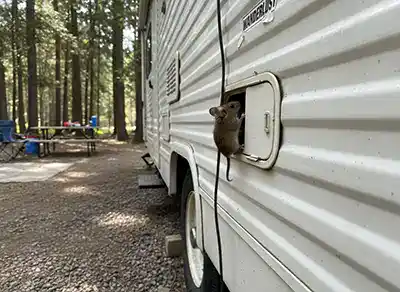
From the outside, it may seem that your RV doesn’t have any entryways for rodents. Besides, you might underestimate the ability of rodents to go through small openings. Mice can fit through holes as small as a dime, whereas rats only need openings the size of a nickel.
There are big and small rodents, obviously, but they generally don’t need too big a hole to enter your RV. And besides, if the material the hole is in is soft enough for their teeth, they may just chew through it.
Rodents commonly enter RVs via the following ways:
- Poorly sealed slide-outs.
- Gaps in plumbing or wiring.
- Plumbing, electrical, or other access panels.
- Cracks around doors.
- Gaps in the floor.
- Corners or cracks between wall panel pieces.
Keeping rodents away from your RV
The easiest way of dealing with a problem is to prevent it. By protecting your RV and keeping rodents out, you won’t have to deal with an infestation or the costs and health risks it brings.
As we’ve mentioned above, there are plenty of entry points through which rodents can easily make it into your RV. So the first line of your RV defense should be concentrated on making these entryways rodent-proof.
RVs are very different, and we can’t say what entry points they may have or where they may be. But the tips below should allow you to identify potential entry points on your own, regardless of your RV type or model:
- Examine the bottom of your RV to spot gaps and holes.
- Look in the RV’s corners and along its edges for holes and gaps.
- Carefully investigate the areas where the RV’s plumbing and wiring come into your living area.
- If your RV has slide-outs, check their seals. If a slide-out isn’t sealed well enough, it may be an easy entry point for rodents.
- If there are access panels anywhere in your RV (e.g., the bathroom or the kitchen), remove them and look inside to spot potential entry points.
There’s one easy way of spotting undesired openings in your RV. At night, you may have someone shine a light on different areas of the RV and look for spots inside where the light shines through. You may do the same during the day, but it may be harder to notice any openings if it is too sunny.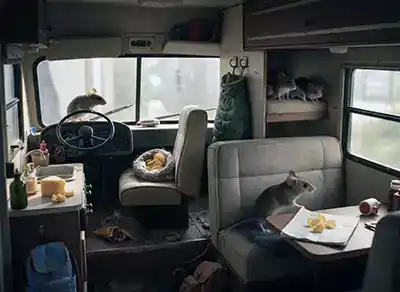
This method probably won’t allow you to spot every potential entry point in your RV, but it is good enough to get started. Don’t neglect the importance of looking for entry points in other areas that you can’t check with a light source.
After identifying gaps and holes, you need to seal them. There are many ways of sealing openings in RVs, with one easy solution being expanding spray foam. It is easy to apply and quickly expands, dries, and seals the area.
Aside from that, the foam readily takes the shape of an opening, giving you a perfect seal if you do things right. However, with spray foam, be careful not to overdo it, as excessive foam can expand beyond the area needed and damage your RV.
Plus, there are some safety measures you need to take to avoid foam particles getting into your body.
There is also a thing called steel wool. And we don’t mean the wool used for cleaning pans; we mean the kind designed to strip wood. Rodents are not going to chew through a good layer of steel wool, so it’s a great way of covering up holes and openings. And since steel wool is flexible, it is rather easy to place where you need it.
No matter which sealing method you use, do the light test afterward to check whether the RV has been sealed properly. If not, repeat the procedure, keeping in mind that the light test isn’t a reliable indicator of sealing quality in all areas of your RV.
Proper storage of an RV
To keep rodents out of your RV, you can also park it in a different location. Relocating an RV isn’t going to make it 100%-rodent-proof, but it may be a good temporary solution if you can’t do repairs in your RV at the moment.
There is a higher risk of rodents entering your RV if you store it outdoors near fields and open areas. If possible, park your recreational vehicle on a hard surface away from grassy or wooded areas. Rodents won’t go too far out from their colony in search of food or whatnot, so simply keeping an RV out of the reach of potential rodent habitat may do the trick.
The best option would perhaps be to park your RV in a garage. If you have a garage big enough to store your RV, go ahead and park it inside. But you would then need to ensure the garage itself is rodent-proof.
Rodents are attracted to food remains, seasoning, or other food sources. You should remove any food items from your RV, regardless of whether it is okay to keep them there. Don’t store food in plastic bins or other containers, as rodents may be able to chew through them.
Aside from that, deep-clean your RV to ensure there are no crumbs or other food remnants. Just like regular food, food remnants are going to strongly attract rodents to your RV.
While your RV is in storage, you should also do frequent checkups to see whether a rodent has gotten in. Wherever you store your RV – whether at home or at a storage facility – inspect it as frequently as possible. If you have a motorhome, you should start the engine to scare away rodents near the engine compartment.
Another thing to keep in mind is that rodents often look for places to live in winter. Therefore, when storing your RV in the winter, you should be extra careful with your storage preparation.
In winter, rodents will likely look for warm materials to build nests from. Most commonly, they use fabrics, sometimes newspapers or other paper products, to make nests.
Before putting your RV in storage, remove anything that could be used as nesting material, such as towels, shirts, blankets, and sofa covers. Do this not only in winter but also at any time of year when you store your RV.
Repelling Rodents
No matter how effective your preventive measures are or how clean your RV is, rodents may still get in. And if they do get into your RV, various rodent repellants become your last line of defense before you have to deal with an infestation.
 A good rodent repellent is peppermint oil – rodents don’t like its smell and try to avoid it. It generally works quite well for RVers. Peppermint oil also smells pleasant to most people, so it’s a natural way of keeping rodents away. And more importantly, peppermint oil is safe for people.
On the other hand, peppermint oil can be quite a messy solution, especially in hard-to-reach areas. As a result, there are various peppermint oil products sold in pouches and specifically designed to repel rodents.
You may also improvise by soaking some cotton balls in peppermint oil and scattering them around your RV. Depending on the size of your RV, you may try placing 1 to 3 cotton balls soaked in peppermint oil in each compartment, such as the engine compartment, near the wheels, the water/electrical basement compartment, and the kitchen cabinets.
Overall, choosing commercial peppermint oil solutions designed to repel rodents is the most convenient option. They will cost some money, but they are less messy and easier to use. In addition, they will come with instructions so you won’t have to do any guesswork.
There are other rodent repellent products available, but peppermint oil is considered the most convenient and human-friendly option. Most importantly, it is quite effective at repelling rodents, so unless you have some specific requirements, stick to peppermint oil.
What if rodents do make it into your RV?
In the end, rodents may be able to break through all your lines of defense and make it into your RV. Moreover, this can happen not only while the RV is in storage but also when you are traveling. In areas infested with rodents, it is rather likely that a couple of unwanted passengers will climb into your RV.
If there is an infestation in your RV, it is important to identify it as soon as possible. The sooner you spot it, the easier and less costly it will be for you to get rid of it.
The most common signs of a rodent infestation are:
- Mouse droppings in the RV.
- Holes where they aren’t supposed to be.
- Nests, sometimes around bedding and mattresses.
- Chewed food or their packaging.
- Natural food brought by the rodents from outside.
If rodents have gotten into your RV in spite of all your planned-out defense lines, you will have to drive them out. Using traps is an effective way of getting rid of rodents. In addition, traps help you pinpoint the spots where rodents hang out most. If you find many rodents trapped in a particular area of the camper, focus on that area.
If no rodents are trapped after about a week, you may assume the infestation has been dealt with. After that, you might proceed to disinfect the RV by ventilating it, steam-cleaning upholstered surfaces, washing fabrics, etc.
Aside from that, you will need to conduct a new inspection of your RV to identify where the problem originated. Maybe you’ve missed an opening somewhere, or the mice managed to chew through your barricades. Maybe you’ve used too little of your repellent. Regardless of what you find, adjust your strategy and then wait for the results to assess it.
The last thing to keep in mind is that you need to be prepared to deal with a rodent infestation at any time. Don’t assume that your defense is going to hold up 100%. Mice and rats are very persistent, and few things can truly stop them. So keep your guard up, look for signs of infestation, and take the necessary measures to get rid of it.
Final Thoughts
Prevention is significantly cheaper and safer than remediation. Because rodents carry diseases and cause expensive electrical or structural damage, the only way to truly protect your investment is to use a layered defense: sealing holes, removing food/bedding, and using scent repellents. Even with these measures, regular inspections are required to ensure your “fortress” hasn’t been breached.