Thank you for reading our post, please rate this article at the end.
Reading Time: 6 minutesLast Updated on November 24, 2025 by Paul Clayton
Table of Contents
Best RV Rust Prevention Tips
Key Takeaways
-
-
Hidden Structural Damage: Road salt accelerates rust significantly, particularly on the undercarriage. It can get behind rubber undercoatings and rot the vehicle from the inside out, damaging vital water, electrical, and fuel systems.
-
Safety Hazards: Salt buildup can harden on brake calipers and corrode fuel lines, potentially leading to brake failure or fluid leaks that compromise the RV’s stopping power.
-
Aesthetic Degradation: Prolonged exposure to salt strips paint and erodes decals, creating an “eyesore” that reduces the RVs resale value.
-
Protective Maintenance: To prevent damage, owners should wash the RV thoroughly after exposure, apply spray oils to undercarriage components, and use ceramic coatings or peelable “Plastidip” rubber coatings on the exterior.
-
Defensive Driving: You can minimize salt spray while driving by “hanging back” (increasing following distance) from the vehicle ahead, avoiding heavily salted major highways, and treating slushy spots like speed bumps.
-
Frequently Asked Questions
Q. Why is road salt damage to the undercarriage often worse than it looks?
The undercarriage is difficult to inspect visually, leading owners to overlook potential issues. The article notes that salt can get behind rubber undercoatings and rot the vehicle from the inside out. This hidden corrosion can damage vital components like water, electrical, and fuel systems before you even realize it.
Q. Can road salt actually cause my brakes to fail?
Yes. When salt is left on brake calipers, it can build up into a hard deposit that reduces stopping power. Furthermore, salt combined with water forms a corrosive substance that can damage fuel lines; if these leak fluid, the integrity of the brakes is further compromised.
Q. What are the best ways to protect the RV’s exterior paint and decals?
Aside from regular washing, we suggest:
-
Ceramic Coatings: To seal the paint and prevent salt from digging in.
-
Wax: A decent short-term solution.
-
Plastidip: A spray-on rubber coating that collects the debris and salt, which can be peeled off like a wrapper when winter is over.
Q. How should I adjust my driving to minimize salt spray?
You should “hang back” and maintain a greater distance from the vehicle ahead, as most salt spray comes from its tires. Additionally, try to avoid major highways (which are salted more heavily) and steer clear of slushy snow spots on the road.
Q. What should I do if I already see rust on my RV?
If the rust is light, you don’t necessarily need to wash the whole rig immediately. We recommend lightly sanding the affected area with 400+ grit and applying spray oils directly to it to slow corrosion.
- Today’s Best Pop-Up Campers
- New vs. Used RV: Navigating the Price Trends
- Can You Rent an RV for a Year?
Best RV Rust Prevention Tips
Alright, guys, if you live in a cold area, you know how much road salt sucks. It makes your beautiful RV look like it hasn’t been washed for years.
Aesthetics aside, road salt is corrosive, accelerates rust, and is generally nasty to your RV. And that’s not all; there are plenty of other reasons you must avoid road salt.
In the guide below, I’ll share the effects of road salt on your RV and offer important tips to help prevent them.
Effects of Road Salt on your RV
Rust
When roads are salted after snow, RVs often get coated with a whitish-gray spray that looks like a flocked Christmas tree.
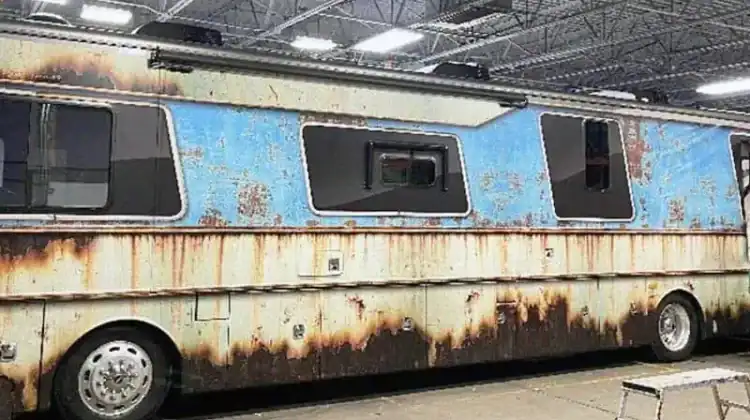
RVers who usually don’t address this issue end up with a lot of rust problems. Road salt massively encourages rust.
However, it’s not like the salt will instantly transform your RV into a powder of rust dust blowing in the wind. Sometimes the effects of rust aren’t visible, especially on the undercarriage, but over time they will become apparent on metal surfaces.
Damaged Undercarriage
Your RVs undercarriage is one area that bears the brunt of road salt damage. And unfortunately, this spot isn’t visible, so it’s easy to overlook and assume everything is fine.
However, it’s important to inspect your RV’s undercarriage because rust can eat it up fast, and in some cases, it gets so bad that it’s not worth repairing.
And if there’s a rubber undercoating, there’s a chance it’s already rotted underneath. The salt gets behind the rubber coating and rots the vehicle from the inside out.
A worn-out undercarriage exposes vital components of your RV, such as the water, electrical, and fuel systems.
In short, if the integrity of the RVs undercarriage is compromised, it could be disastrous, causing serious mechanical damage.
Stripped Paint and Damaged Decals
If road salt is left on your RVs surface for too long, it may create creases and cuts in the paint. Over time, this will result from paint chipping and decal erosion.
Of course, RV aesthetics aren’t a huge deal, but they matter if you need your RV to look nice, especially for resale.
The chipped paint and decal are an eyesore and will make your RV look beaten up.
Brake and Fuel Line Leaks
It’s important to check the condition of your RV brakes for your safety. There’s even a further need to confirm the RV brake status, especially during winter, because faulty brakes can cause you to slip off the road.
Unfortunately, road salt can accelerate the rate of brake failure. See, when road salt is left on the RV’s brake calipers for too long, it builds up into a hard deposit that eventually affects the brakes’ stopping power and effectiveness.
On top of that, when salt combines with water, it forms a corrosive substance that may compromise the integrity of the brakes and fuel lines. For example, if the fuel lines are damaged and leak brake fluid, the brakes’ stopping power is ultimately compromised.
Damage to Other RV Mechanical Parts
In addition to the brake components, many other RV components are likely to be adversely affected by exposure to road salt.
They include mufflers, coil springs, axles, and more. Any component of your RV that will come into contact with the road salt is likely to suffer from salt damage.
How to Prevent Road Salt Damage
It’s entirely possible to avoid road salt, especially if you’ll be using your RV during winter. However, there are a couple of safety precautions you could take to minimize the effects of road salt on your RV.
Wash your RV Thoroughly
After a big winter storm, it’s super important to wash your RV thoroughly once the salt trucks have been out. Road salt sticks to your frame, wheel wells, undercarriage, and exterior panels, and that salty residue can accelerate rust and corrosion far faster than most people realize.
A good rinse, especially underneath, helps protect your paint, metal components, brake lines, and suspension from long-term damage. According to AAA, road salt can dramatically accelerate corrosion on vehicles when left unwashed (https://newsroom.aaa.com).
Even RV manufacturers warn that salt exposure can void certain warranties if not cleaned off promptly (https://www.rvti.org). Keeping your rig clean after a salty drive is an easy win to keep it rolling strong all winter!
Use Spray Oils
The best thing you can do for your RV, especially before winter hits, is to apply oils that slow the effects of corrosion.
And if your RV already has salt or brine, wash it thoroughly, then apply the spray oils to prevent corrosion.
If there’s light rust, you don’t even need to wash it. Simply sand it down and spray it on the affected area.
Ceramic Coatings
If you’re concerned about the aesthetics and worried that the paint and decal would wear off when exposed to road salt, consider adding a ceramic coating or sealant.
Even wax can be decent for a while. While it won’t last all winter, it helps keep the road salt from digging into the paint.
Plastidip
Before winter, you could also consider cleaning, waxing, and adding plastidip.
I’m a big fan of plastidip because it lets me play with colors and use it on my rims, too!
Plastidip is a spray-on rubber coating that covers your RV and provides a protective layer. So, all the sand, road sand, scrapes, and other debris will accumulate on the plastidip, not your RV.
And when spring comes, you simply peel this shit off, and it feels like unwrapping a new car.
RV Driving Tips to Prevent the Effects of Road Salt Damage
While road salt isn’t entirely possible, there are a few driving tips and tricks you could use to prevent it from ever getting on your car in the first place.
Understand that road salt doesn’t magically jump off the road straight into your RV. In most cases, it’s usually thrown on your RV by spinning tires. Every car, RV, or other automobile driving on the same path as your RV sprays huge plumes of dirty brine off each of the four tires onto your RV.
So, here are the tricks to minimize getting sprayed with brine:
Decrease your Following Distance
One helpful thing to do when driving an RV is to reduce the following distance. 99% of the road salt in front of your RV is usually from the RV or car directly in front of you.
So, I suggest you hang back. It’s not only a good way to prevent the road salt from getting sprayed on your RV, but it also helps to keep the road wetness from getting sprayed on your windshield and hood.
On top of that, it’s wintertime, and the roads are usually slippery. Staying back may help you avoid instances of accidents.
Avoid Major Roads
The major roads, especially the highways, are slated more liberally than other roads. If you can find an alternate route that isn’t as heavily road-salted, you could save your RV.
Plus, the alternate routes are less likely to have multiple lanes than the main highways, so there’ll be fewer RVs and other automobiles passing you, which means less splashing.
Be Aware of Snow Spots
You must treat the wet, slushy, and snowy spots like road bumps. Avoid them if you can, and proceed slowly if you’ve to pass over them.
Avoid Going Out
Finally, if the conditions are worsening and you don’t think it’s possible to go out without splashing your RV with road salt, you could cancel the trip.
In any case, going out when the conditions are snowy is dangerous and may put you and your family in harm’s way.
Final Thoughts
While road salt poses a serious threat to an RVs safety, mechanics, and appearance, the damage is largely preventable. By combining proactive measures such as applying protective coatings and driving cautiously with reactive maintenance like thorough washing, RV owners can protect their investment and ensure their vehicle remains safe and road-ready throughout the winter.
Home page
Back to the top of the page