
Thank you for reading our post, please rate this article at the end.
Reading Time: 7 minutesLast Updated on August 8, 2026 by Paul Clayton
Table of Contents
Cost To Install Air Force One Braking System
Key Takeaways
-
- System Functionality & Proportional Braking:
- True Proportional Braking: Uses the motorhome’s actual air brake pressure to apply the towed vehicle’s (“toad”) brakes at the same intensity and force.
- No Inertia Sensor Errors: Avoids false braking, unexpected dragging, or uneven brake pad wear commonly caused by motion-activated inertia sensors.
- Safety & Legal Compliance: Fulfills supplemental braking requirements across all states and provinces with a one-time set-and-forget setup.
- Cost & Hardware Breakdown:
- Hardware Only: Ranges from $1,277 to $1,599 depending on chassis compatibility and features (e.g., Wireless Coachlink monitoring).
- Second Vehicle Kits: Cost approximately $893 to $995 for drivers equipping an additional towed vehicle to an existing RV setup.
- Total Installed Cost: Combined hardware and professional labor costs typically range between $1,900 and $2,600.
- Installation Essentials:
- Motorhome Side: Requires draining the RV’s air tanks, tapping into the supply line and metered air port with NPT tees, and mounting an air connection bracket out of the path of direct heat or moving parts.
- Towed Vehicle Side: Involves mounting the operating unit in the engine bay (often behind the front grille, protected from direct road spray), securing an actuator to the brake pedal, and centering the air hose connection brackets.
- System Functionality & Proportional Braking:
You have taken the time to get your RV ready for your new vacation season, but you would like to bring your car this time.
You most likely have taken the time to look into installing base plates and other components; however, what you want to do is install an Air Force One Braking System.
There are quite a lot of things to bear in mind when it comes to selecting the very best, yet appropriate system for your RV. For one, you have to consider your RV.
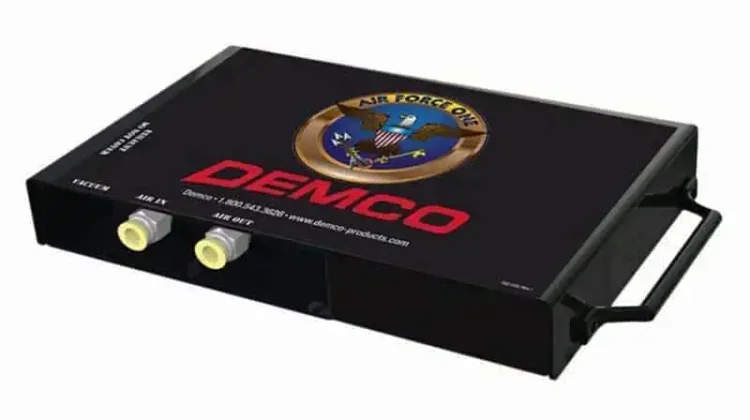
The Air Force One system by Demco is a proportional braking system that uses the air pressure from the motorhome’s brakes to apply the towed vehicle’s brakes. It’s designed for simplicity and safety, with a one-time setup and no need for adjustments after the initial installation.
There are actually numerous places where you are required to install a braking system if you plan to tow your vehicle along.
- New vs. Used RV: Navigating the Price Trends
- Can You Rent an RV for a Year?
- Today’s Best Pop Up Campers
The AFO or Air Force One enables you to be worry-free knowing that you are legally clear to be on the road, regardless of where you go.
The Demco Air Force One supplemental braking system typically costs between $1,277 and $1,599 for the hardware alone, depending on the specific kit variant you need for your motorhome chassis.
Total Expected Cost: When combining the hardware and professional labor, the total out-of-pocket investment usually sits between $1,900 and $2,600.
Hardware Cost Breakdown
- Standard Proportional System (SM99243): This is the most common complete kit for RVs with air brakes. It retails for $1,399 at major retailers like etrailer.com and Camping World.
- System with Wireless Coachlink (DM26VR): Includes a wireless monitor that transmits braking notifications directly to your RV cab. This version costs around $1,599.
- Chassis-Specific Factory Prep Kits: If you own a 2021+ Freightliner with BrakeSync or a 2020+ Tiffin chassis, your RV already has the coach-side air assembly installed. The vehicle-side hardware kit for these models costs around $1,277.
- Second Vehicle Kit (SM99029 / 6271): If you already have the system on your RV and simply want to equip a second towed vehicle (“toad”), the vehicle-only kit costs about $893 to $995.

As stated earlier, the system is a supplementary one, so it works by leveraging the existing brakes your car has.
What it does is to apply the brake whenever it gets an input from the RV. The AFO can be described as a braking system that is truly proportional.
What this means is that when the brakes in the RV are depressed, the brakes in your car are also depressed with the exact intensity and pressure.
What are the advantages of a proportional braking system?

Utilizing a system of proportional braking means that when the brakes are applied in your RV, causing it to panic stop, your car also stops with the same amount of force.
Another advantage is that you do not feel like the car you are towing is dragging the RV back.
Proportional also means that there will be equal stress inside the car as well as outside, so it won’t feel like the car is doing its own thing.
Additionally, it is not going to cause the brakes to be applied too softly to the point where it would feel like the car is pushing the RV when it is trying to stop. What you get is even and nice braking as both are using the same pressure.
Considering that this braking system utilizes air pressure from the RV to analyze just how much force is needed to brake in the towed car, you need not be concerned about the eventuality of false braking, which can occur in an applied braking system that uses an inertia sensor.
The way an inertia sensor-applied braking system works is to have a sensor inside the car’s unit that scans the inertia to apply the brakes.
There are times when you are slowing to a stop, and the sensor will incorrectly trigger, applying the brakes a little too hard in the car.
When this happens, it could feel like you are pulling a weight just behind the RV. With an AFO braking system, you don’t have to worry about that. Your brakes will also not be worn out with this system.
How to Install the Air Force One Braking System
Mount the RV air tank first

You have to pick a decent location to assemble the air connection. Your airlines should not be near any moving parts or direct sources of heat.
They should also not be mounted in a manner that causes them to kink. It is possible to mount the assembly near the RV’s already existing relay valve assembly.
Once this is done, you need to find the RV’s supply hose. This is the line that will be connected to the air braking tank. While it is typically green, it can come in any color. It must, however, not be confused with the hose for a treadle valve.
The line should be trimmed using appropriate tools so that the cut is clean and loose. Having a clean, straight edge is important as it helps to stop leaves in the air system from forming. One thing to note is that before the lines are cut, you have to drain your RV’s air tank.
The NPT tee has to be attached using appropriate connectors. The push-lock connector has to be threaded into the free tee port.
The quick-release or spring brake valve should first be located. In most RVs, it is located just below the relay for the service brake.
The metered port for air is sometimes directly centered above the valve. To identify which valve is the quick release, search for a port that is labeled emergency and then follow the hose leading to said valve.
Installing in the Towed Car

You have to select an appropriate location in the car’s engine compartment to house the system’s operating unit.
As with the RV, it has to be far from any direct heat sources, whilst ensuring the connections are within reach.
Typically, the system is mounted behind the bonnet’s grill as long as it does not impede the radiator’s airflow.
You don’t have to worry about moisture causing damage to the unit; however, it shouldn’t be put in a place that lets it get direct contact with road spray or rainwater.
The L Bracket has to be mounted. This can be done using the hardware provided. The bracket must be centered as much as possible on the towing car. With this in mind, the RV’s bracket also has to be centered.
If one of the two is off-center, the offending one has to be adjusted so that they are both at the same location.
Your air hose should be routed straight to the operating unit located in the engine compartment to the L bracket. It should be connected to an Air In labeled push-lock connector.
Frequently Asked Questions
How much does it cost to install an Air Force One braking system?
The total out-of-pocket cost for hardware and professional installation usually ranges between $1,900 and $2,600. If you purchase only the hardware, prices generally range from $1,277 to $1,599 depending on your motorhome’s chassis and feature options like Wireless Coachlink.
What makes a proportional braking system better than an inertia-based system?
A true proportional braking system applies the towed car’s brakes with the same intensity and pressure as the motorhome’s brakes. Unlike inertia sensors, which can falsely trigger and cause the car to drag or wear down its brake pads when slowing down, the Air Force One system uses actual air pressure from the RV for smooth, synchronized stopping.
Can I transfer or use the Air Force One system with a second towed vehicle?
Yes. If your RV already has the coach-side air assembly installed, you only need to purchase a second vehicle kit (SM99029/6271), which costs between $893 and $995, to equip an additional towed vehicle.
Do I need to adjust or calibrate the Air Force One system every time I tow?
No. Once the initial setup and installation are complete, the Air Force One system is designed for “one-time setup” convenience, requiring no recalibration or routine adjustments before you head out on the road.
Can the Air Force One system be installed on any motorhome?
The Air Force One system is specifically designed for Class A or Class C motorhomes equipped with air brakes. It taps directly into the motorhome’s air brake lines to supply pressure to the towed car’s operating unit.
This video has been included for its clarification of the topic matter. Credit goes to HitchSource.com
Final Thoughts
The Air Force One braking system from SMI (now Demco) offers motorhome enthusiasts a reliable and efficient solution for towing vehicles. With its proportional braking feature, it ensures that the towed vehicle’s brakes are applied with a force corresponding to the motorhome, leading to smoother stops and reduced wear. The system’s one-time setup minimizes hassle, eliminating the need for constant adjustments.
-
The Demco Air Force One supplemental braking system provides a reliable, proportional braking solution specifically engineered for motorhomes with air brakes.
-
By tapping directly into the RV’s air system, it delivers smooth, synchronized stopping power without false triggers, protecting both vehicle braking systems from unnecessary wear.
-
While the initial investment ranges between $1,900 and $2,600 installed, the long-term safety, legality, and ease of use make it one of the most effective braking systems for flat-towing a car behind an air-brake motorhome.