
Thank you for reading our post, please rate this article at the end.
Reading Time: 5 minutesLast Updated on November 4, 2026 by Paul Clayton
Part of our guide: Today’s Best Pop Up Campers
When buying a used pop-up camper, focus on the parts that are expensive to fix: the canvas, the roof and its lift system, the floor and the frame. Check for water damage, mold and soft spots, raise and lower the roof yourself, test every appliance and light, and inspect the tires, bearings and brakes. Used pop-ups often sell for about $2,000 to $15,000 depending on age, size and condition, so compare similar listings, know your tow vehicle’s limits and consider a professional inspection before you pay.
Table of Contents
Key Takeaways
| Topic | Key takeaway |
|---|---|
| Typical price | About $2,000 to $15,000 used, depending on age, size and features |
| Weight | Many weigh about 1,500 to 3,500 lbs, so many SUVs and some cars can tow them |
| Biggest risks | Water damage, canvas tears, mold and a worn lift system |
| Must test | Roof lift, bunk ends, lights, brakes, fridge, furnace, stove and water system |
| Paperwork | Clean title, matching VIN and maintenance records |
| Inspection | Consider a professional RV inspection for higher-priced campers |
Why Buy a Used Pop-Up Camper?
Pop-ups are the most affordable way to get off the ground and out of a tent. They’re light to tow, easy to store in a garage and simple to maintain. Buying used saves even more, since you avoid the steepest depreciation. Fewer manufacturers build pop-ups today than in the past, so the used market is where you’ll find the most choices.

Step 1: Know What Your Vehicle Can Tow
Look up your vehicle’s towing capacity, payload and hitch class in the owner’s manual. Then compare it to the camper’s GVWR (gross vehicle weight rating), not just its dry weight. Leave a safety margin for water, propane, gear and passengers. Larger pop-ups with slide-outs, bathrooms and air conditioners can weigh much more than basic models.
Also check whether the camper has electric brakes. Many states require trailer brakes above a certain weight, and you’ll need a brake controller in your vehicle.
Step 2: Decide Which Features You Need
- Sleeping space: most have two pull-out bunk ends plus a dinette that converts to a bed.
- Kitchen: indoor or outdoor stove, sink and fridge.
- Bathroom: some have a cassette toilet or wet bath, but many have none.
- Heating and cooling: a furnace for cold nights and an air conditioner for summer. See our guide to AC for pop-up campers.
- Slide-out: adds floor space but also weight.
- Off-road build: higher clearance and tougher suspension for rough roads.
Step 3: Set a Budget
| Camper type | Typical used price |
|---|---|
| Older, basic pop-up | About $2,000 to $5,000 |
| Mid-age pop-up with fridge, furnace and AC | About $5,000 to $10,000 |
| Newer, larger or off-road pop-up | About $10,000 to $15,000 or more |
Budget extra for a new battery, tires, canvas repairs, a brake controller and basic gear. Use J.D. Power values and local listings to judge whether the asking price is fair.
Step 4: Inspect the Camper Carefully
Canvas and Screens
Open the camper fully and look for rips, holes, mildew, stains and brittle zippers. Check the seams and the vinyl corners where bunks meet the box. Canvas replacement can cost hundreds to a couple thousand dollars.
Roof and Lift System
Raise and lower the roof yourself. It should move smoothly and evenly without grinding or slipping. Look for cracks, soft spots and sagging on the roof. Ask whether the cables have ever been replaced.
Water Damage and Floor
Press on the floor, especially near the door, corners and under the bunks. Soft spots, stains, swollen wood and a musty smell are warning signs of leaks and rot.
Bunk Ends
Pull out each bunk and check the supports, rails and mattresses. Bunk supports should feel solid with no bending.
Appliances and Systems
Test the stove, fridge on every power source, furnace, water pump, faucets, lights, outlets and air conditioner. Check the propane tank’s date stamp and look for leaks.
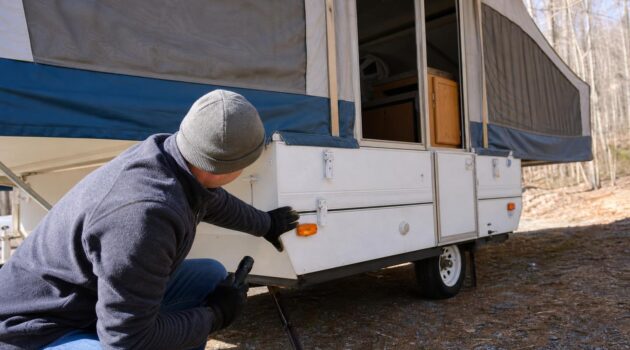
Frame, Tires and Running Gear
Look under the camper for rust, bent frame rails and damaged crank-down jacks. Check tire date codes, tread and sidewall cracks. Ask when the wheel bearings were last serviced, and test the brakes and lights while hitched.
Our guide to mistakes to avoid when buying a used travel trailer covers more inspection tips that also apply to pop-ups.
Pop-Up Brands You’ll See Used
- Forest River Rockwood and Flagstaff: among the most common tent campers on the market.
- Coachmen Clipper: a popular line of camping trailers, including lightweight and off-road models.
- Jayco Jay Series: well-built pop-ups that are still common used, though Jayco no longer builds them.
- Starcraft: long-running pop-up brand found on the used market.
- Fleetwood and Coleman: older models that can be bargains if well maintained.
- Viking: lightweight tent campers that are often affordable used.
For current models, see today’s best pop-up campers.
Questions to Ask the Seller
- Why are you selling it?
- How often was it used, and where was it stored?
- Has it ever leaked or had water damage?
- Has the canvas been repaired or replaced?
- When were the lift cables, bearings and tires last serviced?
- Do all appliances work on every power source?
- Do you have the title, manuals and service records?
- Is there a loan or lien on it?
After You Buy
- Transfer the title and register the camper with your DMV.
- Add insurance coverage.
- Service the wheel bearings and replace old tires.
- Reseal the roof seams and treat the canvas.
- Always dry the canvas fully before long-term storage to prevent mildew.
- Practice setup at home before your first trip.
Frequently Asked Questions
How much should I pay for a used pop-up camper?
Most sell for about $2,000 to $15,000. Compare similar listings and J.D. Power values, and adjust for condition.
How long do pop-up campers last?
With good care and dry storage, many last 15 to 20 years or more. The canvas often needs repair or replacement along the way.
What is the biggest problem with used pop-ups?
Water damage from roof leaks or wet canvas left closed is the most common and costly problem.
Can a car tow a pop-up camper?
Some lightweight pop-ups can be towed by cars or small SUVs, but always check your vehicle’s towing capacity.
Is a pop-up better than a travel trailer?
It depends on your needs. See our comparison of pop-up campers vs. travel trailers.
Final Thoughts
A used pop-up camper is an affordable way to start RVing. Take your time with the inspection, focus on water damage, the canvas and the lift system, and make sure your vehicle can tow it safely. A careful purchase can give you years of happy camping.
Resources
- J.D. Power RV values
- Vehicle manufacturer towing guides
- State DMV title and registration requirements
- National RV Inspectors Association