
RV Solar Calculator
What Can Your Solar Run?
You bought the panels, you bought the lithium battery, and now you’re parked somewhere with no hookups. The question is simple: can you make coffee, run the fridge, keep Starlink up, and still have power at bedtime?
This calculator answers that. Check off what you actually use, tell it how many panels are on your roof and what the weather is doing today, and it shows how much of your day the sun covers. It also checks your battery, your inverter and the amps your wiring has to carry, and shows which one is holding you back.
Start with two panels, the setup most RVs come with from the factory. Then flip the weather to overcast and watch what changes.
Today's energy budget
Daily energy
Limit checks
Weight you're adding
Add this to your loaded trailer weight in the Towing Calculator. On a motorhome or truck camper it comes out of your payload.
Read this before you wire anything
This calculator gives planning estimates. Your real numbers depend on your panels, your campsite, the weather and your habits. It can’t see your wiring, your fuses or how old your batteries are.
A lithium battery bank can push hundreds of amps. That’s enough to melt an undersized cable or start a fire if a fuse is missing. Follow the battery and inverter makers’ wiring charts, fuse every positive line close to the battery, and have a qualified RV electrician check the install.
How to use the calculator
- Check off what you run. The list covers the usual RV gear, from LED lights and a 12V fridge to a microwave and the rooftop AC. Change the watts and hours to match your own stuff, or tap Add an item. Count only the time something actually pulls power. A fridge or AC compressor cycles on and off, so a fridge that’s plugged in 24 hours might only run 10.
- Set your solar. Pick how many panels you have and the watts of one panel. Presets run from 100 W RV panels up to 700 W, the largest single panels sold, and you can type any size. A kit sold as “800 W” is usually several smaller panels, so enter one panel’s watts and the count. Choose where and when you camp, which sets the peak sun hours. Then pick today’s weather: sunny, partly cloudy or overcast.
- Set your battery and inverter. Lithium or AGM, system voltage, amp-hours, and your inverter’s continuous and surge ratings. Those last two are printed on the inverter’s label or spec sheet.
- Read the results. The big number is how much of today’s use the sun covers. Next to it: how many days your battery lasts at this pace, and how many panels it would take to cover everything on a sunny day.
- Change one thing at a time. Add a panel. Uncheck the coffee maker. Switch to overcast. The numbers update as you go, so you can see exactly what each choice costs you.
What these numbers actually mean
- Covered by sun. The share of today’s power use your panels replace. At 100% you end the day with the battery as full as it started. Below 100%, the battery makes up the difference and goes into the night a little lower.
- Days until the battery is empty. How long you can keep up today’s routine before the battery runs flat, if every day looks like today. Three days or more gives you room for a cloudy stretch.
- Panels to cover it all. How many panels of your size it takes to run everything you checked on a sunny day. Roof space is usually the real limit here, not money.
- Inverter continuous. Your biggest 120V appliance plus the small stuff running alongside it. If your inverter is rated below that, it shuts off. Run big loads one at a time.
- Inverter surge. The split-second spike when a motor or compressor starts. A rooftop AC can pull three to four times its running watts for that moment. That spike, not the running load, trips most inverters.
- Battery current. Amps coming out of the battery. At 12 volts, a 1,200 W microwave pulls well over 100 amps. Your battery’s BMS has a limit, and your cables and fuses have to be sized for it too.
What two panels can really run
Two 200 W panels flat on the roof make about 1,584 Wh on a clear Florida summer day. That covers 68% of a typical camping day, which uses about 2,336 Wh. The 200 Ah lithium battery covers the rest and lasts about 2.9 days at that pace.
The typical day in the calculator: LED lights, a 12V fridge, the water pump, a roof fan, phones, a laptop, TV in the evening, Starlink for six hours, one pot of coffee and 15 minutes of microwave.
| Today’s weather | Two panels make | Share of a typical day (2,336 Wh) | Battery lasts | Share of basics only (980 Wh) |
|---|---|---|---|---|
| Sunny | 1,584 Wh | 68% | 2.9 days | 100% |
| Partly cloudy | 950 Wh | 41% | 1.6 days | 97% |
| Overcast | 396 Wh | 17% | 1.1 days | 40% |
Basics only means lights, fridge, water pump, roof fan and phone charging. Two panels run those all day in sun and nearly all day under broken clouds. On a gray day the battery carries most of the load, and 200 Ah of lithium buys you about 3.7 days of basics.
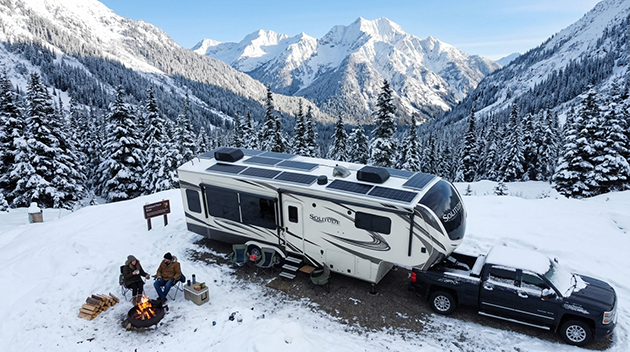
Add a third 200 W panel and the typical day is fully covered in sun. That’s the fastest upgrade on most rigs, as long as you have the roof space.
Watts, amp-hours and peak sun hours
Three numbers do most of the work in RV solar. Once they click, the rest is arithmetic.
- Watts (W) are how hard something pulls right now. A phone charger pulls 10 to 20 W. A microwave pulls 1,000 to 1,500 W.
- Watt-hours (Wh) are how much energy it uses over time: watts × hours. A 60 W TV for 3 hours is 180 Wh. This is the number that drains your battery.
- Amp-hours (Ah) are how batteries are sold. Multiply by voltage to get watt-hours: a 12 V, 100 Ah battery holds 1,200 Wh. Then take off what you can’t use: lithium gives you about 90%, AGM only about 50% before you shorten its life.
- Peak sun hours are not daylight hours. They’re the number of hours of full-strength sun the day adds up to. A 12-hour summer day in Florida works out to about 5.5. A winter day in most of the US is closer to 2.5 to 3.5.
The calculator puts them together like this:
Item energy     watts × hours        (÷ 0.90 if it runs through the inverter)
One panel       200 W × 5.5 sun hrs × 0.72 losses × weather
                sunny 792 Wh · partly cloudy 475 Wh · overcast 198 Wh
Usable battery  12 V × 200 Ah × 90% = 2,160 Wh
Days of runway  usable battery ÷ (daily use − daily solar)
The 0.72 covers real-world losses on panels lying flat on a hot roof: heat, sun angle, wiring and the charge controller. Tilted or ground-mounted panels do better, around 0.82. Flexible panels glued to the roof run hotter and do worse, around 0.65.
Big loads: short bursts or propane
Most RV power problems come from a handful of high-watt appliances. How long they run matters more than how many watts they pull.
- Microwave, coffee maker, hair dryer. High watts, but only minutes at a time. A 2,000 W inverter handles them fine if you run one at a time. Fifteen minutes of microwave is about 330 Wh, roughly a fifth of what two panels make on a sunny day.
- Induction cooktop and electric water heater. 1,400 to 1,800 W for half an hour or more. Either one can eat a full day of two-panel output. Off grid, cook and heat water on propane.
- Rooftop air conditioner. A 13,500 BTU unit pulls about 1,300 W running and three to four times that for a split second at startup. Three hours of compressor time uses about 4,300 Wh, close to three times what two panels make. Running AC on solar takes 6 to 10 panels, a large lithium bank and usually a soft start so a 3,000 W inverter can handle the startup.
- Residential 120V fridge. It runs all day through the inverter, so it costs more than a 12V compressor fridge doing the same job. Expect 1,000 to 1,500 Wh a day.
- Space heater. At 1,500 W it will empty most RV battery banks in a couple of hours. Use the propane furnace; its blower fan only needs about 40 W.
Typical RV appliance power
Use these as starting points. The label on each appliance, or a plug-in watt meter, beats any table.
| Appliance | Watts | Typical use | Wh per day | 12V or 120V |
|---|---|---|---|---|
| LED lights, whole RV | 20–40 | 4–6 hrs | 100–250 | 12V |
| 12V compressor fridge | 45–60 | 8–12 hrs running | 400–700 | 12V |
| Water pump | 50–80 | 20–40 min | 20–50 | 12V |
| Roof vent fan | 20–40 | 6–10 hrs | 150–400 | 12V |
| Furnace blower (propane heat) | 30–50 | 2–6 hrs | 60–300 | 12V |
| Phones and tablets | 10–20 each | 2–3 hrs | 40–120 | 12V (USB) |
| CPAP, no heated humidifier | 30–60 | 8 hrs | 250–500 | 120V or 12V |
| Laptop | 45–90 | 3–6 hrs | 150–500 | 120V |
| TV, 24–32 inch | 30–70 | 2–4 hrs | 70–300 | 120V or 12V |
| Starlink | 25–75 | 4–12 hrs | 150–900 | 120V |
| Coffee maker | 800–1,200 | 10–15 min | 150–300 | 120V |
| Microwave | 1,000–1,500 | 10–20 min | 200–500 | 120V |
| Instant Pot | 700–1,000 | 30–60 min | 400–1,000 | 120V |
| Induction cooktop | 1,200–1,800 | 30–60 min | 600–1,800 | 120V |
| Residential fridge | 100–200 | 8–10 hrs running | 1,000–1,500 | 120V |
| Electric water heater | 1,400 | 1–2 hrs | 1,500–3,000 | 120V |
| Rooftop AC, 13,500 BTU | 1,200–1,500 | per compressor hour | 1,400+ per hour | 120V |
120V items lose about 10% passing through the inverter. Where you have a choice, the 12V version of an appliance stretches your battery further.
Weight counts too
Every panel and battery you add rides with you. The calculator adds it up at the bottom of the results so you can check it against your tow vehicle.
The starter setup above (two 200 W panels, a 200 Ah lithium bank and a 2,000 W inverter) adds about 140 pounds once you count mounts, cable and fuses. Build out a full AC-capable system and you’re looking at 250 to 400 pounds. Swap lithium for AGM and the battery weight roughly doubles.
- Travel trailers and fifth wheels: add the new total to your loaded trailer weight. Batteries mounted on the tongue add straight to tongue weight, and that comes out of your truck’s payload.
- Motorhomes and truck campers: the added weight comes out of your cargo carrying capacity (CCC) or payload.
Run the new numbers through the Towing Calculator before your next trip, and weigh the rig at a certified scale once the system is installed.
FAQ
How many solar panels do I need for my RV?
For weekend camping with lights, a 12V fridge, a fan and phone charging, two 200 W panels are usually enough in summer sun. Add a laptop, TV, Starlink and some coffee-maker or microwave time and most people need three or four. Running a rooftop air conditioner takes 6 to 10. Enter your own gear in the calculator for your number.
Can I run my RV air conditioner on solar?
Yes, but not on a typical factory setup. Three hours of a 13,500 BTU rooftop AC uses about 4,300 Wh, which takes roughly six 200 W panels in strong sun, plus a large lithium bank, a 3,000 W inverter and usually a soft start. Most rigs don’t have that much roof space, so plan for limited AC hours.
How long will my RV battery last?
Take usable battery capacity and divide it by what you use beyond what the sun puts back. A 200 Ah lithium bank holds about 2,160 usable Wh. If you use 750 Wh a day more than your panels make, it lasts about 2.9 days.
What size inverter do I need for my RV?
At least the watts of your biggest 120V appliance plus whatever else runs at the same time. A 2,000 W inverter handles a microwave or coffee maker one at a time. A rooftop AC usually needs 3,000 W and a soft start.
Is lithium worth it over AGM for RV solar?
For off-grid use, usually yes. You can use about 90% of a lithium battery’s capacity versus about 50% of an AGM’s. Lithium also weighs about half as much for the same capacity, which matters for payload and tongue weight.
Can I use bigger panels, like 550 W or 800 W?
Yes, and the calculator takes any size up to 1,000 W per panel. Single panels top out around 700 W today. Those are home and commercial panels, roughly 7.8 by 4.3 feet and around 85 pounds each, so most RV roofs fit one or two at most. Many owners mount them on the ground or a trailer rack instead. Most “800 W” listings are kits of two to eight smaller panels: enter one panel’s watts and the count, and the calculator shows the total array.
Do flexible solar panels work as well as rigid ones?
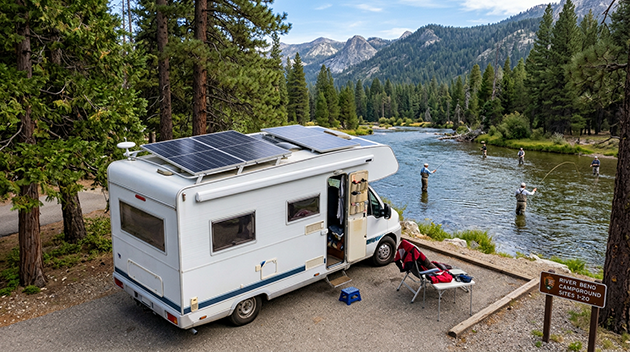
They’re lighter and lower profile, but they lie flat against a hot roof with no air gap. That heat cuts their output. The calculator uses about 10% less production for flexible panels mounted flat.



