Thank you for reading our post, please rate this article at the end.
Reading Time: 7 minutesLast Updated on November 15, 2026 by Paul Clayton
To determine the value of a used camper, start with its J.D. Power (formerly NADA) book value for the exact year, make, model and options, compare it with what similar campers are actually listed and selling for near you, then subtract the cost of any repairs a professional inspection finds. Water damage, old tires, roof condition and a clean title move the number far more than décor or gadgets. The seven tips below walk through that process step by step, with a worksheet you can use on any travel trailer, fifth wheel or motorhome.
I learned this the hard way. My first travel trailer was a used bunkhouse that fit my family perfectly, until a hidden leak in the back wall turned into a repair bill of several thousand dollars five months later, and I traded it in at a painful loss. My brother-in-law went the other way and bought a brand-new 40-foot trailer at a high price, and it arrived with a factory roof leak; a year later the toilet came through the floor. Quality is a concern new or used, so knowing what a camper is really worth protects you either way.

Table of Contents
Key Takeaways
| Tip | What to do | Typical effect on value |
|---|---|---|
| 1. Book value | Look up J.D. Power low, average and high retail with options | Sets the baseline |
| 2. Real listings | Compare 5 to 10 similar campers within a few hundred miles | Asking prices often run 5% to 20% above selling prices |
| 3. Water damage | Check walls, floors, ceiling and roof seams with a moisture meter | Can cut value by thousands or make the camper a project |
| 4. Age and depreciation | Expect the steepest drop in the first few years | Many towables lose roughly 20% to 30% early on and about half by year five to seven |
| 5. Tires, roof, mileage | Read tire date codes, roof age and engine miles | Deduct replacement costs |
| 6. Records and upgrades | Ask for service receipts; value upgrades modestly | Records add confidence; upgrades rarely return full cost |
| 7. Title and season | Verify VIN, title and liens; note local demand and time of year | A bad title is a walk-away; off-season can lower price |
7 Tips on How to Determine the Value of a Used Camper
1. Get the J.D. Power Book Value
J.D. Power acquired the NADA guides and remains the most widely used reference for RV values; banks and credit unions often lend against it. Enter the exact year, manufacturer, model and floor plan, then add factory options such as slide-outs, awnings, generator, second air conditioner and solar prep. Note the low, average and high retail figures.
Book value assumes average condition. Treat it as a starting point, not the final price, because the guide cannot see leaks, worn tires or a soft floor.
2. Compare Real Listings, Dealers and Private Sellers
Search for the same model, within a year or two either side, on dealer websites and private marketplaces. Five to ten comparable listings give you a realistic range. Keep in mind:
- Asking is not selling. Private campers commonly sell 5% to 20% below the listed price, and listings that sit for months are overpriced.
- Dealers price higher to cover reconditioning, financing and profit, but may offer a short warranty. Dealer lots do not always inspect trade-ins thoroughly, so do your own inspection either way.
- Owner forums for your brand often discuss recent selling prices and known weak spots for specific models.
Understanding broader trends helps too; our guide on how to read the RV market explains when prices rise and fall.

3. Hunt for Water Damage First
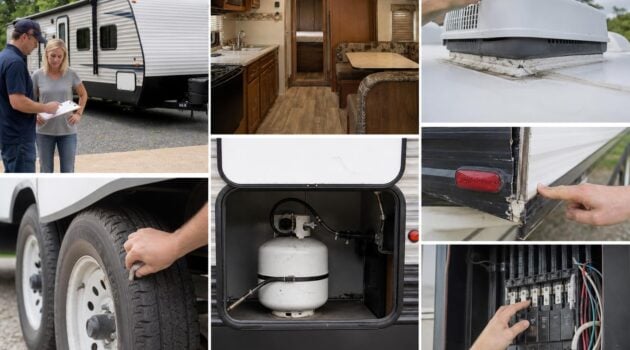
Water damage is the single biggest value killer. Wood framing and floor decking rot quietly behind fiberglass and paneling, and by the time you see it, repairs can run from about $1,500 for a small area to $10,000 or more for wall delamination or floor replacement.
- Press on floors near the door, bathroom, kitchen and slide-outs for soft spots.
- Look for stains, wavy paneling or bubbles in exterior fiberglass (delamination).
- Inspect every roof seam, vent and the front and rear caps for cracked sealant.
- Use an inexpensive moisture meter along walls and around windows; readings well above the rest of the wall point to a leak.
- Smell for mustiness and check inside cabinets and under beds.
A professional RV inspection usually costs about $300 to $1,000 depending on size and test level, and it often pays for itself in negotiation. See our breakdown of RV inspection cost and the mistakes to avoid when buying a used travel trailer.
4. Factor In Age and the Depreciation Curve
Campers lose value fastest when new. Many towables drop roughly 20% to 30% in the first year or two and around half by year five to seven, then the curve flattens. That is why a well-kept camper three to seven years old is often the best value: the first owner absorbed the steep loss and usually sorted out factory defects.
Very old campers can still be good buys at the right price, but expect more maintenance and check that campgrounds you plan to use do not have age limits. Read more in should I buy a 10-plus-year-old used motorcoach.
5. Check Tires, Roof and Mileage
- Tires: Read the four-digit DOT date code (week and year). Many tire makers and RV groups advise replacing trailer tires about every five to seven years regardless of tread. Budget roughly $500 to $1,200 for a set on a travel trailer.
- Roof: Ask what the roof material is and when it was last resealed or coated. A full roof replacement can run several thousand dollars.
- Mileage (motorhomes): Lower is not always better; a motorhome that sat for years can need seals, belts and fuel system work. Judge miles alongside service records.
- Appliances and systems: Run the fridge on both power sources, furnace, water heater, air conditioner, slides, jacks, awning and every faucet.
- Running gear: Look at the frame for rust, the axles for uneven tire wear and the hitch and brakes for damage.
6. Review Maintenance Records and Upgrades
A folder of receipts for roof inspections, bearing repacks, brake service and appliance repairs is a strong sign of care and justifies paying toward the higher book figure. Missing records mean you should assume deferred maintenance and price it in.
Upgrades such as solar panels, lithium batteries, a newer air conditioner or new flooring add appeal, but buyers rarely pay back their full cost. As a rule of thumb, count roughly a quarter to a half of what the seller spent, and only if the work was done well.
7. Verify the Title, Liens and Local Demand
Ask to see the title and confirm the name matches the seller’s ID and the VIN matches the camper. Deal with the owner directly, not a relative or friend. If a bank holds the title because of an unpaid loan, arrange the payoff through the lender so the lien is released when you pay; otherwise you can end up with a camper you cannot register. A missing, salvage or rebuilt title should lower the price sharply or end the deal.
Location and timing matter too. Prices are often softer in late fall and winter and in regions where camping is seasonal, and popular floor plans such as bunkhouses and lightweight couples trailers hold value better.
A Simple Used Camper Value Worksheet
- Write down the J.D. Power average retail value with options.
- Average the asking prices of comparable listings, then knock off roughly 10% to estimate real selling prices.
- Pick a starting figure between the two.
- Subtract the estimated cost of every repair found in the inspection: tires, roof work, soft floors, failed appliances.
- Add a modest amount for verified records and quality upgrades.
- Adjust for title status, season and local demand.
Example: a travel trailer books at about $22,000 and similar units are listed around $24,000 (selling nearer $21,500). Start near $21,500, subtract about $900 for tires past their date and $600 for roof resealing, and add a little for a documented service history. A fair offer lands around $20,000 to $20,500.
New vs Used: Which Holds Value Better?
A new camper gives you a warranty and a clean history, but you take the biggest depreciation hit, and fixing first-year defects can keep it at the dealer for weeks during camping season. A used camper that has been “burnt in” by its first owner often has those factory bugs already fixed, costs far less and loses value more slowly. For a first camper, I still recommend buying used and modestly priced: you will learn what you actually need before spending big. If budget is tight, see our list of the best used RV trailers under $5k.
Value of a Used Camper FAQ
Is J.D. Power (NADA) value accurate for campers?
It is the best starting point, but it assumes average condition and cannot account for local demand or hidden damage. Combine it with real listings and an inspection.
Are old RVs worth buying?
Often, yes, if the price reflects the condition. An older camper costs less and depreciates slowly, but water damage and worn systems are more likely, so an inspection is essential.
What is the biggest thing to look for in a used camper?
Water damage. Check floors, walls, ceilings, roof seams and slide-outs, and use a moisture meter. Rodent damage is another common hidden problem; see how to rodent-proof your camper.
How long do travel trailers last?
With good care, many last 10 to 20 years and some go longer. Roof maintenance and keeping water out are the biggest factors.
How can I add value to my camper before selling?
Fix leaks, replace expired tires, deep-clean, reseal the roof, gather service records and make sure every system works. These steps return more than cosmetic upgrades.
Final Thoughts
The value of a used camper is the book value adjusted by reality: what similar campers actually sell for, what the inspection finds and what the paperwork shows. Start with J.D. Power, compare real listings, hunt hard for water damage, price in tires and roof work, reward good records modestly and never skip the title check. Do that and you will pay a fair price, or know when to walk away.
Resources
- J.D. Power RV valuation guides (formerly NADA Guides)
- National RV Inspectors Association (NRVIA)
- RV Industry Association (RVIA) consumer information
- Tire manufacturer guidance on trailer tire age and DOT date codes