
Thank you for reading our post, please rate this article at the end.
Reading Time: 9 minutesLast Updated on December 31, 2025 by Paul Clayton
Table of Contents
What Is Switchbacks Hiking?
Key Takeaways
-
-
Definition and Purpose: Switchbacks are zigzag paths on steep terrain designed to create a gradual incline. While they reduce construction costs, their primary purpose in hiking is to prevent soil erosion by managing water runoff.
- The Danger of “Cutting”: Hikers should never take shortcuts between switchback loops. Doing so destroys vegetation, loosens soil, and creates gullies that eventually make the entire trail unusable and dangerous.
- Safety and Efficiency: Although switchbacks increase distance, they are safer and easier than climbing straight up. They provide a manageable grade that reduces physical strain and the risk of falling.
- Preparation Strategies: To prepare for switchback-heavy trails, hikers should practice stair climbing and build endurance by gradually increasing mileage on flatter terrain.
- On-Trail Techniques:
- Pacing: Maintain a slow, steady rhythm to conserve energy for the entire ascent.
- Hydration/Nutrition: Increase water and snack intake to accommodate increased physical demand.
- Gear: Use adjustable trekking poles (shortened for the uphill) to provide extra stability and support.
- Resting: Avoid sitting during breaks to prevent your heart rate from dropping too low and to prevent muscle strain from getting cold.
- Weight Management: Keep your backpack as light as possible without sacrificing essentials like safety gear, food, and water.
- Leave No Trace: Following switchback etiquette is a core part of the “Leave No Trace” principles. Staying on the designated path protects the environment and sets a positive example for other hikers.
-
Have you ever wondered what hiking switchbacks are? These are key segments of a hiking trail. While it may seem that they allow you to cover rough terrain, they serve a much more critical purpose.
Let’s discover why switchbacks are essential and why you should care about them.
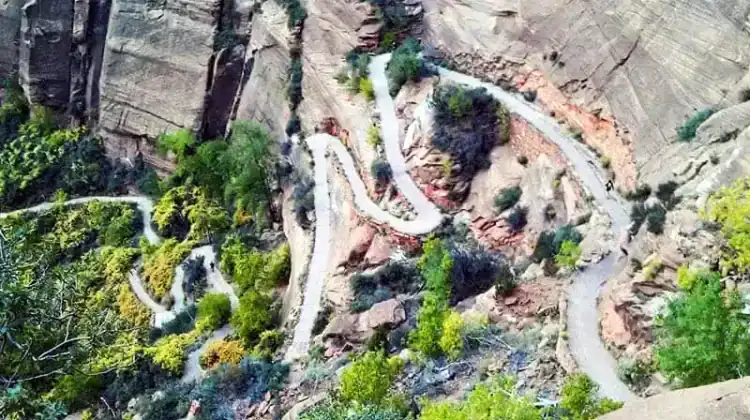
The term switchback is used in fields beyond hiking, but it has the same meaning: a switchback is a zigzag trail that ascends a steep hill or mountain. Switchbacks are commonly used in road and railroad construction.
The rationale for using switchbacks in road or railroad construction is to minimize the need for tunnels and extensive earthworks. In other words, switchbacks cut construction costs.
You could argue that hiking switchbacks follow the same rationale as road or  railroad switchbacks. However, there is one additional significant reason for the widespread use of switchbacks on hiking trails.
Why Are Switchbacks Important?
The purpose of switchbacks is to protect the earth from excessive erosion. Trails that run straight up a slope allow water to flow faster than zigzag trails. This, sooner or later, hollows out the trail and washes vegetation and soil down the hill.
A straight trail would eventually become unusable and even dangerous due to erosion. Switchbacks are used to address this issue. Not only that, but switchbacks are often complemented by rolling dips that allow water to be conveyed off the trail.
Can You Cut Through Switchbacks?
Switchbacks help preserve the environment, but they also make climbing the hill longer. So, can you cut through switchbacks to reach the top of the hill faster?
Well, you can, but you really shouldn’t. The reason for this is erosion. Cutting through a switchback will kill the vegetation and promote soil loosening. And while you may think that only a few people cut through switchbacks and that the damage can’t be too severe, things aren’t as simple.
This will be true initially. However, the damage will worsen over time as more people cut straight through a switchback. Eventually, the entire trail may become unusable due to soil erosion.
So please follow trail etiquette and do not cut straight through a switchback.
Next, you should realize that you are making the ascent more difficult by attempting to cut through a switchback. Switchbacks allow you to go uphill more easily; you won’t have to deal with the dramatic slope straight up the hill.
And while the distance will surely be longer, it will be easier for you to cover the entire switchback than to try to challenge the incline. Not only that, but the risk of falling off the trail is much lower due to the lower incline of switchback trails.
A switchback is a shortcut by itself, and by cutting through a switchback, you are defeating its purpose and making things more difficult for yourself. And if this wasn’t enough, you are also harming the environment, as described above.
Click here to read what cross-country hiking is.
How to Prepare for a Switchback
Even though switchbacks allow you to cut down the effort while ascending a hill, they remain quite challenging. Switchbacks can be pretty long, and they still have some slope. And as you probably know, it’s one thing to cover relatively level terrain and entirely another to go up even not-too-inclined hills.
Compare climbing stairs to walking on a flat surface, such as a level street.  Needless to say, going up the stairs is much more strenuous.
Speaking of stairs, it’s one of the best exercises you could do to prepare yourself for conquering your first switchback. Training on stairs may be a bit over-the-top, but once you can jump two steps at a time without significant fatigue, you can be sure that switchbacks won’t be able to defeat you.
Another tip is to try to build endurance on other, simpler trails. While your first switchback ascent will undoubtedly be challenging, building up to 15-20 miles a day on a more level trail will make things much easier for you.
Tips on Conquering Switchbacks
We want to share a few tips for navigating switchbacks easily.
The tips below apply to hiking in general. However, when it comes to challenging trail segments such as switchbacks, you must be more mindful of resource management.
No matter where you are, you must adapt your pace to the segment you are currently experiencing.
With that said, let’s move on to our five tips on conquering switchbacks.
Click here to read about the best time to hike Mount Washington
Keep a Steady Pace
First, maintain a steady pace. This tip applies to hiking, wherever you are, and switchbacks are no exception. Furthermore, when you encounter a switchback, you must be more careful with your speed.
We recommend slowing your pace when you approach a switchback. As with hiking in general, if you put all your effort into the early stages, you will become exhausted and won’t be able to continue at the same pace later.
You need to conserve energy to cover the entire switchback without struggling and pushing yourself to the limit. Besides, you should avoid giving it all to the switchback if there is still plenty of the trail left. You want to conserve your energy not only for the switchback but also for whatever awaits you next.
By the way, if you know at the beginning of the journey that there will be a switchback along the trail, be a little more careful with your energy expenditure since you’ll need it sooner or later when going uphill.
Stay hydrated
Again, stay hydrated throughout the hiking trip. But while ascending a switchback, you may need more water than on more manageable trail segments.
No one can tell you how much you should increase your water intake when dealing with switchbacks. You may not even need to do so if you feel well. Overall, we recommend drinking water when you feel thirsty.
By the way, you may want to take a little more water with you if you will be hiking on a trail with one or more switchbacks. The same applies to snacks. The more difficult the terrain, the more food and water you should take.
Make Use of Trekking Poles
If you haven’t been using trekking poles, it’s the right time to give them a shot at a switchback. Trekking poles can be insanely helpful in hiking, primarily when covering rough terrain.
Make sure to pick adjustable trekking poles; you will want to shorten them to account for the incline. You can also use fixed-length trekking poles on the ascent, but it will be less comfortable.
Avoid Sitting On Your Breaks
When taking breaks on your way up the switchback, avoid sitting. It will take less time for your heart rate to go back to normal if you sit. Rest only enough to catch your breath. You don’t want to get cold during your break, as it will be more challenging to pick up your pace.
Minimize Your Backpack Weight
This is another universal tip that applies wherever you hike. However, managing your backpack weight is especially critical on difficult sections of the trail. Your best bet is to have less in your backpack. It’s easier said than done.
On one hand, you will want to have a little more food and water when dealing with switchbacks; on the other, you want your backpack to be lighter. The situation is a bit weird. You must make some compromises to minimize your backpack’s weight.
If you can remove unnecessary items to make your backpack lighter, go ahead. Make sure to keep all your essentials in your backpack, though, because lowering the weight of your backpack at the cost of necessary items isn’t worth it.
If you can’t lower the weight of your backpack, at least try to keep it around the same mark. Again, you can remove unnecessary items to do so.
But what if there’s nothing to get rid of in your backpack?
In this case, you have no alternative but to take a heavier backpack. You shouldn’t omit necessary items or cut your food short to meet weight milestones.
You must be more mindful of resource management if you have a heavy backpack. For example, you may need to slow your pace to avoid becoming exhausted quickly. Remember that doing so will reduce the distance you’ll be able to cover.
If slowing down isn’t an option, you must work on your endurance before the trip to the challenging trail. As mentioned above, you can build up your endurance on easier trails.
Frequently Asked Questions
Q: Why can’t I hike straight up the hill instead of following the zigzag?
While a straight line is the shortest distance, it is also the most environmentally damaging. Straight trails act as funnels for rainwater, causing rapid soil erosion and destroying local vegetation. Following the switchback protects the mountain and provides a safer, more manageable incline.
Q: Is cutting through a switchback really that bad if I’m just one person?
Yes. While the damage from one person might seem small, it creates a visible path that encourages others to follow. Over time, these “social trails” damage the plants that hold the soil in place, eventually leading to significant erosion that can render the entire official trail unusable.
Q: How should I adjust my trekking poles when hiking uphill on a switchback?
If you have adjustable trekking poles, you should shorten them. Shortening the poles accounts for the hill’s incline, allowing you to maintain better balance and posture without reaching uncomfortably high with your arms.
Q: What is the best way to rest while tackling a long series of switchbacks?
The article recommends avoiding sitting down during your breaks. Instead, stand and catch your breath just long enough to recover. Sitting causes your heart rate to drop too quickly and allows your muscles to cool, which makes it much harder to regain momentum.
Q: How can I physically prepare for a trail that has a lot of switchbacks?
The best preparation is stair climbing. Training on stairs mimics the vertical effort required for switchbacks. Additionally, building up your general endurance on flatter trails (aiming for 15–20 miles) will make the strenuous nature of an uphill climb feel much easier.
The Seven Leave No Trace Principles
Since switchbacks are intended to preserve the environment, we think it’s  worth discussing hiking etiquette, particularly the seven Leave No Trace principles.
These principles help minimize our environmental impact when we hike. The seven principles aren’t important merely because they promote ecological friendliness; they are also vital because you don’t want to encourage others to violate the etiquette.
If people see you cutting straight through the trail, they will likely follow you. Besides, seeing an obvious shortcut through the trail will be very inviting to hikers. By adhering to the seven Leave No Trace principles, you can preserve the environment and discourage others from violating hiking etiquette.
The seven Leave No Trace rules are as follows.
Plan and Prepare
The first rule is to plan your trip at the right time. This rule promotes smaller parties and hiking on less busy days to help preserve the environment. Finally, the first Leave No Trace rule advises you to pack properly to manage waste.
Travel and Camp on Durable Surfaces
The second tip is closely tied to switchbacks. Overall, this rule promotes travel on durable, safe, and environmentally friendly surfaces. Staying on trails is the best option, as they are designed for hiking.
This rule also recommends wearing the lightest possible footwear to avoid leaving deep tread marks in the soil and tearing up the trail.
Dispose of Waste Properly
This one is pretty self-explanatory. Properly disposing of waste is essential for switchbacks, as polluting areas outside switchbacks encourages others to do the same.
Leave What You Find
This rule doesn’t apply to switchbacks, but it’s essential to follow it. Don’t take home souvenirs and leave everything in its place. You will thus reduce your footprint and allow others to enjoy nature.
Minimize the Impact of Fires
Again, the sixth tip doesn’t apply to switchbacks, but you should do everything possible to reduce your footprint and keep things natural when building campfires.
Respect Wildlife
In the context of switchbacks, remember that your laziness to cover a switchback may (and probably will) end badly in the long term. Don’t cut through switchbacks, and encourage others to follow your example.
Final Thoughts
Switchbacks are essential engineering features that balance hiker accessibility with environmental conservation. While they may seem tedious, they are vital for protecting the landscape from erosion.
By respecting trail etiquette, maintaining a steady pace, and preparing physically, hikers can safely navigate these steep sections while helping preserve the trails for future generations.