
Thank you for reading our post, please rate this article at the end.
Reading Time: 9 minutesLast Updated on February 23, 2026 by Paul Clayton
Table of Contents
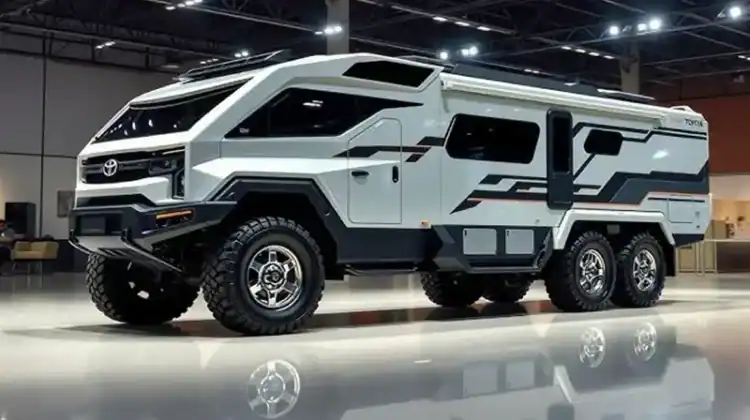
Toyota HikeCruze 6×6 is not a “weekend warrior” RV
The 2026 Toyota HikeCruze 6×6 has officially moved from a “viral rumor” to a serious conversation piece in the overland community. If you’ve spent any time on Crow Survival, you know we value equipment that doesn’t just look the part but can actually keep you alive and comfortable when the pavement ends and the nearest cell tower is 500 miles away.
Key Takeaways
-
- Engineering Purpose: The 6×6 configuration is designed for functional survival, offering superior payload distribution for heavy luxury gear, reduced ground pressure for soft terrain (sand/silt), and mechanical redundancy.
- Tiered Model Strategy:
- Nomad ($285k): Focused on utility and field repairs with industrial materials.
- Summit ($450k): Built for extreme cold and deep water with CTIS and thermal insulation.
- Zenith ($710k): The ultimate luxury/security build featuring ballistic armoring and a drone-launch pad.
- Hyper-Hybrid Powertrain: Features a 3.5L Twin-Turbo V6 Hybrid engine producing up to 780 lb-ft of torque in high-output trims. It includes a “Limp-Home” electric mode for low-speed travel if the combustion engine fails.
- High-Tech Navigation: The TerrainIQ 4.0 system uses Lidar sensors to scan 50 feet ahead, automatically adjusting the air suspension and locking the differentials before the driver hits an obstacle.
- Urban Maneuverability: Despite its size, Active Rear Steering allows the third axle to turn up to 5 degrees, giving it a turning radius comparable to a standard heavy-duty pickup truck (like an F-250).
- Self-Sustaining Amenities: The rig acts as a mobile fortress with all-electric induction cooking, UV/carbon water filtration, and an optional Atmospheric Water Generator that extracts moisture from the air.
The HikeCruze 6×6 represents a radical departure for Toyota, a company usually known for conservative, “bulletproof” simplicity. This rig is a high-tech, triple-axle, ultra-luxury fortress. While many in the industry initially dismissed the HikeCruze as a rendering, the 2026 “Vision Series” production path has solidified its place as the ultimate aspirational rig for serious preppers and long-term nomads.
Here is our deep-dive evaluation of the 2026 Toyota HikeCruze 6×6.
The Core Philosophy: Why 6×6?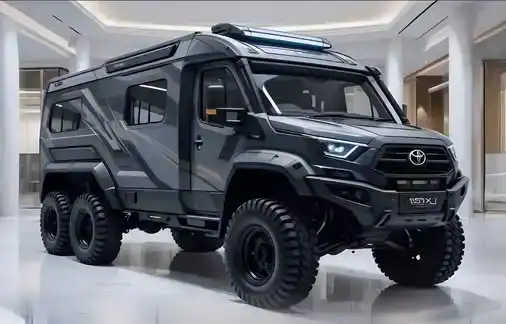
Before we get into the leather and the lithium, let’s talk physics. Why three axles? For the HikeCruze, it isn’t just about the “cool factor.”
-
Payload Distribution: Traditional 4×4 campers often struggle to meet the Gross Vehicle Weight Rating (GVWR) once you add 100 gallons of water, steel armor, and a full kitchen. The third axle allows the HikeCruze to carry a full-scale luxury apartment without stressing the frame.
-
Traction and Floatation: With six wheels driving, the ground pressure is significantly reduced. This means this 12,000-lb beast is less likely to sink in silt or soft sand than a standard heavy-duty truck.
-
Redundancy: In a survival situation, having a third axle means that even a catastrophic failure of one rear differential doesn’t necessarily leave you stranded.
Available Models & Trim Configurations
Toyota has structured the HikeCruze lineup into three distinct tiers. Each is built on the same 6×6 chassis but varies wildly in its internal systems and “survival” rating.
The Nomad Edition (The “Purist” Build)
-
Target: The hardcore overlander who prioritizes range and utility.
-
Exterior: Matte “Tactical Sand” or “Lava Gray” paint with high-clearance steel bumpers.
-
Interior: Industrial-grade materials. Think Marine-grade vinyl and powder-coated aluminum cabinetry.
-
Options: Manual locking hubs, a secondary 40-gallon fuel tank, and a simplified electrical system for easier field repairs.
-
Price: Starting at $285,000.
The Summit 6×6 (The “Extreme Environment” Build)
-
Target: Arctic explorers and high-altitude adventurers.
-
Key Upgrades: Full-body thermal insulation (rated to -40°F), heated lithium-battery bays, and an integrated “Snorkel” system for deep-water crossings.
-
Interior: Real wood finishes with heated flooring throughout the cabin.
-
Options: Central Tire Inflation System (CTIS), allowing you to air up or down from the driver’s seat.
-
Price: Starting at $450,000.
The Zenith Ultra-Luxury (The “Mobile Mansion”)
-
Target: The 1% who want to survive the apocalypse in total comfort.
-
Key Upgrades: Electro-chromic “Smart Glass” (tints at the touch of a button), AI-concierge system, and a Starlink-integrated rooftop deck.
-
Interior: Hand-stitched leather, a wine cellar (optional), and a 3D-mapping navigation suite.
-
Options: Level 4 ballistic armoring and a drone-launch pad for scouting trails ahead.
-
Price: Starting at $710,000.
Powertrains: The Heart of the Beast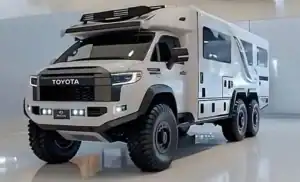
Toyota has stayed away from a pure EV setup for the HikeCruze, recognizing that charging stations are nonexistent in the middle of the Gobi Desert. Instead, they’ve opted for a “Hyper-Hybrid” system.
-
The Engine: A specialized i-FORCE MAX 3.5L Twin-Turbo V6 Hybrid.
-
Output: In its base form, it produces 540 hp and 650 lb-ft of torque. The Zenith trim features a high-output electric motor assist that boosts peak torque to a staggering 780 lb-ft.
-
Transmission: A reinforced 10-speed Automatic with a dedicated low-range transfer case that sends power to all three axles simultaneously.
-
The “Limp-Home” Mode: The hybrid battery can power the vehicle at low speeds (up to 15 mph) for several miles, even if the internal combustion engine fails, a critical survival feature.
Drive Modes:
The HikeCruze features TerrainIQ 4.0, an AI-driven system that uses Lidar sensors to scan the ground 50 feet ahead. It automatically engages the front, center, and rear-locking differentials before you even realize the terrain has changed.
Off-Road vs. On-Road Performance
Off-Road Mastery
The HikeCruze features the TerrainIQ 4.0 system. This uses Lidar scanners mounted on the roof to “read” the trail 50 feet ahead and automatically adjust the adaptive air suspension.
-
Articulation: The rear tandem axles use a “walking beam” suspension, ensuring that at least 4 wheels remain in contact with the ground even during extreme rock crawling.
-
Recovery: Every model comes standard with a 15,000-lb Warn Winch integrated into the front bumper and a second 10,000-lb winch in the rear.
On-Road Civility
Surprisingly, the 6×6 isn’t a chore to drive on the highway. Toyota’s Active Rear Steering allows the third axle to turn up to 5 degrees. This reduces the turning radius to something comparable to a standard Ford F-250, making gas station maneuvers far less stressful.
Interior Amenities: Five-Star Survival
Crow Survival readers often ask: “Can I actually live in it?” The answer is yes.
-
The Kitchen: An all-electric induction galley. No propane means no “boom” risk and more storage space. It includes a high-efficiency convection oven and a hidden countertop that slides out to double your prep space.
-
Water Filtration: A multi-stage UV and carbon filtration system that can pull water from a stream and turn it into potable drinking water.
-
The “Cloud-Rest” Sleeping System: In the HikeCruze, the bed is on a motorized lift. During the day, it sits against the ceiling, revealing a 4-person dinette. At night, it lowers with the linens already in place.
Detailed Options List (Survival Focus)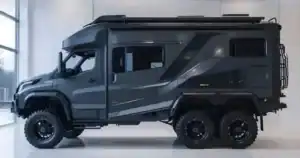
When ordering a HikeCruze, the options list is where you turn a truck into a home.
-
Solar Array Upgrade ($12,000): Replaces the standard roof with 1,200W of high-efficiency flexible solar panels.
-
Atmospheric Water Generator ($8,500): Extracts moisture from the air to produce up to 5 gallons of water per day (humidity-dependent).
-
Blackout/Silent Mode ($4,000): One-touch kill switch for all exterior and interior lights and electronic signatures for stealth camping.
The Visual Evaluation: 6 Key Perspectives
I. The Exterior “Stance” (Front-Quarter)
The HikeCruze looks like it belongs in a sci-fi film. The “Titan Trail” design language uses sharp, geometric angles rather than curves. The LED Matrix headlights are recessed to protect them from branches, and the massive 40-inch tires give it an unmistakable “go-anywhere” silhouette.
II. The Rear Expedition Hub
At the back, you’ll find the “Adventure Gate.” This modular rack holds two full-size spares, a set of MAXTRAX recovery boards, and a 5-gallon jerry can for emergency fuel.
III. The Roof-Top Command Deck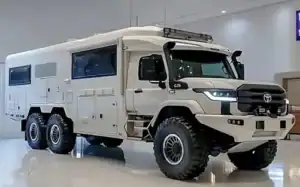
The roof isn’t just for solar. A fold-out railing turns the top of the camper into a “Safari Deck,” perfect for glassing the horizon or setting up a Starlink dish.
IV. The Pilot’s Cockpit
The dashboard is a wrap-around digital interface. It replaces traditional mirrors with high-definition side cameras to eliminate blind spots, a necessity when you’re 25 feet long.
V. The Living Lounge
The interior uses “Smart Glass” windows that can turn opaque for privacy or 100% clear for a panoramic view of the wilderness. The seating is upholstered in “Endura-Fabric,” a puncture-resistant, easy-to-hose-down material.
VI. The Utility Bay
Behind an exterior hatch lies the “heart” of the rig: a massive 20kWh LFP battery bank, the inverter, and the water manifold. Everything is color-coded and labeled for easy troubleshooting in the field.
Frequently Asked Questions
Q: What is the primary benefit of the 6×6 configuration over a standard 4×4?
While the “cool factor” is high, the third axle is purely functional. It allows for superior payload distribution, meaning the truck can carry a “luxury apartment” (water, armor, and a full kitchen) without stressing the frame. It also provides better floatation on soft surfaces like sand and mechanical redundancy if one rear differential fails.
Q: How does the “TerrainIQ 4.0” system assist with off-roading?
This AI-driven system uses Lidar sensors mounted on the roof to scan the terrain 50 feet ahead. It automatically adjusts the adaptive air suspension and engages the locking differentials before the vehicle even reaches the obstacle, ensuring a seamless transition across difficult terrain.
Q: Can the HikeCruze 6×6 be driven on normal roads and in cities?
Surprisingly, yes. To combat the typical bulk of a 6×6, Toyota included Active Rear Steering, which allows the third axle to turn up to 5 degrees. This significantly reduces the turning radius, making it roughly as maneuverable as a standard heavy-duty pickup, such as the Ford F-250.
Q: What happens if the vehicle runs out of fuel or the engine fails in a remote area?
The HikeCruze features a “Hyper-Hybrid” powertrain. A critical survival feature is the “Limp-Home” mode, which allows the high-capacity lithium battery to power the vehicle at speeds up to 15 mph for several miles, even if the internal combustion engine is completely disabled.
Q: What are the different models available, and how much do they cost?
There are three distinct tiers designed for different lifestyles:
-
The Nomad ($285,000): A utility-focused build for purists.
-
The Summit ($450,000): Built for extreme environments with -40°F thermal insulation and central tire inflation.
-
The Zenith ($710,000): The “Mobile Mansion” featuring ballistic armoring, an AI concierge, and a drone-launch pad.
Comparison: HikeCruze vs. EarthRoamer LTi
For those cross-shopping the industry titans, here is how the 2026 HikeCruze stacks up against the legendary EarthRoamer LTi.
| Feature | Toyota HikeCruze 6×6 | EarthRoamer LTi |
| Drive Configuration | Full-Time 6×6 | 4×4 (Ford F-550) |
| Engine | 3.5L/4.4L Hybrid | 6.7L Turbo Diesel |
| Turning Radius | 22.5 ft (Rear Axle Steer) | 26.8 ft |
| Body Construction | Aluminum-Steel Hybrid | Carbon Fiber |
| Price (Base) | $285,000 | $825,000 |
| Advantage | Maneuverability & Tech | Interior Volume & Provenance |
This video has been included to clarify the topic. Credit goes to YYD Auto
Real-World Alternatives You Can Buy Today
If you are looking for a high-end 6×6 or expedition vehicle that actually exists, here are three leading options:
1. JMACX 6×6 (The “Real” HikeCruze) 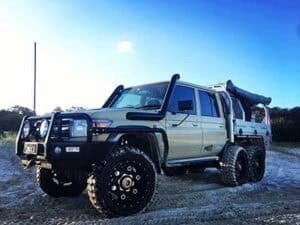
Based in Australia, JMACX is the gold standard for Toyota 6×6 conversions.
-
Why it’s similar: It uses a Toyota Land Cruiser donor vehicle and adds a third driven axle with full engineering certification.
-
Key Feature: Their “Super Chassis” replaces the entire rear of the truck with a stronger, coil-sprung frame capable of carrying massive camper modules.
2. Patriot Campers MEGA 6×6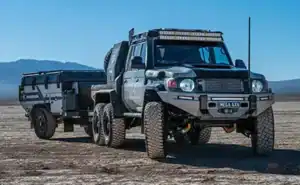
A famous “monster” built that often tours the US and Australia.
-
Why it’s similar: It looks exactly like the rugged “Nomad” version of the HikeCruze.
-
Key Feature: Features 37-inch tires, portal axles for massive ground clearance, and a custom Nappa leather interior. It is essentially a “Zenith” trim brought to life.
3. EarthRoamer LTi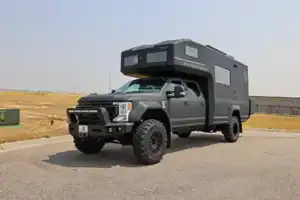
The vehicle that the HikeCruze article specifically compares itself to.
-
The Reality: While the HikeCruze is cheaper in the article ($285k), a real EarthRoamer starts around $750,000–$850,000.
-
Key Feature: It uses a carbon-fiber camper body mounted on a Ford F-550 chassis. It is the most “proven” luxury expedition rig in the world.
Final Thoughts
The 2026 Toyota HikeCruze 6×6 is not a “weekend warrior” RV. It is a heavy-duty expedition tool designed for the 0.1% of travelers who intend to go where there are no roads. The 2026 Toyota HikeCruze 6×6 is the first vehicle we’ve seen that successfully combines Toyota’s legendary “Limp-Home” reliability with the opulent comfort of a high-end yacht.
While the $300k+ price tag is steep, when you factor in the Toyota reliability and the fact that it replaces both a luxury SUV and a home, the value proposition starts to make sense for the serious survivalist. For that serious survivalist who views their vehicle as their primary insurance policy against a changing world, it is an investment in absolute freedom.