Thank you for reading our post, please rate this article at the end.
Reading Time: 14 minutesLast Updated on December 6, 2025 by Paul Clayton
Table of Contents
How RV Salvage Yards Can Save You Money
Key Takeaways
-
- Cost Savings: Buying an RV from a salvage yard is primarily a way to save money compared to buying a brand-new RV, which can be very expensive.
- Definition of a Salvaged RV: A salvaged RV is one that an insurance company has declared a “totaled loss” and paid a claim on due to significant damage (structural, interior, etc.) or, in rare cases, because it was stolen and then recovered.
- The Price Equation: The actual cost-effectiveness depends on factoring in all expenses: purchase price + repair costs + any missing parts + inspection/insurance costs. A successful salvage purchase requires the total cost to be lower than that of a comparable new/used RV.
- Key Differences from New RVs: Salvaged RVs typically lack warranties and have lower resale value (especially in the short term). Quality and reliability can vary significantly, requiring thorough investigation.
- Importance of Due Diligence: Buyers must get all documentation related to the RV’s history and the reason it was salvaged. This is crucial for assessing necessary repairs and costs.
- Self-Awareness of Project Scope: Buyers need to decide how much repair work (zero work, interior-only, exterior/engine/structural) they are willing and able to handle, as this limits the search pool and determines the potential discount.
- Market Strategy: The salvage RV market is smaller (lower supply and lower demand), which can encourage sellers to negotiate. Buyers should be professional and assertive without being aggressively rude or desperate.
- Long-Term Value: Salvaged RVs are generally a better option for long-term ownership, as the “tainted title” significantly hurts short-term resale value but becomes less of an issue as the vehicle ages.
- Parts Sourcing: Buyers can often find discounted parts at other salvage yards or “surplus stores.”
Frequently Asked Questions
Q: What exactly does “salvaged RV” mean?
A: An RV is classified as “salvaged” when an insurance company declares it a “totaled loss” and pays out a claim. This usually means the cost to repair damage (which can be structural, interior, or otherwise significant) is deemed unfeasible, though it can also occur if a stolen and recovered RV is later sold.
Q: How can I ensure a salvaged RV is a good deal and not a financial trap?
A: You must thoroughly research the RV’s history by obtaining all documentation related to the salvage claim. Crucially, factor in all potential costs (purchase price, parts, repairs, inspection, and extra insurance) to ensure the final, fully-repaired total is significantly lower than the price of a comparable non-salvaged RV.
Q: Do salvaged RVs come with a warranty?
A: Generally, no. Since an insurance claim has already been paid on the vehicle, standard manufacturer or dealer warranties are typically void. Any warranty offered would be rare and likely limited, so thorough personal investigation is advised.
Q: How does a salvage title affect the ability to sell the RV later?
A: A salvage title significantly lowers the RV’s resale value, especially in the short term. Many dealers may refuse to take it, and individual buyers may be hesitant to take it. The article suggests salvaged RVs are best for long-term use, as the “tainted title” matters less as the vehicle ages.
Q: Where can I find affordable parts to repair a salvaged RV?
A: You can often find discounted parts by checking other RV salvage yards and “surplus stores.” These stores hold extra manufacturer parts, which, due to low demand, can often be purchased at significant discounts (up to 50% or more).
So what’s the knock on RVs?
Well, they’re not exactly cheap. Premium RV models have price tags that could make you fall over from shock. In some instances, RVs can cost as much as a house and take substantial financing, so you really need to be sure you’re getting exactly what you want when you make a purchase.
On top of that, many people are looking for cheaper ways to buy RVs.
RV Salvage Yards can really help you get moving when you’re not quite looking to spend a fortune. It’s an interesting idea that many are starting to catch on to as a way to lessen the pain of buying an RV brand-new.
- Today’s Best Pop-Up Campers
- New vs. Used RV: Navigating the Price Trends
- Can You Rent an RV for a Year?
Your RV
The reason for buying an RV is simple – you want the luxury of home brought along for the road.
If you’re trying to “rough it” minus the “roughing it” part, RVs are probably the start and end of your search.
We brought up costs in the introduction, so let’s get into strategies for looking into buying RVs from salvage yards and how that can save you money.
What Is A Salvaged RV?

There are many different reasons a vehicle can be classified as a “Salvaged RV”.
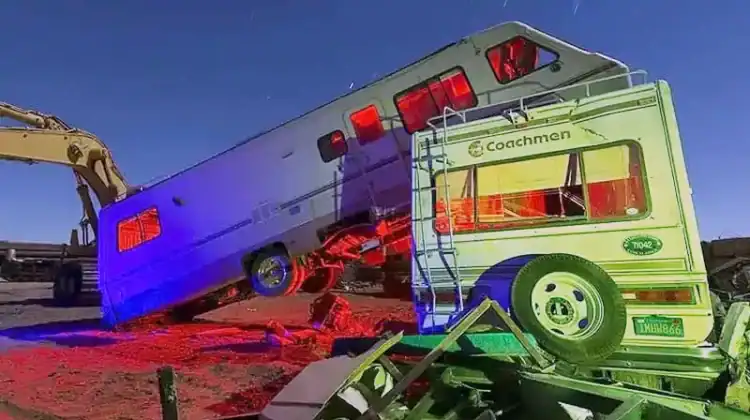
Basically, there’s been some reason that the RV has been declared “totaled”. This means an insurance company has paid a claim for the vehicle. In many instances, some physical damage started a claim.
This level of physical damage could vary widely depending on the cause of the claim. First of all, there could be some structural damage that indicates a serious problem with the RV. In other cases, an RV may simply have had interior damage so severe that it rendered the RV unusable.
No matter the reason that caused your RV to be taken off the streets by an insurance company, it’s a pretty good bet that it was significant in some regard. It’s up to you to get that information and decide whether the repair work has already been done or needs to be done, and what you’re willing to put up with.
On top of all of these differences, you can also find some occasional RVs that end up being salvaged for other uses.
If a claim is paid on an RV because it’s reported stolen, that still falls under the category of a salvaged vehicle. This would happen if the vehicle is found or recovered, then it could still become available for sale. In a situation like this, where there’s no real damage, you could find yourself in an amazing RV at a steal of a price.
The Difference Between New And Salvaged
It’s obvious that if you’re buying a salvaged vehicle, you’re not getting something brand new.
However, what are the real differences between a new and a salvaged vehicle? Many things can be affected:
- Price
- Warranties
- Quality
- Reliability
- Ability to Sell
Price
This is the #1 reason you’re even reading this article right now – salvaged RVs can help you save on price. The biggest thing to remember is that you have to factor all repair costs and extra costs into the original price tag.
If a new RV costs $50,000 and a salvaged RV costs $30,000, and you put $20,000 back into the RV, you just came out a big-time loser. You bought a worse product and paid the same exact amount. On top of that, you have some other factors to consider.
Just be smart about what you’re spending and make sure that the bottom line matches the expectations.
Warranties
Since an insurance company already paid out a claim on your RV, there’s really no warranty info to speak of. Some stores may be willing to guarantee something if they’ve done their own repair work or offer warranties on parts of the RV that are unaffected, but I’d find that somewhat rare and would advise you to do a thorough investigation before you buy.
Quality
This one could go either way. Sometimes, salvaged RVs are still high-quality vehicles with plenty of life left in them. Other times, they need to be completely rebuilt and could even be dangerous to those  who ride in them.
You really need to do your homework here and figure out if the quality of what you’re buying is worth it.
Reliability
This is a big one for many people. You could be making a major investment, so to save money, you need to buy a reliable vehicle. Investigating the condition of the salvaged tag will help you decide whether you’re getting a reliable vehicle or one that can be returned to that condition.
Ability to Sell
Generally speaking, you’re not going to be able to sell these RVs again – at least not at a high price, and certain parties will flat-out tell you, “no”.
Salvaged RVs can be great if you’re going to hold on to them, just don’t expect to flip them quickly if you lose interest.
Get Documentation
Buying a salvaged RV comes down to doing your homework and doing it quite well.
If you decide to buy a salvaged RV, you can’t start to take people’s word for anything. I know it doesn’t feel good not to trust others, but you can’t trust others. Get all the documentation related to the RV so you have a clear picture of what’s going on.
While your friendly salesman may be telling you the whole truth, there’s nothing wrong with getting it all on paper and making sure you have all the facts. From there, mechanics may be able to give you better estimates of the vehicle and help you decide whether you’ll need to put a lot of money into the project.
If everything checks out, you can proceed with confidence, knowing you’re getting exactly what you’re paying for—a nice deal!
Knowing What You Want To Work On
This is similar to the last section about getting documentation. Buying a salvaged RV comes down to having a lot of self-awareness. When you buy an RV, you need to have a specific game plan.
How are you going to attack this purchase?
If you only want salvaged RVs that are zero work, you’ve limited yourself to stolen RVs or to something paid out for a very rare claim. That means you’re going to limit your possible results, and it may take you a long time to find a salvage RV. That’s fine, but just keep that search time in your mind as you look – don’t get frustrated without results right away.
If you’re talented and looking for a project you can completely redesign, you might be interested in a salvaged RV with interior damage. Ideally, in this situation, you would want to find a vehicle with no structural or exterior damage.
The interior could be a pain, but probably isn’t as hard to work on as the structure or something like engine issues, so if you’re looking for a project, that might be your best bet. However, be sure to get your full documentation and think critically about whether any of these interior problems will also cause exterior problems later.
Not many problems in a salvaged RV — just one issue, and that’s it. Oftentimes, these things are related, and problems can spread over the life of a vehicle.
If you’re a mechanic yourself or are planning on hiring a mechanic, you may be willing to get a bit riskier and venture into salvaged RVs that have exterior problems, engine failures, or total vehicle damage, including structural damage.
These problems are the worst of the worst and should get you a significant  discount; however, you will have to put time or money into the vehicle as a sacrifice for that discount.
Some people love a tinkering project, and that will be right up their alley. If you want to keep this vehicle for a long time, and you’re confident that you or your mechanic can fix it up the way it needs to be, then you’ve got a great match.
In the end, it all comes down to self-awareness. You do not want to fall into the trap of talking yourself into something that isn’t a great fit.
When you do find that great fit, though, you’re in business.
Check Often
Since we’ve been talking about searching so hard for deals, here’s a tip for finding great deals on salvaged RVs.
You need to check the marketplace often.
New deals can pop up at any time, and if you only search once a month, you’re going to miss out on some incredible deals that pop up.
There are various online and physical salvage yards where you can find models.
You should probably consider bookmarking those websites for easy viewing, and if you’re a serious customer who builds a relationship at a salvage yard, you can set them up to help you by asking for notifications when a specific model or a specific type of salvage project comes in.
If you make it clear that you’re a serious buyer, they’re definitely going to get you on the phone when a call comes in – it’s important to their bottom line to make that sale.
The more research you do, the better your chances of finding a great deal on a salvaged RV that fits your exact needs. That takes some time, but that can turn into a big win.
Where To Look
For physical locations, I love this website. They have a nice listing and can make it easy to sort by state.
Since there’s not a whole bunch listed there, you should also do your own Google searches for both websites with salvage RV listings and retailers who may be selling salvaged RVs around you.
Since there are fewer of these salvage yards than traditional sales lots, you’ll need to set your expectations properly. You may be in for a bit of a lengthy drive to check out models, and you may have to search Google a little bit harder than you normally do. Stick to it, you’ll find those sellers that are out there with the best deals.
Navigating a Smaller Market
Buying a salvage RV is different than buying a brand-new RV, and that’s due to the fact that there’s a much smaller market for salvage RVs. Don’t let yourself think that’s a complete negative; this can actually be positive in your favor.
Think about supply and demand – in the salvage RV market, there is generally less supply AND less demand. Simply put, the market is smaller in every single way. That changes many factors at play and should change how you behave as a buyer as well.
Both sides in this scenario are probably more willing to find a deal when the terms are right. As a buyer, you need to be careful not to let on that you’re getting desperate to find a bargain. The salesmen are obviously going to know that you’re looking for an RV on the cheap, but that doesn’t mean you play into their hands.
At the same time, they should be willing to negotiate because when is the next time a buyer is going to come across their path, looking for an RV that is clearly damaged in some way, shape, or form?
It pays to be polite and professional without giving out any clues. You shouldn’t treat this as a war where the sellers are terrible people and are out to get you. If they’re hiding details from you, I wouldn’t do business with them, but if they’re open and actively trying to help you find a good fit, I would go in with a somewhat honest approach and be clear about your limits and what you’re looking for.
This is always a feeling-out process, but because the market is smaller, you don’t want to burn any bridges right away. For example, if one McDonald’s restaurant got mad at you, you could probably go to the McDonald’s down the street.
If you anger someone selling salvaged RVs, it may be hard to find another one close to you, and as small as the market is, I would believe it if word spread.
In the end, just be professional and realize that you’re dealing with a smaller market, fewer items available, but also fewer buyers. Don’t be intimidated by the fact that you’re dealing with products that were abandoned in some way, but don’t be aggressively rude about that information either.
Be logical, be cool, and simply be assertive when trying to find the best deal, and you will find yourself saving money in no time.
Down The Road
It is important to note that several factors will affect the future of your salvaged RV.
RV salvage yards help you save money when you’re buying an RV that you’re going to use long-term.
Many dealers will not even look at you as a seller if you have a salvage title, and it could affect individual buyers as well. This “tainted title” could hold you back if you plan to use your RV for less than a year and then sell it. Someone will be buying your RV that you put work into for pennies on the dollar.
At the same time, this doesn’t have to be negative. As your vehicle ages, its perceived value will decline, and if you’ve kept the RV in good shape, someone is less likely to worry about whether it was salvaged 7 years ago.
Will you still have some individuals scared away? Sure. However, it’s less likely to matter when the price tag creeps cheaper and cheaper, so, at the end of the product life cycle, it’s probable that you’re going to be able to make a fairly easy sale.
This just makes it even more important to do your homework and make sure you get a deal up front, because salvage RV buying is the best option for those who want a long-term solution.
The Bottom Line
Buying a salvaged RV is a great way to save on the bottom line, as long as you make it there.
You want to make sure you factor in as many costs as possible beforehand.
This process works, but only when you do your homework.
Factor in everything, including:
- Purchase price
- Repair costs
- Buying any parts that may be missing from your RV
- Any inspection costs needed
- Any extra insurance costs
- Anything you may lose out on, like warranties or dealer specials
Listen, buying a salvaged RV can be a great idea even when you factor all of these costs into your decision, but it’s still important that you do them.
When you’re buying a vehicle for a reason like a recovered stolen claim, a lot of these could be “zeroes”.
If the outside is simply damaged and can be repaired and reinforced, you may not need to replace parts, so you can scratch that off.
This process can get you into a great deal very quickly – or turn your purchase upside down. Just make sure you’re doing your homework and adding up the numbers. When the numbers make sense, you save cents!
Getting Parts
Getting parts is one of the more fun parts of having a salvaged RV. There are salvage yards that may be holding different parts, and you may have to go on an adventure to find them.
At the same time, there are also things called “surplus stores” where people hold on to extra RV parts from manufacturers.
Buying parts at these stores can lead to discounts of up to 50% (sometimes more) and is a great way to get your salvaged RV back up to speed.
While it kind of sounds like you’re taping up an RV together with duct tape and old pieces, that’s not the case. These stores often have high-quality items, but they’re simply not in high demand. When demand is low, that’s when you can strike for a great bargain.
Again, you may need to be persistent in your search. Finding these items can be difficult at times, but for the resourceful customer, you’ll be able to add parts cheaply and keep those costs down right where we like them.
What does salvage mean on an RV?
The term “salvage”, when applied to an RV, refers to the status of a recreational vehicle that has endured such considerable damage that the cost of its repair would typically be deemed unfeasible. This status, known as a salvage title, is often assigned when an insurance company determines the RV is a total loss.
In essence, an RV with a salvage title indicates that the damage sustained is extensive enough to question its repairability.
Where to find Salvaged RVs
There is no official, up-to-date national database that provides an exact number of RV junk or salvage yards in the USA, but most sources agree that the total is likely in the low hundreds, with some estimates placing the number of specialized RV salvage or junkyard operations between 75 and 120 nationwide. Many states have only a handful (often fewer than five), while larger states with more RV activity—such as California, Florida, Indiana, Arizona, and Texas—may have several each.
Distribution and Notable Yards
-
RV salvage yards remain a niche segment compared to general auto salvage yards, and many are clustered in regions with active RV manufacturing, sales, or repair industries (such as Indiana or Kentucky).
-
Notable large yards include Visone RV in Kentucky, reportedly housing over 1,000 salvage RV units, and Colaw RV Salvage in Missouri, both of which serve clients across the US.
-
Salvage yards acquire written-off or non-roadworthy RVs, then sell used parts or recycle the remaining materials.
Rarity and Industry Trends
-
In recent years, RV-specific salvage yards have become increasingly rare, particularly in states with higher disposal or zoning restrictions.
-
Some auto salvage yards will also accept and process RVs, blurring the distinction between strictly RV-focused businesses and general junkyards that accept recreational vehicles.
While industry directories and websites provide partial listings, a precise nationwide number fluctuates due to ongoing business closures, mergers, and regulatory changes.
Final Thoughts
At the end of the day, buying a salvaged RV can be a great win for you as a customer. The best wins happen when you’re persistent and you do your homework.
Don’t settle for something that isn’t a great match for you – that will lead to regrets.
Think about your situation and have a very specific match in mind. It sounds goofy, but you almost want to visualize the RV you want before you find it.
Trying to “press” to find a model isn’t the answer. Enjoy the process and give yourself time to find that perfect model. You also want to check sites and dealers regularly so you see the best offerings as soon as they hit the market.
With this knowledge, you can save money and make a high-quality purchasing decision when buying a salvaged RV.
Home page
Back to the top of the page