

Thank you for reading our post, please rate this article at the end.
Reading Time: 9 minutesLast Updated on February 3, 2026 by Paul Clayton
Table of Contents
9 Tips for Finding the Best RV Financing
Key Takeaways
-
- Financing Options: Buyers can choose between dealer financing, which offers speed and promotional rates, or bank/credit union financing, which typically provides lower rates by avoiding dealer markups.
- The Cost of Interest: Interest is the fee paid for borrowing money. The interest rate and loan term primarily determine your loan’s total cost.
- Loan Term Impact: While longer terms (up to 20 years) result in lower monthly payments, they significantly increase the total interest paid, sometimes exceeding the RV’s actual value.
- The Power of Down Payments: Paying more upfront (ideally 15-20%) reduces the principal balance and total interest, making the loan more cost-efficient over time.
- Credit Score Influence: A higher credit score directly translates into lower interest rates and a better chance of loan approval.
- Negotiation Leverage: RV prices often have significant markups; researching market values and obtaining bank pre-approval can help you negotiate a better price at the dealership.
- Tax Benefits: If your RV has sleeping, cooking, and toilet facilities, the loan interest may be eligible for a mortgage interest tax deduction.
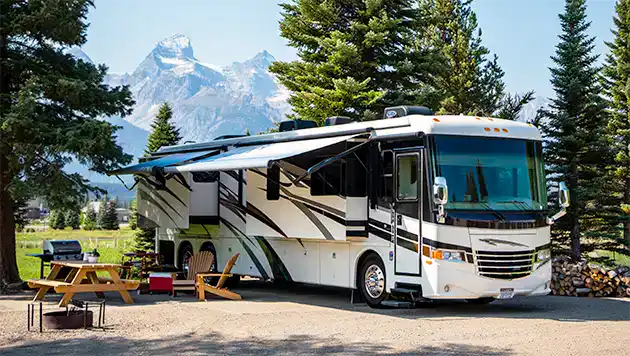
The journey of purchasing an RV can be both thrilling and overwhelming, given the significant financial commitment involved. Herein, we present a comprehensive guide on ‘9 Tips for Finding the Best RV Financing’.
This guide will equip you with the financial strategies and tactics to make your RV purchase smoother and more affordable. It covers essential aspects, including understanding your credit score, exploring financing options, negotiating the price, and more.
By following these tips, you can secure a great deal and make your dream of owning an RV come true.
- Today’s Best Pop-Up Campers
- New vs. Used RV: Navigating the Price Trends
- Can You Rent an RV for a Year?
An RV can be a costly buy. But who said you have to pay it up front? After all, there are so many RV financing opportunities out there that you could make use of!
With that being said, let’s try to understand how to finance an RV and what you should pay special attention to.
How To Finance An RV
Let’s first begin by reviewing the ways of RV financing. Those are financing options: either directly with the dealership you are buying from or through a third party, such as a bank or credit union.
Each option has pros and cons, and we can’t say one is clearly better than the other. Deciding which choice is better for your budget and convenience is up to you. But to help you a little, let’s have a look at the advantages and disadvantages of either way of RV financing.
Dealer financing
Financing through the dealer often isn’t the most cost-efficient way to go, but there are, nonetheless, some bonuses that come with dealer financing.
The main advantage of RV financing through a dealer is quickness. You don’t have to address any third parties to arrange an RV loan. Everything can be done in minutes, on the spot, without you having to go back and forth between the dealer and a financing institution.
Additionally, you may occasionally encounter time-limited promotional offers with very low interest rates. Third parties, such as banks and credit unions, typically don’t offer discounts on financing rates.
With that being said, financing through an RV dealership isn’t always the most cost-efficient way to go. Dealer financing can be convenient, but you will have to pay for that convenience.
To enable RV financing for customers, RV dealerships negotiate deals with financial institutions. Essentially, an RV dealership serves as a middleman between you and a financial institution. And the bad thing here is that dealers add their own markup on the loan, so you end up paying more than you would if you dealt directly with a lending institution.
This doesn’t mean that dealer financing can’t be beneficial. If you are confident the dealer will help you secure the best deal, you may work with them.
Bank financing
The best thing about bank or credit union financing is that you get plain consumer rates without dealer markups. From a cost-efficiency perspective, financing through a bank is often the best option.
Aside from that, if you’ve worked with a bank for a long while, you can be confident that they will work with you to find a great deal, as well as that no hiccups will happen in the process.
On the other hand, the downside of financial institutions is that they offer the best possible deal with no room for negotiation. You either take it or leave it.
Additionally, financing through a third party may take time due to back-and-forth between the dealership and the bank, as well as application processing times.
The importance of numbers
Whether it’s a bank or a dealership, the party financing an RV ultimately depends on the numbers. When choosing between dealer and bank financing, numbers play a role in agreeing on interest rates and loan terms.
Knowing the amounts you will need to pay is essential to securing the best deal. Things can get pretty complicated, though, for a first-time customer, so we’d like to cover a couple of crucial things that you should know about when it comes to the costs of RV financing.
There are more or less complex financial calculations behind the scenes, but we won’t dive too deep into them so that you stay on board with us.
What is interest?
When you take out a loan, you will have to pay back the base amount that you have borrowed, as well as some interest on top. If you finance a $75,000 RV, you will have to pay not only the $75,000 but also additional interest, which depends on several factors we will review shortly.
Interest is the fee you pay for using a bank or credit union’s money. Interest allows financial institutions to profit from their transactions.
Typically, the repayments that you need to make on a loan are made up of two components: a component that reduces the amount you owe for the principal amount (the sum that you borrowed) and a component that covers the interest on the loan.
The amount of interest you pay on the financed RV primarily depends on the interest rate and the loan term. If you know these two, you can calculate the monthly payments you will need to make (including both the repayment for the loan and interest), as well as the total amount of interest that you will have to pay throughout the loan.
The total interest you will pay on the loan determines the loan’s cost efficiency. Generally, you’d like to choose a loan with a lower total interest cost, but this depends on your needs.
Now that we understand the basic things that you will need to deal with when financing an RV, let’s discuss the factors that impact the amount of payable interest on RV financing.
Factors that impact the amount of interest
As noted above, the total interest you will pay depends on the deal’s interest rate.
In RV financing, the interest rate is typically expressed as an annual percentage. However, since loan repayments are usually made monthly, the interest rate is adjusted to a monthly rate by dividing the annual interest rate by the number of payments made in a year (=number of months in which you will be making repayments).
The interest rate by itself is crucial in RV financing, but there is more you will need to know to find out how much interest you will have to pay in total. Several key factors affect the total interest payable on the loan.
To more clearly demonstrate the impact of these changes, we will use an RV loan calculator from Mortgage Calculator. To keep things simple, we won’t dive into the financing aspect of the loan calculation and will provide numbers to make the impact of the key factors clear.
Loan term
The loan term is the most essential factor in calculating a loan’s total interest. The loan term is the period during which the loan is repaid in equal installments.
Typically, RV financing is arranged for 5-15 years, with some institutions offering 20-year terms. At a fixed interest rate, the longer the loan term, the lower the monthly payment, but the higher the total interest. This means that while longer loans are easier on your budget in the short term, they are much less cost-efficient in the long term.
Let’s take an example with a $25,000 vehicle price, a 6% interest rate, 10- and 20-year loan terms, and everything else set to 0. If you plug these numbers into the calculator, you will see that:
- For a 10-year loan, the monthly payment is $277.55, and the total interest is $8,306.15.
- For a 20-year loan, the monthly payment is $179.1,1, and the total interest is $17,985.86.
This clearly demonstrates what we described above. With a longer loan term, you may end up paying more interest than the RV is worth at the end of the loan!
In reality, however, interest rates decline as loan terms lengthen, reducing the practical difference between interest rates. Longer-term loans still imply higher total interest, however, so you should go for a shorter-term loan if possible.

Down payments
A down payment is the amount you pay up front on a loan. A $10,000 down payment reduces the principal amount owed by $10,000. If you don’t account for taxes, $25,000 with a $10,000 down payment is equivalent to a $15,000 loan with no down payment.
Let’s take the above numbers, as well as a 6% interest rate and 10 years of duration, as the basis of calculation. We get:
- With no down payment, the monthly payment is $277.55, and the total interest is $8,306.15.
- With a $10,000 down payment, the monthly payment is $166.53, and the total interest is $4,983.69.
If you enter a $15,000 vehicle price with no down payment, you’ll get the exact numbers as with a $25,000 loan with a $10,000 down payment, assuming the sales tax is set to 0%. If the sales tax weren’t set to 0%, there would be differences between these loans, since sales tax is applied to the vehicle price before the down payment is deducted.
Trade-in
You probably know that trading in your older RV allows you to get a discount on the estimated value of the RV. When trading in your older RV, you are essentially making a down payment.
Things are a bit different if you still owe anything for your old RV to a bank or the dealership. If you still owe $5,000, the loan amount will be increased by $5,000.
Credit score
Your credit score affects the interest rate. The higher your credit score, the lower the interest rate will be for you. Shopping around, you can still find a good deal with a sub-par credit score, but generally, if you have a bad score, you will mostly find higher rates, as well as outright rejection.
9 Tips for Finding the Best RV Financing
1. You may need to use the RV as collateral
Many RV loans are secured by the vehicle, meaning the RV serves as collateral. If you are unable to make the monthly payments, the lender may repossess your RV. Some lenders do offer unsecured loans, but their interest rates tend to be higher.
2. Loan terms will vary between lenders
Don’t rush to sign a contract – instead, shop around to find the best deal. RV financing terms can vary significantly from lender to lender, so do your research to find the best fit.
3. You could end up paying more than the RV is worth
Perhaps the worst thing about RV loans is that you could end up paying more than the RV is worth. This can happen if you go for a loan with a very long term. Add to this the fact that RVs depreciate rapidly, and it’s really easy to pay much more than you should.
4. You can negotiate with dealerships
It is well known that new RVs can carry 20-30% markups over their actual price. As a result, dealerships can afford to significantly reduce the initial price.
To get the deal, though, you need to make a realistic offer. To do this, you need to determine the RV’s bottom line by researching market prices. Pay special attention to the cost of used RVs that are 1-2 years old.
5. Pre-approval through a bank can be beneficial
Before visiting a dealership, it may be beneficial to obtain pre-approval from your bank and bring the paperwork. You may use the bank papers as leverage to secure a better deal from the dealership.
6. You can get mortgage interest tax deductions
If you didn’t know, you can actually write off your RV loan interest as mortgage interest for some reasonable tax deductions. However, this only applies to self-contained RVs – those with cooking, sleeping, and toilet facilities.
7. A down payment will benefit you long-term
Lenders often require customers to make down payments of 15-20% of the loan amount. Some allow as little as 10%, but you should pay as much up front as possible. This will benefit you in the long term by reducing the total interest you will pay.
8. Starting small can be the best option
If you can’t get a large RV now, a great alternative is to start with a smaller one. In the future, you may be able to trade in your smaller RV to get some discounts on a new RV financing deal.
9. Pay attention to how the interest rate is calculated
Make sure to go for a loan with a simple interest rate. At this rate, you will pay interest on the amount you owe now, and the monthly interest will be reduced with each payment.
Final Thoughts
Securing the best RV financing requires balancing monthly affordability with long-term cost efficiency.
While dealerships offer unmatched convenience, savvy buyers should shop around and compare third-party lenders to avoid hidden markups.
The most successful buyers are those who arrive prepared with a strong credit score, a substantial down payment, and market research to use as leverage.
By focusing on simple interest loans and shorter terms, you can enjoy the RV lifestyle without the burden of paying significantly more than the vehicle is worth.